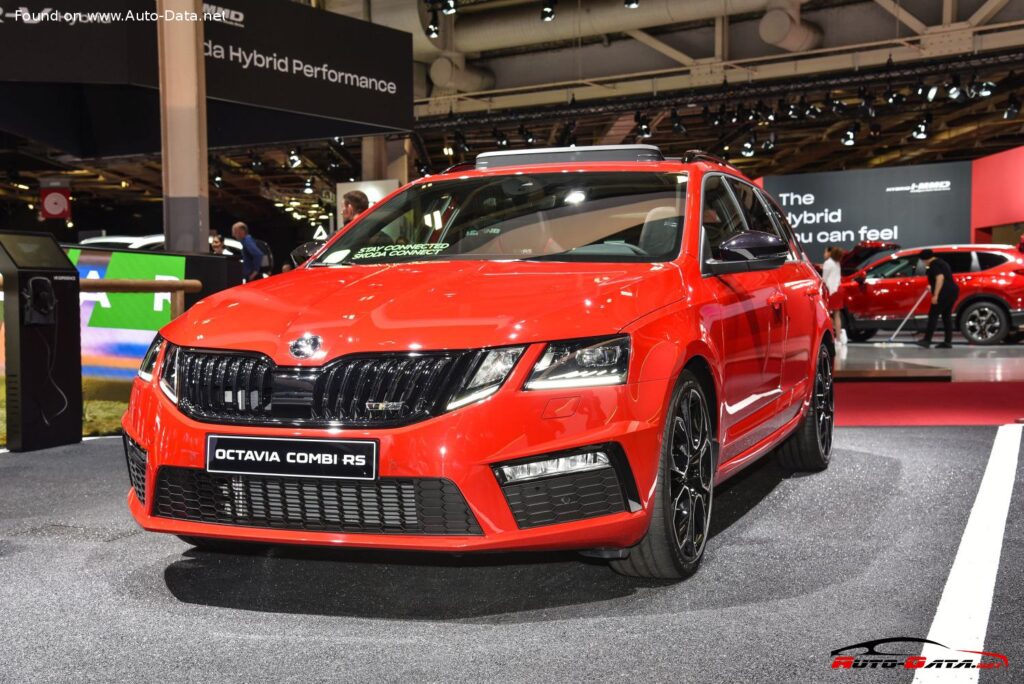
The Skoda Octavia III Combi (facelift 2017) 1.4 G-TEC (110 Hp) CNG represents a significant offering within the European C-segment, showcasing Skoda’s commitment to practicality, efficiency, and alternative fuel technologies. As a product of the Czech automaker Skoda, a subsidiary of the Volkswagen Group, the Octavia has long been a cornerstone of its lineup, particularly revered for its spaciousness and value proposition. The third generation, introduced in 2012, received a notable facelift in 2017, enhancing its aesthetic appeal and technological offerings. This specific variant, the 1.4 G-TEC Combi, underscores a focus on sustainable mobility, utilizing compressed natural gas (CNG) alongside gasoline to deliver a compelling blend of low running costs and reduced environmental impact, a strategy highly relevant in its primary European markets. Produced from 2017 to 2018, this model solidified the Octavia’s reputation as a versatile and economical station wagon, catering to families and fleet operators alike who prioritize efficiency without compromising on space or comfort.
Powertrain & Engine Architecture
At the heart of the Skoda Octavia III Combi (facelift 2017) 1.4 G-TEC (110 Hp) CNG lies a sophisticated 1.4-liter (1395 cm3 or 85.13 cu. in.) turbocharged inline-four engine, designated by the code CPWA. This powertrain is engineered for dual-fuel operation, capable of running on both gasoline and compressed natural gas (CNG). The engine delivers a respectable 110 horsepower, translating to a power-per-liter output of 78.9 Hp/l, which is quite efficient for its displacement. Power is delivered to the front wheels via a smooth and engaging 6-speed manual transmission, offering drivers a direct connection to the vehicle’s dynamics.
The CPWA engine utilizes direct fuel injection, a technology that precisely meters fuel directly into the combustion chamber, improving efficiency and reducing emissions. The turbocharger, a key component of the engine’s design, forces more air into the cylinders, boosting power output. The engine features a multi-point sequential CNG injection system, optimizing the combustion process when running on natural gas. The valvetrain employs a dual overhead camshaft (DOHC) configuration with four valves per cylinder, enhancing volumetric efficiency and contributing to the engine’s overall performance. The 6-speed manual transmission provides a range of gear ratios designed to balance fuel economy and drivability. The gear ratios are typically optimized for efficient cruising and acceleration in everyday driving conditions.
Driving Characteristics
The Octavia 1.4 G-TEC prioritizes economy over outright speed. Acceleration from 0 to 60 mph takes approximately 10.5 seconds (0-100 km/h in 11 seconds), with a top speed reaching around 120 mph (193 km/h). These figures are adequate for daily commuting, highway travel, and family transportation. The engine’s turbocharger provides a noticeable boost in power during acceleration, but the overall driving experience is characterized by smooth, linear power delivery rather than aggressive performance. Compared to higher-output versions of the Octavia, such as those equipped with the 1.8 TSI gasoline engine, the 1.4 G-TEC offers less spirited acceleration and a lower overall power output. However, it compensates with significantly improved fuel economy and reduced emissions.
When running on CNG, the engine’s power output may be slightly reduced compared to gasoline operation, but the difference is generally minimal. The transition between CNG and gasoline is seamless and automatic, ensuring a consistent driving experience regardless of the fuel source. The 6-speed manual transmission allows drivers to maintain optimal engine speed for fuel efficiency or to select a lower gear for increased acceleration when needed. The suspension is tuned for comfort, providing a relatively smooth ride quality, although it may not offer the same level of handling precision as sportier Octavia variants.
Equipment & Trim Levels
The Skoda Octavia III Combi (facelift 2017) 1.4 G-TEC typically came with a solid level of standard equipment, positioning it as a mid-range offering within the Octavia lineup. Standard features generally included air conditioning, a modern infotainment system with a touchscreen display, Bluetooth connectivity, power windows and mirrors, and ABS (Anti-lock Braking System). Safety features such as multiple airbags and electronic stability control were also standard. Interior upholstery typically consisted of fabric seats, with options for higher-quality materials available as upgrades.
Optional extras for the 1.4 G-TEC variant could include features like a sunroof, parking sensors, a rearview camera, automatic climate control, and upgraded infotainment systems with navigation. Alloy wheels were also often available as an option, enhancing the vehicle’s aesthetic appeal. The trim level often dictated the availability of certain features, with higher trims offering more luxurious appointments and advanced technology. The focus of this trim was on providing a well-equipped, practical, and economical vehicle for families and fleet operators.
Chassis & Braking
The Skoda Octavia III Combi (facelift 2017) 1.4 G-TEC utilizes the Volkswagen Group’s MQB platform, a modular chassis architecture that provides a solid foundation for the vehicle’s handling and ride quality. The suspension system consists of independent MacPherson struts at the front and a multi-link suspension at the rear, offering a good balance between comfort and control. The suspension is tuned to provide a comfortable ride, but it also offers reasonable handling characteristics for everyday driving. Stabilizer bars are fitted to both the front and rear axles to reduce body roll during cornering.
The braking system typically consists of ventilated disc brakes at the front and drum brakes at the rear. ABS (Anti-lock Braking System) is standard, enhancing driver control during emergency braking maneuvers. The braking system is designed to provide adequate stopping power for the vehicle’s weight and performance characteristics. The steering system is typically an electromechanical power steering system, providing precise and responsive steering feel. The tires are typically 205/55 R16, offering a good balance between grip, comfort, and fuel efficiency.
Market Reception & Comparison
Critics generally viewed the Skoda Octavia III Combi (facelift 2017) 1.4 G-TEC favorably, praising its practicality, fuel economy, and low emissions. The CNG variant was particularly well-received in European markets where natural gas infrastructure was readily available and government incentives were in place. The Octavia’s spacious interior, large cargo capacity, and comfortable ride were also frequently highlighted as key strengths. Compared to other trims in the Octavia lineup, the 1.4 G-TEC offered a compelling value proposition for drivers prioritizing fuel efficiency and environmental responsibility.
The 1.8 TSI gasoline version of the Octavia offered more spirited performance but at the cost of higher fuel consumption and emissions. The 1.6 TDI diesel version provided similar fuel economy to the G-TEC but with the drawbacks associated with diesel engines, such as higher particulate matter emissions and potential maintenance concerns. The G-TEC variant stood out as a unique offering, providing a cleaner and more sustainable alternative to traditional gasoline and diesel engines. Its reliability was generally considered to be on par with other Octavia variants, benefiting from the robust MQB platform and Skoda’s reputation for build quality.
Technical Specifications: Skoda Octavia III Combi (facelift 2017) 1.4 G-TEC (110 Hp) CNG
| Category | Specification |
| General Information | |
| Brand | Skoda |
| Model | Octavia |
| Generation | Octavia III Combi (facelift 2017) |
| Type (Engine) | 1.4 G-TEC (110 Hp) CNG |
| Start of production | 2017 year |
| End of production | 2018 year |
| Powertrain Architecture | Internal Combustion engine |
| Body type | Station wagon (estate) |
| Seats | 5 |
| Doors | 5 |
| Performance Specs | |
| Fuel consumption (economy) – urban | 7.5 l/100 km (31.4 US mpg) |
| Fuel consumption (economy) – extra urban | 4.8 l/100 km (49 US mpg) |
| Fuel consumption (economy) – combined | 5.8 l/100 km (40.6 US mpg) |
| CO2 emissions (Petrol) | 132 g/km |
| CO2 emissions (CNG) | 102 g/km |
| Fuel Type | Petrol / CNG |
| Acceleration 0 – 60 mph | 10.5 sec |
| Acceleration 0 – 100 km/h | 11 sec |
| Maximum speed | 193 km/h (119.92 mph) |
| Emission standard | Euro 6 |
| Weight-to-power ratio | 12.2 kg/Hp (82 Hp/tonne) |
| Engine Specs | |
| Power | 110 Hp |
| Power per liter | 78.9 Hp/l |
| Engine Model/Code | CPWA |
| Engine displacement | 1395 cm3 (85.13 cu. in.) |
| Number of cylinders | 4 |
| Engine configuration | Inline |
| Cylinder Bore | 74.5 mm (2.93 in.) |
| Piston Stroke | 80 mm (3.15 in.) |
| Fuel injection system | Direct injection |
| Engine aspiration | Turbocharger |
| Engine oil capacity | 4 l (4.23 US qt) |
| Space, Volume and Weights | |
| Kerb Weight | 1341 kg (2956.4 lbs) |
| Trunk (boot) space – minimum | 480 l (16.95 cu. ft.) |
| Trunk (boot) space – maximum | 1610 l (56.86 cu. ft.) |
| Fuel tank capacity (Petrol) | 50 l (13.21 US gal) |
| CNG cylinder capacity | 15 kg |
| Max. roof load | 75 kg (165.35 lbs) |
| Dimensions | |
| Length | 4667 mm (183.74 in.) |
| Width | 1814 mm (71.42 in.) |
| Height | 1462 mm (57.56 in.) |
| Wheelbase | 2680 mm (105.51 in.) |
| Front track | 1543 mm (60.75 in.) |
| Rear (Back) track | 1549 mm (60.98 in.) |
| Minimum turning circle (turning diameter) | 10.59 m (34.74 ft) |
| Drivetrain, Brakes and Suspension Specs | |
| Drivetrain Architecture | The Internal combustion engine (ICE) drives the front wheels of the vehicle. |
| Drive wheel | Front wheel drive |
| Number of gears and type of gearbox | 6 gears, manual transmission |
| Assisting systems | ABS (Anti-lock braking system) |
| Tires size | 205/55 R16 |
| Wheel rims size | 16 inches |
Legacy
The Skoda Octavia, and specifically the Octavia III Combi (facelift 2017) 1.4 G-TEC (110 Hp) CNG variant, holds a significant legacy and market impact, particularly within its primary European markets. Skoda, as a brand, has successfully shed its communist-era image to become a respected and highly competitive player in the global automotive landscape, largely due to models like the Octavia. The Octavia is often seen as a smart, value-oriented alternative to its Volkswagen Group stablemates like the VW Golf Variant or SEAT Leon ST, offering comparable technology and build quality but with a distinct advantage in terms of interior space and cargo volume, often at a more accessible price point.
In the used car market, the 1.4 G-TEC variant remains a popular choice for buyers seeking an economical and environmentally friendly vehicle. Its relatively simple engine design and robust construction contribute to its long-term reliability. However, potential buyers should be aware of the specific maintenance requirements associated with CNG systems, such as periodic inspections of the CNG tank and fuel lines. Overall, the Octavia III Combi 1.4 G-TEC represents a well-engineered and practical vehicle that continues to offer a compelling value proposition in the used car market.