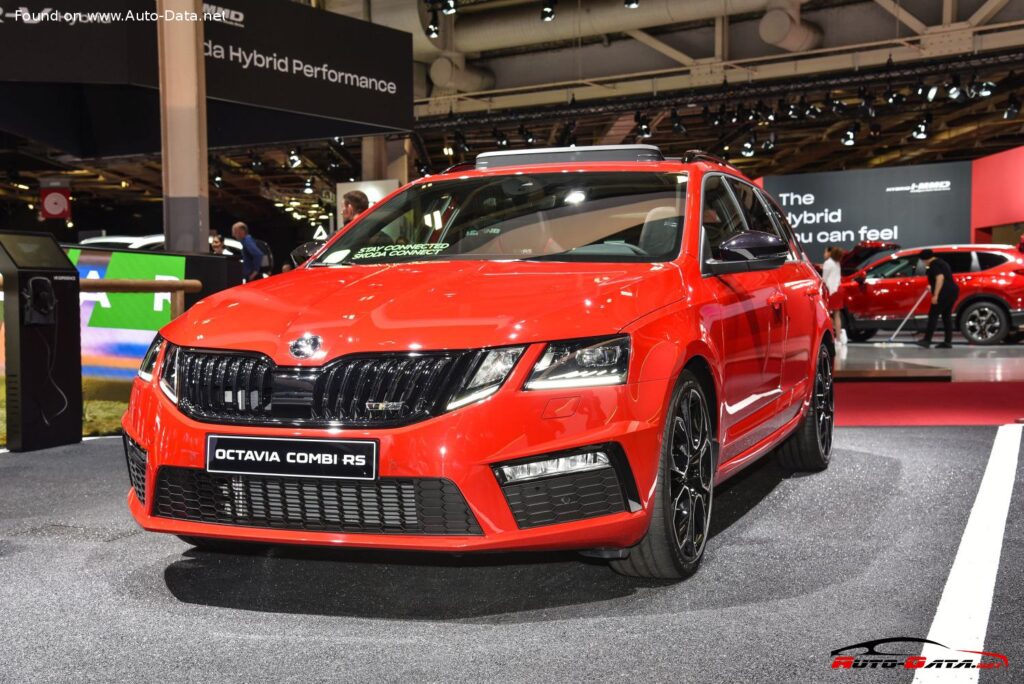
The Skoda Octavia III Combi (facelift 2017) 1.4 G-TEC (110 Hp) CNG DSG represents a compelling proposition within the European compact segment, particularly for those prioritizing efficiency, practicality, and reduced running costs. As a product of the Czech automaker Skoda, a subsidiary of the Volkswagen Group, the Octavia has long been lauded for its exceptional value, robust engineering, and cavernous interior space. The third generation, introduced in 2013 and subsequently updated with a significant facelift in 2017, further solidified its position as a segment leader. This particular variant, the 1.4 G-TEC, stands out due to its innovative bi-fuel powertrain, capable of running on both gasoline and compressed natural gas (CNG), paired with a smooth-shifting DSG automatic transmission. While never officially sold in the United States, the Octavia Combi played a crucial role in Europe, offering a family-friendly station wagon body style that resonated strongly with consumers seeking versatility without compromising on fuel economy or environmental performance.
Powertrain & Engine Architecture
At the heart of the Skoda Octavia III Combi (facelift 2017) 1.4 G-TEC (110 Hp) CNG DSG lies a sophisticated 1.4-liter turbocharged inline-four engine, designated with the internal code CPWA. This powertrain is a prime example of modern Volkswagen Group engineering, designed for both efficiency and responsiveness. The engine produces a respectable 110 horsepower, delivered at an unspecified RPM, and a robust 147.51 lb-ft of torque available across a broad range from 1500 to 3500 rpm. This wide torque band ensures flexible driving performance, making the Octavia G-TEC adept at both urban commuting and longer highway journeys.
The distinguishing feature of this variant is its bi-fuel capability. Operating primarily on compressed natural gas (CNG), the vehicle seamlessly switches to gasoline when the CNG supply is depleted. This setup offers significant advantages in terms of environmental impact and running costs, especially in European markets where CNG infrastructure is more developed and natural gas prices are often lower than gasoline or diesel. When running on CNG, the Octavia G-TEC boasts remarkably low CO2 emissions of just 99 g/km, meeting the stringent Euro 6 emission standard. Even on gasoline, emissions are a competitive 126 g/km. Fuel economy figures are impressive, with a combined rating of 42.8 US mpg (5.5 l/100 km) on gasoline, which is further enhanced when running on CNG due to its energy density and lower carbon content.
The CPWA engine utilizes direct fuel injection, a technology that improves combustion efficiency and reduces emissions. The engine also features a turbocharger, which provides increased power output and torque compared to a naturally aspirated engine of similar displacement. The valvetrain employs a combination of overhead camshafts and four valves per cylinder, optimizing airflow for improved performance. Power is delivered to the front wheels via a 7-speed DSG (Direct Shift Gearbox) automatic transmission. This dual-clutch unit is renowned for its rapid and smooth gear changes, contributing to both driving comfort and efficiency. The DSG transmission features electronically controlled hydraulics and a sophisticated mechatronic control unit to manage gear selection and clutch engagement.
Driving Characteristics
The 1.8L 90 hp Automatic configuration of the Octavia was positioned as the entry-level trim in many European markets. It was designed for drivers prioritizing fuel economy and affordability over outright performance. Compared to the higher-output versions, such as those with larger gasoline engines or the diesel variants, the 1.4 G-TEC offered a more relaxed driving experience. Acceleration was adequate for everyday driving, but it lacked the punch of the more powerful models. The DSG transmission helped to mitigate some of the performance deficit by providing quick and precise gear changes, keeping the engine in its optimal power band.
The gear ratios in the 7-speed DSG were tuned for efficiency, with taller gearing in the higher gears to reduce engine speed at highway speeds. This contributed to lower fuel consumption and reduced noise levels. The wide torque band of the 1.4-liter engine meant that the driver didn’t need to downshift frequently to maintain speed, making it a comfortable and easy car to drive in a variety of conditions. Compared to manual transmission versions, the DSG offered greater convenience, especially in urban traffic, but some drivers might have preferred the greater control offered by a manual gearbox.
Equipment & Trim Levels
The Skoda Octavia III Combi (facelift 2017) 1.4 G-TEC (110 Hp) CNG DSG typically came with a generous level of standard equipment, reflecting Skoda’s reputation for value. Standard features often included air conditioning, power windows, power mirrors, a multi-function steering wheel, and an infotainment system with a touchscreen display. Safety features such as ABS, electronic stability control, and multiple airbags were also standard.
Interior upholstery was typically cloth, with options for higher-grade materials such as leather or Alcantara available as upgrades. The dashboard configuration was clean and functional, with a focus on ergonomics. Optional extras included features such as a sunroof, parking sensors, a rearview camera, adaptive cruise control, and a more advanced infotainment system with navigation and smartphone integration. Trim levels varied depending on the market, but generally, the G-TEC variant was available in mid-range trims, offering a good balance of features and affordability.
Chassis & Braking
The Octavia Combi’s chassis was designed to provide a comfortable and stable ride. The suspension system consisted of independent MacPherson struts at the front and a multi-link suspension at the rear. This setup provided good handling characteristics and absorbed bumps and imperfections in the road surface effectively. The suspension was tuned to prioritize comfort over sporty handling, making it a pleasant car to drive on long journeys.
The braking system featured ventilated disc brakes at the front and disc brakes at the rear. ABS (Anti-lock Braking System) was standard, providing enhanced braking performance and stability in emergency situations. The size of the brake discs and the thickness of the stabilizer bars varied depending on the trim level and optional equipment. The steering system was an electric power-assisted rack and pinion, providing a light and precise steering feel.
Market Reception & Comparison
Critics generally viewed the Skoda Octavia III Combi (facelift 2017) 1.4 G-TEC (110 Hp) CNG DSG favorably, praising its fuel efficiency, practicality, and value for money. The bi-fuel powertrain was seen as a clever solution for reducing running costs and environmental impact, particularly in markets with well-developed CNG infrastructure. However, some critics noted that the performance was not as strong as that of the higher-output versions.
Compared to other trims in the Octavia lineup, the 1.4 G-TEC offered a compelling alternative for drivers who prioritized fuel economy and environmental responsibility. It was more affordable than the higher-output gasoline and diesel versions, but it also offered less performance. In terms of reliability, the 1.4 G-TEC powertrain was generally considered to be reliable, with few reported issues. However, the CNG system required regular maintenance to ensure optimal performance and safety. Compared to competitors such as the Volkswagen Golf Variant and Ford Focus Estate, the Octavia Combi offered a larger cargo capacity and a more spacious interior, making it a practical choice for families and those needing to transport large items.
Technical Specifications
| Specification | Value |
| General Information | |
| Brand | Skoda |
| Model | Octavia |
| Generation | Octavia III Combi (facelift 2017) |
| Type (Engine) | 1.4 G-TEC (110 Hp) CNG DSG |
| Start of Production | 2017 year |
| End of Production | 2018 year |
| Powertrain Architecture | Internal Combustion engine |
| Body type | Station wagon (estate) |
| Seats | 5 |
| Doors | 5 |
| Performance Specs | |
| Fuel consumption (economy) – urban | 6.8 l/100 km (34.6 US mpg) |
| Fuel consumption (economy) – extra urban | 4.8 l/100 km (49 US mpg) |
| Fuel consumption (economy) – combined | 5.5 l/100 km (42.8 US mpg) |
| CO2 emissions | 126 g/km |
| CO2 emissions (CNG) | 99 g/km |
| Fuel Type | Petrol / CNG |
| Acceleration 0 – 60 mph | 10.5 sec |
| Maximum speed | 193 km/h (119.92 mph) |
| Emission standard | Euro 6 |
| Weight-to-power ratio | 12.4 kg/Hp (80.5 Hp/tonne) |
| Weight-to-torque ratio | 6.8 kg/Nm (146.4 Nm/tonne) |
| Engine Specs | |
| Power | 110 Hp |
| Power per liter | 78.9 Hp/l |
| Torque | 200 Nm (147.51 lb.-ft.) @ 1500-3500 rpm |
| Engine layout | Front, Transverse |
| Engine Model/Code | CPWA |
| Engine displacement | 1395 cm3 (85.13 cu. in.) |
| Number of cylinders | 4 |
| Engine configuration | Inline |
| Cylinder Bore | 74.5 mm (2.93 in.) |
| Piston Stroke | 80 mm (3.15 in.) |
| Number of valves per cylinder | 4 |
| Fuel injection system | Direct injection |
| Engine aspiration | Turbocharger |
| Engine oil capacity | 4 l (4.23 US qt) |
| Space, Volume and Weights | |
| Kerb Weight | 1366 kg (3011.51 lbs.) |
| Max. weight | 1879 kg (4142.49 lbs.) |
| Max load | 513 kg (1130.97 lbs.) |
| Trunk (boot) space – minimum | 610 l (21.54 cu. ft.) |
| Trunk (boot) space – maximum | 1740 l (61.45 cu. ft.) |
| Fuel tank capacity | 50 l (13.21 US gal) |
| CNG cylinder capacity | 15 kg |
| Max. roof load | 75 kg (165.35 lbs.) |
| Dimensions | |
| Length | 4667 mm (183.74 in.) |
| Width | 1814 mm (71.42 in.) |
| Height | 1462 mm (57.56 in.) |
| Wheelbase | 2680 mm (105.51 in.) |
| Front track | 1543 mm (60.75 in.) |
| Rear (Back) track | 1549 mm (60.98 in.) |
| Minimum turning circle (turning diameter) | 10.59 m (34.74 ft.) |
| Drivetrain, Brakes and Suspension Specs | |
| Drivetrain Architecture | Front-wheel drive, Internal Combustion engine |
| Drive wheel | Front wheel drive |
| Number of gears and type of gearbox | 7 gears, automatic transmission DSG |
| Front brakes | Ventilated discs |
| Rear brakes | Disc |
| Assisting systems | ABS (Anti-lock braking system) |
| Steering type | Steering rack and pinion |
| Power steering | Electric Steering |
| Tires size | 205/55 R16 |
| Wheel rims size | 16 inches |
Legacy
The Skoda Octavia, particularly in its Combi form, has carved out a significant niche in the European automotive landscape. It is widely regarded as a benchmark for practicality, value, and robust engineering within the compact segment. For many European families and fleet operators, the Octavia represented a smart, no-nonsense choice that offered Volkswagen Group quality and technology at a more accessible price point than its Volkswagen Golf Variant sibling, while providing superior space. Its reputation for reliability and low running costs further enhanced its appeal.
The 1.4 G-TEC variant, specifically, played an important role in Skoda’s strategy to offer environmentally conscious options. In countries like Germany, Italy, Austria, and Sweden, where CNG refueling infrastructure is more prevalent, the G-TEC models provided a compelling alternative to traditional gasoline or diesel powertrains. The lower CO2 emissions and reduced fuel costs associated with CNG made it an attractive choice for eco-conscious buyers and those looking to minimize their environmental footprint and operational expenses. Its primary competitors in the European market included other C-segment station wagons such as the Volkswagen Golf Variant, Ford Focus Estate, Opel Astra Sports Tourer, and Peugeot 308 SW. The Octavia consistently stood out due to its superior cargo volume and perceived value.
While the Skoda brand and the Octavia model were never sold in the United States, their impact in Europe is undeniable. The Octavia helped solidify Skoda’s transformation from a former Eastern Bloc manufacturer into a respected, modern automotive brand known for its “Simply Clever” solutions and high-quality vehicles. The third-generation Combi, especially with its efficient and eco-friendly G-TEC powertrain, remains a testament to Skoda’s commitment to delivering practical, well-engineered cars that meet the evolving demands of the European market, balancing performance, comfort, and environmental responsibility.