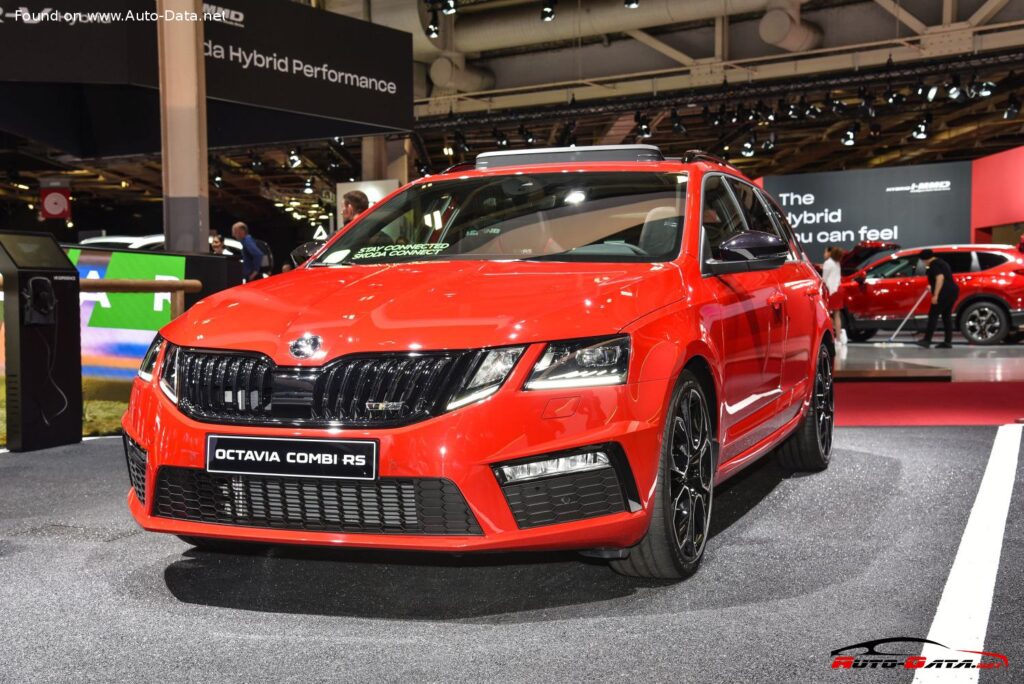
The Skoda Octavia III Combi (facelift 2017) 2.0 TDI (150 Hp) 7 DSG represents a significant iteration of Skoda’s highly successful compact family car, specifically its versatile station wagon variant. Launched for the 2018 model year and produced through 2019, this particular configuration highlights the blend of practicality, efficiency, and refined performance that has cemented the Octavia’s reputation across European markets. As a core model within the Volkswagen Group’s portfolio, the Octavia, particularly in its third generation (5E), leveraged shared platforms and powertrains to offer a compelling package of space, technology, and value.
While the Skoda brand does not have a presence in the United States, the Octavia plays a crucial role in Europe, Asia, and other global markets where it competes fiercely in the C-segment. The “Combi” designation signifies its station wagon body style, known for its exceptional cargo capacity and family-friendly attributes. The “facelift 2017” refers to the mid-cycle refresh introduced for the third generation, bringing updated styling, enhanced interior features, and revised powertrain options. This specific model, powered by the 2.0-liter TDI diesel engine paired with a 7-speed DSG automatic transmission, embodies the modern European approach to efficient, long-distance motoring.
Skoda Octavia III Combi 2.0 TDI: Powertrain and Performance
At the heart of the Skoda Octavia III Combi (facelift 2017) 2.0 TDI (150 Hp) 7 DSG is a robust and efficient 2.0-liter (1968 cm3) turbocharged direct injection (TDI) diesel engine. This inline four-cylinder powerplant, part of the Volkswagen Group’s widely acclaimed EA288 family (specifically engine codes CKFC or CRMB), is renowned for its blend of power delivery and fuel economy. It generates a healthy 150 horsepower, available across a broad rev range from 3500 to 4000 rpm, making it suitable for both city driving and sustained highway cruising.
Crucially for a vehicle designed to carry passengers and cargo, the engine delivers a substantial 250.77 lb.-ft. of torque, accessible from a low 1750 rpm and sustained up to 3000 rpm. This ample low-end torque ensures strong acceleration and effortless overtaking maneuvers, even when the vehicle is fully loaded. The engine’s architecture features a DOHC (Double Overhead Camshaft) valvetrain with four valves per cylinder and a common rail fuel injection system, optimized for precise fuel delivery and combustion efficiency. A turbocharger with an intercooler further enhances performance by compressing the intake air, leading to greater power output.
Power is transmitted to the front wheels via a sophisticated 7-speed DSG (Direct Shift Gearbox) automatic transmission. This dual-clutch unit is celebrated for its rapid, smooth gear changes, contributing significantly to both the car’s performance and its fuel efficiency. The combination allows the Octavia Combi to accelerate from 0 to 60 mph in a respectable 8.6 seconds, with a top speed reaching 132.35 mph. The vehicle’s weight-to-power ratio stands at 8.9 kg/Hp (111.8 Hp/tonne), underscoring its capable performance for its class.
Environmental considerations are paramount in modern European automotive design. This Octavia variant meets the stringent Euro 6d-Temp emission standard, reflecting its commitment to reduced pollutants. It incorporates a Start & Stop system to minimize fuel consumption and emissions during idle periods, along with a particulate filter to capture soot from the diesel exhaust. Fuel economy figures are impressive for a vehicle of its size: a combined cycle rating of 53.5 – 52.3 US mpg (4.4-4.5 l/100 km) highlights its long-distance cruising efficiency. CO2 emissions are kept low at 115-117 g/km, further solidifying its eco-credentials in its primary markets.
Design and Features: Practicality and Modern Aesthetics
The Skoda Octavia III Combi (facelift 2017) retains the brand’s hallmark design language, emphasizing clean lines, functional elegance, and intelligent packaging. As a five-door station wagon (estate), its primary appeal lies in its exceptional versatility and cargo-carrying capability. The facelift introduced subtle yet effective styling revisions, most notably a redesigned front fascia with split headlights, giving the car a more assertive and contemporary look. The overall dimensions – 183.74 inches in length, 71.42 inches in width (79.41 inches including mirrors), and 58.86 inches in height – strike a balance between maneuverability and interior spaciousness, supported by a generous 105.75-inch wheelbase.
Inside, the Octavia Combi is designed to accommodate five occupants comfortably, with a focus on ergonomics and durable materials. While specific interior features are not detailed in the technical data, a facelift typically brings updated infotainment systems, connectivity options, and enhanced driver-assistance technologies. The true highlight, however, is the cargo area. With the rear seats in place, the trunk offers a cavernous 21.54 cubic feet (610 liters) of space. Folding down the rear seats expands this to an impressive 61.45 cubic feet (1740 liters), making it one of the most capacious vehicles in its segment and an ideal choice for families, tradespeople, or anyone requiring significant hauling capability.
Safety and handling are addressed through a well-engineered chassis and standard features. The front suspension utilizes an independent McPherson strut setup with coil springs and an anti-roll bar, providing responsive handling and a comfortable ride. The rear features a torsion beam setup with coil springs, a cost-effective and space-efficient solution that doesn’t compromise on practicality. Braking performance is handled by ventilated discs at the front and solid discs at the rear, augmented by an Anti-lock Braking System (ABS) for enhanced control during emergency stops. The electric power steering system, with a rack and pinion setup, offers precise feedback and easy maneuverability, reflected in its tight minimum turning circle of 34.81 feet. The vehicle also boasts a respectable drag coefficient (Cd) of 0.315, contributing to its fuel efficiency and reduced wind noise.
Technical Specifications
| Category | Specification |
| Brand | Skoda |
| Model | Octavia III Combi (facelift 2017) |
| Engine Type | 2.0 TDI (150 Hp) 7 DSG |
| Production Years | 2018 – 2019 |
| Body Type | Station wagon (estate) |
| Seats / Doors | 5 / 5 |
| Fuel Type | Diesel |
| Engine Displacement | 2.0 Liters (1968 cm3 / 120.09 cu. in.) |
| Power | 150 Hp @ 3500-4000 rpm |
| Torque | 250.77 lb.-ft. (340 Nm) @ 1750-3000 rpm |
| Cylinders / Configuration | 4 / Inline |
| Valves per Cylinder | 4 |
| Engine Layout | Front, Transverse |
| Fuel Injection System | Diesel Commonrail |
| Engine Aspiration | Turbocharger, Intercooler |
| Valvetrain | DOHC |
| Compression Ratio | 16.2:1 |
| Acceleration 0-60 mph | 8.6 seconds |
| Maximum Speed | 132.35 mph (213 km/h) |
| Fuel Economy – Urban | 45.2 – 44.4 US mpg (5.2-5.3 l/100 km) |
| Fuel Economy – Extra Urban | 60.3 – 58.8 US mpg (3.9-4 l/100 km) |
| Fuel Economy – Combined | 53.5 – 52.3 US mpg (4.4-4.5 l/100 km) |
| CO2 Emissions | 115-117 g/km |
| Emission Standard | Euro 6d-Temp |
| Drive Wheel | Front Wheel Drive |
| Gearbox | 7-speed automatic transmission DSG |
| Front Suspension | Independent, McPherson with coil spring and anti-roll bar |
| Rear Suspension | Coil spring, Torsion beam |
| Front Brakes | Ventilated discs |
| Rear Brakes | Disc |
| Assisting Systems | ABS (Anti-lock braking system) |
| Steering Type | Steering rack and pinion, Electric Power Steering |
| Tire Sizes | 205/55 R16; 225/45 R17; 225/40 R18 |
| Wheel Rims Sizes | 6.5J x 16; 7J x 17; 7.5J x 18 |
| Length | 183.74 in. (4667 mm) |
| Width | 71.42 in. (1814 mm) |
| Width (incl. mirrors) | 79.41 in. (2017 mm) |
| Height | 58.86 in. (1495 mm) |
| Wheelbase | 105.75 in. (2686 mm) |
| Front Track | 60.98 in. (1549 mm) |
| Rear Track | 60.63 in. (1540 mm) |
| Kerb Weight | 2958.6 – 3254.02 lbs. (1342-1476 kg) |
| Max. Weight | 4246.1 – 4373.97 lbs. (1926-1984 kg) |
| Trunk Space (min/max) | 21.54 – 61.45 cu. ft. (610 – 1740 l) |
| Fuel Tank Capacity | 13.21 US gal (50 l) |
| AdBlue Tank Capacity | 3.43 US gal (13 l) |
| Minimum Turning Circle | 34.81 ft. (10.61 m) |
| Drag Coefficient (Cd) | 0.315 |
| Permitted Trailer Load (with brakes 8%) | 3968.32 lbs. (1800 kg) |
| Permitted Trailer Load (without brakes) | 1543.24 lbs. (700 kg) |
Legacy and Market Impact
The Skoda Octavia has long been considered the backbone of the Skoda brand, representing its transformation from a Soviet-era manufacturer to a respected European automaker under Volkswagen Group ownership. The third-generation Octavia, and particularly its facelifted Combi variant with the 2.0 TDI engine and DSG transmission, solidified its position as a segment leader in terms of practicality, value, and overall quality.
In its primary European markets, the Octavia Combi 2.0 TDI carved out a formidable reputation as an ideal family car and a highly sought-after fleet vehicle. Its combination of vast interior space, particularly the class-leading trunk capacity, impressive fuel economy, and robust diesel performance made it a compelling proposition against rivals. Key competitors in this segment include the Volkswagen Golf Variant (SportWagen in some markets), Ford Focus Wagon, Opel Astra Sports Tourer, Peugeot 308 SW, and Renault Megane Estate. The Octavia consistently outshone many of these in terms of sheer practicality and perceived value, often offering more space for the money while benefiting from Volkswagen’s proven engineering.
The 2.0 TDI engine, despite the broader shift away from diesel in some markets, remained a popular choice for its efficiency and torque, especially for long-distance drivers and those requiring towing capability. The 7-speed DSG transmission further enhanced its appeal, offering a level of refinement and driving ease often associated with more premium brands. The Octavia’s success is a testament to Skoda’s strategy of offering “simply clever” solutions – practical features, robust construction, and competitive pricing – wrapped in an increasingly attractive package.
The Octavia III Combi’s legacy is one of consistent excellence and market relevance. It demonstrated that a brand known for affordability could deliver a sophisticated, well-engineered vehicle that met the diverse needs of European consumers. Its success paved the way for Skoda’s continued expansion and helped establish the brand as a credible and desirable alternative to its more established German, French, and Italian counterparts, reinforcing its position as a key player in the global automotive landscape.