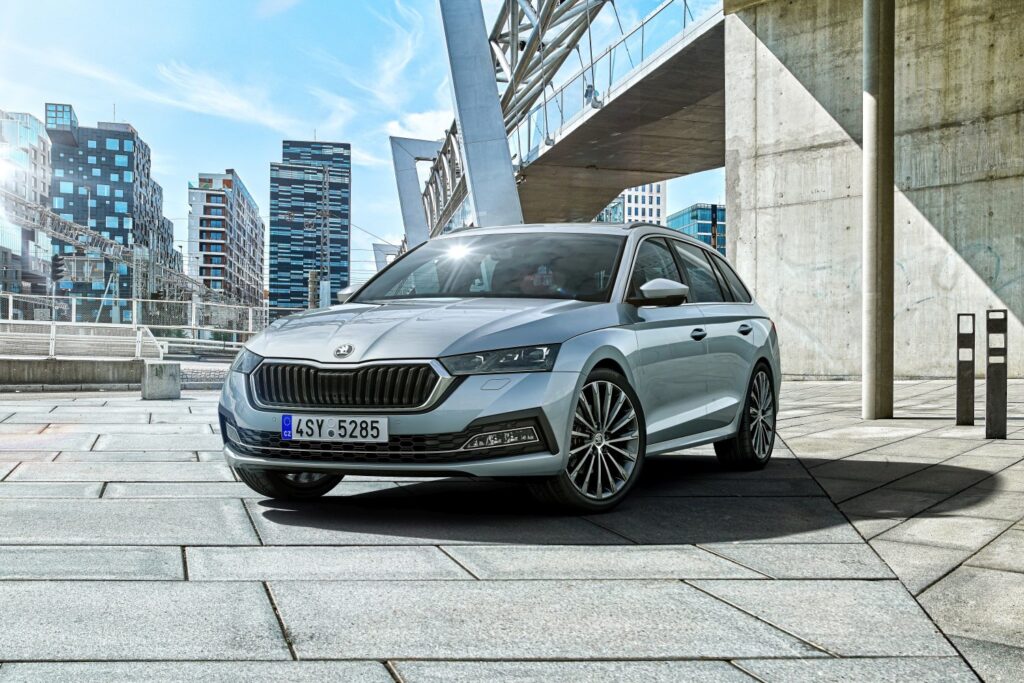
The Skoda Octavia IV Combi 2.0 TSI 4×4 DSG represents the fourth generation of Skoda’s popular compact estate car, produced from March 2021 to March 2023. As a key model within the Volkswagen Group portfolio, the Octavia Combi caters to the European market’s demand for practical, spacious, and efficient vehicles. While not directly sold in the United States, understanding its specifications provides insight into the advanced engineering and technology prevalent in modern European automobiles. This particular variant, equipped with a 2.0-liter turbocharged gasoline engine producing 190 horsepower, and a dual-clutch DSG transmission coupled with all-wheel drive, aims to balance performance with everyday usability.
Skoda Octavia IV Combi 2.0 TSI: An Overview
The Octavia has long been a cornerstone of Skoda’s lineup, known for offering exceptional value and a generous amount of space for its size. The fourth generation, introduced in 2020, builds upon this reputation with updated styling, enhanced technology, and improved efficiency. The Combi (estate/wagon) body style is particularly popular in Europe, where practicality is highly valued. The 2.0 TSI 4×4 DSG model represents a higher-performance trim level, appealing to drivers seeking a more engaging driving experience and enhanced all-weather capability.
Engine & Performance
At the heart of the Octavia Combi 2.0 TSI 4×4 DSG lies the EA888 evo4 2.0-liter inline-four cylinder gasoline engine. This engine, a staple within the Volkswagen Group, delivers 190 horsepower at 4,200-6,000 rpm and 320 Nm (236.02 lb.-ft.) of torque between 1,500 and 4,100 rpm. Direct fuel injection and a turbocharger with intercooler contribute to both power output and efficiency. The engine’s specific output is 95.8 horsepower per liter. Power is transmitted to all four wheels via a sophisticated seven-speed dual-clutch DSG (Direct-Shift Gearbox) transmission, enabling rapid and smooth gear changes. This combination results in a 0-100 km/h (0-62 mph) acceleration time of 6.9 seconds, and a 0-60 mph time of 6.6 seconds. The vehicle achieves a maximum speed of 229 km/h (142.29 mph). The weight-to-power ratio is 7.8 kg/Hp, and the weight-to-torque ratio is 4.6 kg/Nm, indicating a responsive and well-balanced powertrain.
Design & Features
The Skoda Octavia IV Combi is a five-door, five-seat station wagon (estate) characterized by its clean lines and modern aesthetic. Its dimensions – 4,689 mm (184.61 in) in length, 1,829 mm (72.01 in) in width, and 1,468 mm (57.8 in) in height – provide a spacious interior and a substantial cargo area. A key feature of the Octavia Combi is its generous trunk space, offering 640 liters (22.6 cu. ft.) with the rear seats up and expanding to 1,700 liters (60.03 cu. ft.) when folded down. The vehicle incorporates modern safety features, including ABS (Anti-lock Braking System) and a comprehensive suite of driver-assistance systems. The drag coefficient of 0.262 contributes to improved fuel efficiency and reduced wind noise. The suspension utilizes an independent McPherson strut setup at the front and an independent multi-link setup at the rear, providing a comfortable ride and responsive handling. Electric power steering further enhances the driving experience.
Technical Specifications
| Brand | Skoda |
| Model | Octavia |
| Generation | Octavia IV Combi |
| Type (Engine) | 2.0 TSI (190 Hp) 4×4 DSG |
| Start of production | March, 2021 |
| End of production | March, 2023 |
| Powertrain Architecture | Internal Combustion engine |
| Body type | Station wagon (estate) |
| Seats | 5 |
| Doors | 5 |
| Combined fuel consumption (WLTP) | 7-7.4 l/100 km (33.6 – 31.8 US mpg, 40.4 – 38.2 UK mpg, 14.3 – 13.5 km/l) |
| CO2 emissions (WLTP) | 159-169 g/km |
| Fuel Type | Petrol (Gasoline) |
| Acceleration 0 – 100 km/h | 6.9 sec |
| Acceleration 0 – 62 mph | 6.9 sec |
| Acceleration 0 – 60 mph | 6.6 sec |
| Maximum speed | 229 km/h (142.29 mph) |
| Emission standard | Euro 6d-ISC-FCM |
| Weight-to-power ratio | 7.8 kg/Hp |
| Weight-to-torque ratio | 4.6 kg/Nm |
| Power | 190 Hp @ 4200-6000 rpm |
| Torque | 320 Nm @ 1500-4100 rpm (236.02 lb.-ft. @ 1500-4100 rpm) |
| Engine layout | Front, Transverse |
| Engine Model/Code | EA888 evo4 / DNNA |
| Engine displacement | 1984 cm3 (121.07 cu. in.) |
| Number of cylinders | 4 |
| Engine configuration | Inline |
| Cylinder Bore | 82.5 mm (3.25 in.) |
| Piston Stroke | 92.8 mm (3.65 in.) |
| Compression ratio | 12.2:1 |
| Number of valves per cylinder | 4 |
| Fuel injection system | Direct injection |
| Engine aspiration | Turbocharger, Intercooler |
| Valvetrain | DOHC |
| Engine oil capacity | 5.7 l (6.02 US qt | 5.02 UK qt) |
| Coolant | 10 l (10.57 US qt | 8.8 UK qt) |
| Kerb Weight | 1481-1671 kg (3265.05 – 3683.92 lbs.) |
| Max. weight | 2075-2190 kg (4574.59 – 4828.12 lbs.) |
| Max load | 519-594 kg (1144.2 – 1309.55 lbs.) |
| Trunk (boot) space – minimum | 640 l (22.6 cu. ft.) |
| Trunk (boot) space – maximum | 1700 l (60.03 cu. ft.) |
| Fuel tank capacity | 55 l (14.53 US gal | 12.1 UK gal) |
| Max. roof load | 75 kg (165.35 lbs.) |
| Permitted trailer load with brakes (8%) | 1700 kg (3747.86 lbs.) |
| Permitted trailer load with brakes (12%) | 1700 kg (3747.86 lbs.) |
| Permitted trailer load without brakes | 750 kg (1653.47 lbs.) |
| Permitted towbar download | 80 kg (176.37 lbs.) |
| Length | 4689 mm (184.61 in.) |
| Width | 1829 mm (72.01 in.) |
| Width including mirrors | 2003 mm (78.86 in.) |
| Height | 1468 mm (57.8 in.) |
| Wheelbase | 2680 mm (105.51 in.) |
| Front track | 1543 mm (60.75 in.) |
| Rear (Back) track | 1535 mm (60.43 in.) |
| Ride height (ground clearance) | 141 mm (5.55 in.) |
| Drag coefficient (Cd) | 0.262 |
| Minimum turning circle (turning diameter) | 10.4 m (34.12 ft.) |
| Drivetrain Architecture | All wheel drive (4×4). ICE drives front wheels, rear wheels driven via clutch. |
| Number of gears and type of gearbox | 7 gears, automatic transmission DSG |
The Skoda Octavia IV Combi 2.0 TSI 4×4 DSG represents a well-rounded package, combining practicality, performance, and efficiency. While not available in the US market, it exemplifies the sophisticated engineering and features found in contemporary European vehicles.