
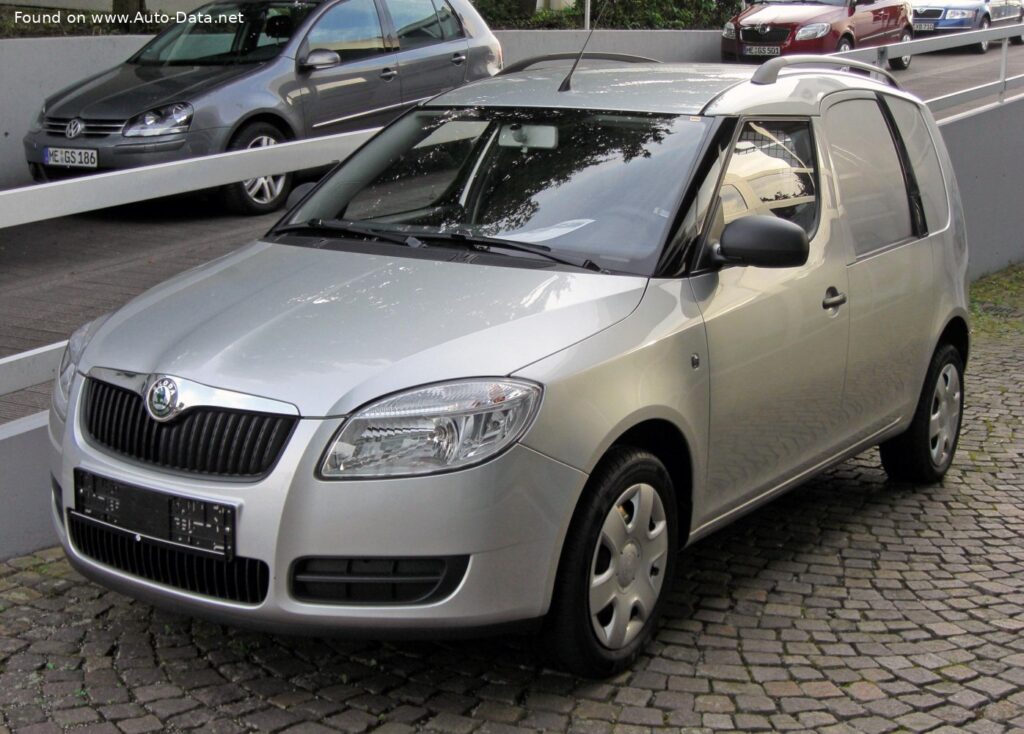
The Skoda Praktik was a small, panel van-based vehicle produced by the Czech automaker Skoda between 2006 and 2010. Essentially a commercial vehicle adapted for limited passenger use, the Praktik occupied a niche market segment, particularly in Europe, offering a practical and affordable alternative to larger, more conventional minivans. It was based on the second-generation Fabia platform, sharing many components with that model. While not officially sold in the United States, understanding the Praktik provides insight into Skoda’s broader product strategy and its focus on providing functional vehicles for specific needs. The 1.4 TDI variant, equipped with a 69 horsepower engine, was a common offering, prioritizing fuel efficiency over outright performance.
Skoda Praktik 1.4 TDI: Overview and Market Position
The Praktik was conceived as a cost-effective and versatile vehicle, primarily aimed at small businesses and tradespeople needing a compact van for deliveries or carrying equipment. However, its design also allowed for a limited number of passengers, making it suitable for families with basic transportation needs. It distinguished itself from traditional vans with a more car-like interior and a focus on practicality. Skoda, as part of the Volkswagen Group, leveraged existing platforms and technologies to keep production costs down, resulting in an attractively priced vehicle in the European market. The Praktik filled a gap between small passenger cars and larger, more expensive commercial vans.
Engine & Performance
The 1.4 TDI engine powering the Praktik was a three-cylinder diesel unit, part of Volkswagen Group’s EA188 engine family (specifically the BNM code). This engine produced 69 horsepower at 4000 rpm and 155 Nm (114.32 lb.-ft.) of torque between 1600 and 2800 rpm. While not a powerhouse, the engine prioritized fuel economy and low-end torque, making it suitable for urban driving and carrying loads. The engine featured a turbocharger with an intercooler to improve efficiency and power delivery. Fuel injection was handled by a pump-nozzle (unit injector) system. Performance figures reflected the engine’s modest output: acceleration from 0 to 100 km/h (0-62 mph) took 16.5 seconds, and the top speed was 158 km/h (98.18 mph). The engine’s power-to-weight ratio was 17.1 kg/Hp, and its torque-to-weight ratio was 7.6 kg/Nm. The 1.4-liter displacement (86.78 cu. in.) and SOHC valvetrain contributed to its relatively simple and robust design.
Design & Features
The Skoda Praktik’s design was dictated by its utilitarian purpose. It was a five-door minivan with a relatively boxy shape maximizing interior space. The vehicle seated two occupants, with a large cargo area behind the front seats. The rear windows were often blanked out in commercial versions, but passenger models featured windows for improved visibility. Safety features, while basic by modern standards, included ABS (Anti-lock Braking System). The Praktik’s interior was functional and durable, with hard-wearing materials designed to withstand regular use. Key features included a large rear cargo area (1900 liters / 67.1 cu. ft. minimum), a 55-liter (14.53 US gal) fuel tank, and a relatively tight turning circle of 10.5 meters (34.45 ft.). The suspension consisted of an independent McPherson strut setup at the front and a torsion beam at the rear, providing a reasonable balance between ride comfort and load-carrying capacity. The drag coefficient of 0.33 was typical for vehicles of this type and era.
Technical Specifications
| Brand | Skoda |
| Model | Praktik |
| Generation | Praktik |
| Type (Engine) | 1.4 TDI (69 Hp) |
| Start of production | 2006 |
| End of production | 2010 |
| Powertrain Architecture | Internal Combustion engine |
| Body type | Minivan |
| Seats | 2 |
| Doors | 5 |
| Fuel consumption (urban) | 6.4 l/100 km (36.8 US mpg, 44.1 UK mpg, 15.6 km/l) |
| Fuel consumption (extra urban) | 4.5 l/100 km (52.3 US mpg, 62.8 UK mpg, 22.2 km/l) |
| Fuel consumption (combined) | 5.3 l/100 km (44.4 US mpg, 53.3 UK mpg, 18.9 km/l) |
| CO2 emissions | 139 g/km |
| Fuel Type | Diesel |
| Acceleration 0 – 100 km/h | 16.5 sec |
| Acceleration 0 – 62 mph | 16.5 sec |
| Acceleration 0 – 60 mph | 15.7 sec |
| Maximum speed | 158 km/h (98.18 mph) |
| Emission standard | Euro 4 |
| Weight-to-power ratio | 17.1 kg/Hp |
| Weight-to-torque ratio | 7.6 kg/Nm |
| Power | 69 Hp @ 4000 rpm |
| Torque | 155 Nm @ 1600-2800 rpm (114.32 lb.-ft. @ 1600-2800 rpm) |
| Engine layout | Front, Transverse |
| Engine Model/Code | EA188 / BNM |
| Engine displacement | 1422 cm3 (86.78 cu. in.) |
| Number of cylinders | 3 |
| Engine configuration | Inline |
| Number of valves per cylinder | 2 |
| Fuel injection system | Pump-nozzle (Unit Injector) |
| Engine aspiration | Turbocharger, Intercooler |
| Valvetrain | SOHC |
| Engine oil capacity | 3.8 l (4.02 US qt | 3.34 UK qt) |
| Coolant | 5.5 l (5.81 US qt | 4.84 UK qt) |
| Kerb Weight | 1180-1195 kg (2601.45 – 2634.52 lbs.) |
| Max. weight | 1835 kg (4045.48 lbs.) |
| Max load | 640-655 kg (1410.96 – 1444.03 lbs.) |
| Trunk (boot) space – minimum | 1900 l (67.1 cu. ft.) |
| Fuel tank capacity | 55 l (14.53 US gal | 12.1 UK gal) |
| Max. roof load | 75 kg (165.35 lbs.) |
| Permitted trailer load with brakes (12%) | 900 kg (1984.16 lbs.) |
| Permitted trailer load without brakes | 450 kg (992.08 lbs.) |
| Permitted towbar download | 50 kg (110.23 lbs.) |
| Length | 4205 mm (165.55 in.) |
| Width | 1684 mm (66.3 in.) |
| Width including mirrors | 1884 mm (74.17 in.) |
| Height | 1607 mm (63.27 in.) |
| Wheelbase | 2617 mm (103.03 in.) |
| Front track | 1436 mm (56.54 in.) |
| Rear (Back) track | 1500 mm (59.06 in.) |
| Front overhang | 851 mm (33.5 in.) |
| Rear overhang | 737 mm (29.02 in.) |
| Ride height (ground clearance) | 120-140 mm (4.72 – 5.51 in.) |
| Drag coefficient (Cd) | 0.33 |
| Minimum turning circle (turning diameter) | 10.5 m (34.45 ft.) |
| Approach angle | 15° |
| Departure angle | 24° |
| Drivetrain Architecture | Front wheel drive |
| Number of gears and type of gearbox | 5 gears, manual transmission |
| Front suspension | Independent, type McPherson with coil spring and anti-roll bar |
| Rear suspension | Torsion |
| Front brakes | Disc |
| Rear brakes | Drum |
| Assisting systems | ABS (Anti-lock braking system) |
| Steering type | Steering rack and pinion |
| Power steering | Hydraulic Steering |
| Tires size | 175/70 R14; 195/55 R15 |
| Wheel rims size | 5J x 14; 6J x 15 |
