
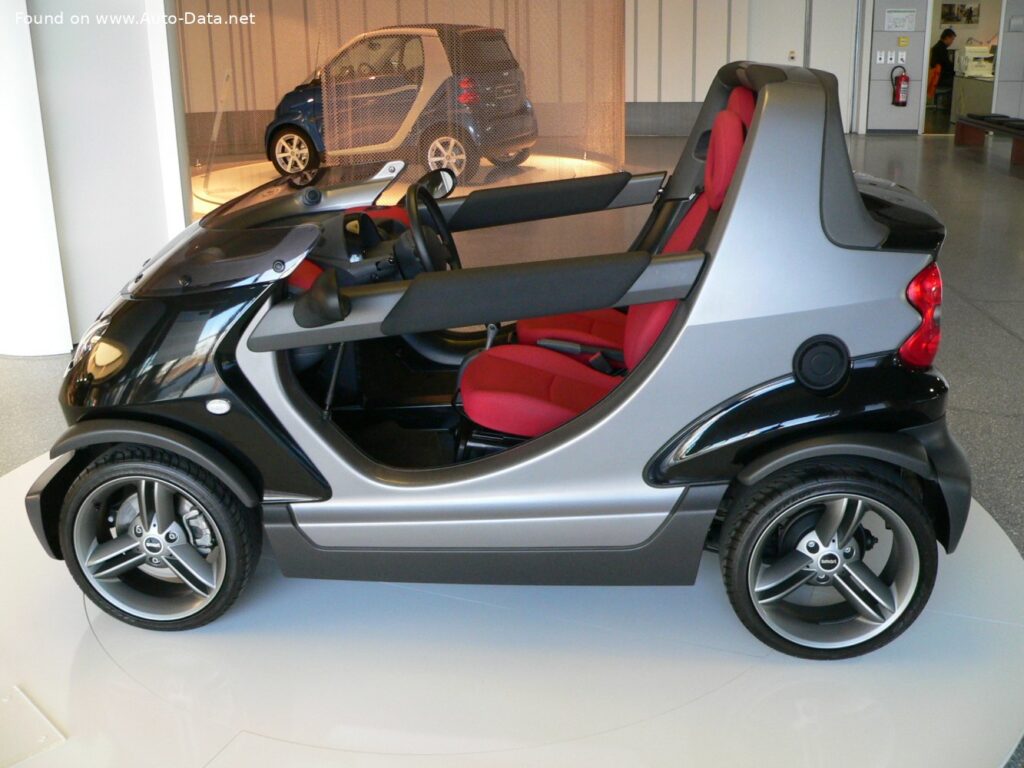
The Smart Crossblade is a unique and unconventional roadster produced by Smart between 2001 and 2006. Based on the Smart City-Coupe, the Crossblade was designed to offer an open-air driving experience with a distinctive, almost futuristic aesthetic. Unlike most convertibles, the Crossblade lacked a traditional roof, instead featuring a removable hardtop that resembled a fighter jet canopy. This unusual design, combined with its compact size and rear-wheel-drive layout, made the Crossblade a niche vehicle primarily sold in Europe, where it gained a cult following for its quirky charm and urban practicality.
Smart Crossblade: A Unique Roadster
The Smart Crossblade emerged during a period when Smart was establishing itself as a brand focused on innovative and space-efficient urban mobility. While the City-Coupe and ForTwo models addressed the need for compact city cars, the Crossblade aimed to inject a dose of fun and individuality into the Smart lineup. It was positioned as a lifestyle vehicle, appealing to drivers seeking a distinctive and attention-grabbing car for weekend drives and city cruising. The Crossblade never saw significant sales volume in the United States, as Smart’s official US presence was limited during its production run. However, it remains a sought-after vehicle among collectors and enthusiasts.
Engine & Performance
The Smart Crossblade was powered by a 599cc inline-three cylinder engine, producing 70 horsepower at 5250 rpm and 73.76 lb.-ft. of torque at 2250 rpm. While not a performance car by any means, the engine provided adequate power for urban driving and leisurely cruising. The Crossblade’s relatively lightweight construction – weighing in at approximately 1609 lbs – helped to offset the modest power output. Acceleration from 0 to 60 mph took around 16 seconds, and the car had a top speed of 83.89 mph. The engine featured multi-port fuel injection and a compression ratio of 9.5:1. Power delivery was to the rear wheels via a six-speed manual transmission, contributing to the car’s unique driving dynamics. The weight-to-power ratio of 10.4 kg/Hp and weight-to-torque ratio of 7.3 kg/Nm further illustrate the car’s focus on efficiency rather than outright speed.
Design & Features
The most striking feature of the Smart Crossblade is undoubtedly its lack of a conventional roof. Instead, it came with a removable hardtop constructed from reinforced plastic, designed to resemble a fighter jet canopy. This top provided some protection from the elements but was not fully sealed, meaning the Crossblade was best enjoyed in fair weather. The body style is a two-door cabriolet, seating two passengers. The car’s overall design was characterized by its short wheelbase, wide track, and distinctive front fascia. The interior was minimalist and functional, reflecting the Smart brand’s focus on practicality. Safety features included an Anti-lock Braking System (ABS), which was relatively advanced for a vehicle of its size and price point at the time. The Crossblade’s compact dimensions made it exceptionally easy to maneuver and park in crowded urban environments. Trunk space was limited to 5.3 cubic feet, reflecting the car’s small overall size.
Technical Specifications
| Brand | Smart |
| Model | Crossblade |
| Generation | Crossblade |
| Type (Engine) | 0.6 i (70 Hp) |
| Start of production | 2001 |
| End of production | 2006 |
| Powertrain Architecture | Internal Combustion engine |
| Body type | Cabriolet |
| Seats | 2 |
| Doors | 2 |
| Fuel consumption (urban) | 6.2 l/100 km (37.9 US mpg) |
| Fuel consumption (extra urban) | 5.3 l/100 km (44.4 US mpg) |
| Fuel Type | Petrol (Gasoline) |
| Acceleration 0 – 100 km/h | 16.8 sec |
| Acceleration 0 – 62 mph | 16.8 sec |
| Acceleration 0 – 60 mph | 16 sec |
| Maximum speed | 135 km/h (83.89 mph) |
| Weight-to-power ratio | 10.4 kg/Hp |
| Weight-to-torque ratio | 7.3 kg/Nm |
| Power | 70 Hp @ 5250 rpm |
| Torque | 100 Nm @ 2250 rpm (73.76 lb.-ft. @ 2250 rpm) |
| Engine layout | Rear, Transverse |
| Engine Model/Code | M 160.910 |
| Engine displacement | 599 cm3 (36.55 cu. in.) |
| Number of cylinders | 3 |
| Engine configuration | Inline |
| Cylinder Bore | 63.5 mm (2.5 in.) |
| Piston Stroke | 63 mm (2.48 in.) |
| Compression ratio | 9.5:1 |
| Number of valves per cylinder | 2 |
| Fuel injection system | Multi-port manifold injection |
| Engine oil capacity | 2.5 l (2.64 US qt | 2.2 UK qt) |
| Coolant | 4.2 l (4.44 US qt | 3.7 UK qt) |
| Kerb Weight | 730 kg (1609.37 lbs.) |
| Max. weight | 980 kg (2160.53 lbs.) |
| Max load | 250 kg (551.16 lbs.) |
| Trunk (boot) space – minimum | 150 l (5.3 cu. ft.) |
| Fuel tank capacity | 22 l (5.81 US gal | 4.84 UK gal) |
| Length | 2500 mm (98.43 in.) |
| Width | 1515 mm (59.65 in.) |
| Height | 1549 mm (60.98 in.) |
| Wheelbase | 1812 mm (71.34 in.) |
| Front track | 1272 mm (50.08 in.) |
| Rear (Back) track | 1354 mm (53.31 in.) |
| Minimum turning circle | 8.7 m (28.54 ft.) |
| Drivetrain Architecture | Rear wheel drive |
| Number of gears and type of gearbox | 6 gears, manual transmission |
| Front suspension | Wishbone |
| Rear suspension | De-Dion |
| Front brakes | Disc |
| Rear brakes | Drum |
| Assisting systems | ABS (Anti-lock braking system) |
| Steering type | Steering rack and pinion |
| Tires size | 195/40 R16; 215/35 R16 |
In conclusion, the Smart Crossblade remains a unique and memorable vehicle. Its unconventional design, compact size, and rear-wheel-drive layout set it apart from other roadsters of its era. While not a high-performance machine, the Crossblade offered a fun and engaging driving experience, particularly in urban environments. Its rarity and distinctive styling have made it a desirable collectible for Smart enthusiasts and those seeking a truly unique automotive experience.
