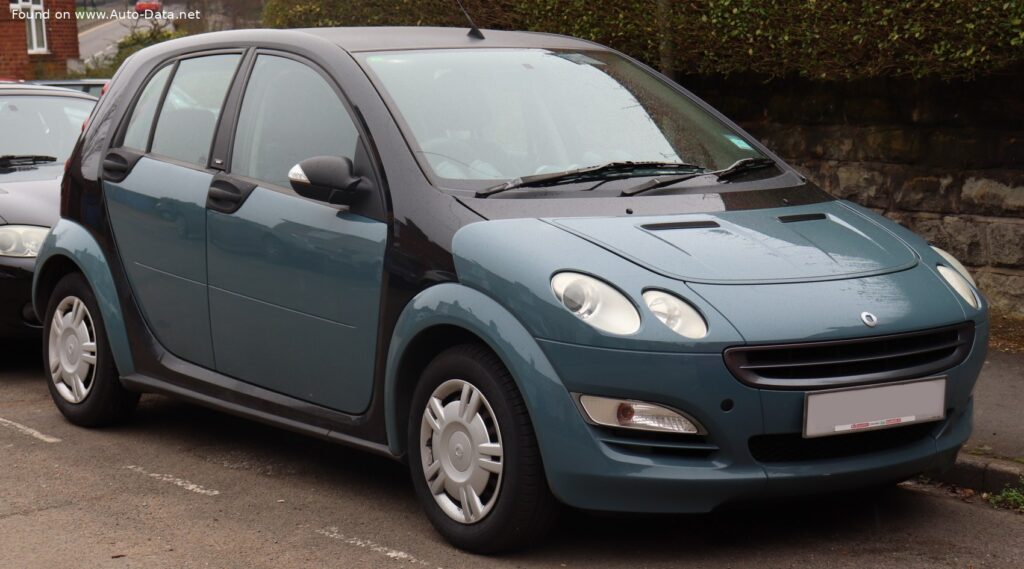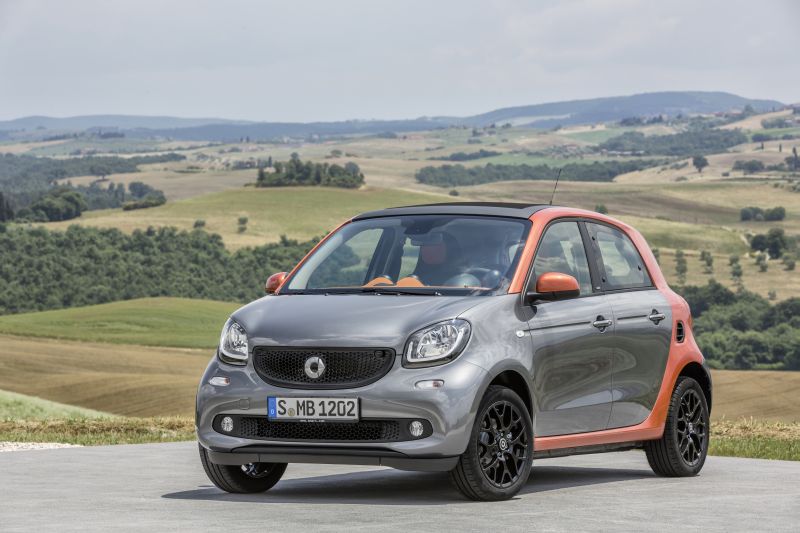
The Smart Forfour II (W453) 1.0, produced from 2014 to 2019, represents a significant evolution in the Smart city car lineage. While the original Forfour (2004-2006) was discontinued due to financial pressures, the W453 model marked a return to the four-seat city car segment. Developed under Mercedes-Benz ownership, the Forfour II shared its platform with the Renault Twingo V, a collaboration aimed at reducing development costs and expanding market reach. Unlike its predecessor, which was built by Smart exclusively, the W453 Forfour was manufactured in Renault’s Novo Mesto plant in Slovenia alongside the Twingo. This model was primarily aimed at the European market, where compact city cars are highly popular, and offered a unique combination of maneuverability, fuel efficiency, and practicality in a small package.
Smart Forfour II (W453) 1.0: A Detailed Overview
The Forfour II distinguished itself from many competitors with its rear-wheel-drive layout, a characteristic inherited from the original Smart Fortwo. This configuration, while unusual for a city car, contributed to its nimble handling and surprisingly spacious interior for its footprint. The 1.0-liter engine variant, producing 71 horsepower, was a mainstay of the range, offering a balance between affordability and acceptable performance for urban driving. The W453 Forfour aimed to address criticisms of the original model, offering improved build quality, a more refined driving experience, and enhanced safety features.
Engine & Performance
The heart of the Smart Forfour II 1.0 is a 999cc inline three-cylinder petrol engine, designated M 281.920. This naturally aspirated engine delivers 71 horsepower at 6000 rpm and 91 Nm (67.12 lb-ft) of torque at 2850 rpm. While not a powerhouse, the engine provides adequate performance for city commuting and short trips. The power-to-weight ratio of 12.7 kg/Hp and torque-to-weight ratio of 9.9 kg/Nm contribute to a reasonably responsive driving experience. Acceleration from 0 to 100 km/h (0-62 mph) takes 15.9 seconds, and 0-60 mph is achieved in 15.1 seconds. The Forfour 1.0 has a maximum speed of 151 km/h (93.83 mph). Fuel economy is a key strength, with combined fuel consumption rated at 4.2 l/100 km (56 US mpg, 67.3 UK mpg), and CO2 emissions of 97 g/km, meeting Euro 6 emission standards. The engine utilizes multi-port manifold fuel injection and a compression ratio of 10.5:1.
Design & Features
The Smart Forfour II is a five-door hatchback, offering seating for four adults, a significant improvement over the two-seat Smart Fortwo. Its compact dimensions – 3495 mm (137.6 in) in length and 1665 mm (65.55 in) in width – make it exceptionally maneuverable in congested urban environments. The rear-wheel-drive layout allows for a tight turning circle of 8.65 m (28.38 ft). The interior design is functional and modern, with a focus on maximizing space. The trunk offers 185 liters (6.53 cu ft) of space with the rear seats up, expanding to 975 liters (34.43 cu ft) when folded down. Safety features include ABS (Anti-lock Braking System) and a robust body structure designed to protect occupants in the event of a collision. The Forfour II also features electric power steering and is equipped with either 165/65 R 15 or 185/60 R 15 tires mounted on 5.0J x 15 or 5.5J x 15 wheel rims. The car’s kerb weight is 900 kg (1984.16 lbs), with a maximum permissible weight of 1400 kg (3086.47 lbs).
Technical Specifications
| Brand | Smart |
| Model | Forfour |
| Generation | Forfour II (W453) |
| Type (Engine) | 1.0 (71 Hp) |
| Start of production | 2014 |
| End of production | 2019 |
| Powertrain Architecture | Internal Combustion engine |
| Body type | Hatchback |
| Seats | 4 |
| Doors | 5 |
| Fuel consumption (urban) | 4.8 l/100 km (49 US mpg, 58.9 UK mpg, 20.8 km/l) |
| Fuel consumption (extra urban) | 3.8 l/100 km (61.9 US mpg, 74.3 UK mpg, 26.3 km/l) |
| Fuel consumption (combined) | 4.2 l/100 km (56 US mpg, 67.3 UK mpg, 23.8 km/l) |
| CO2 emissions | 97 g/km |
| Fuel Type | Petrol (Gasoline) |
| Acceleration 0 – 100 km/h | 15.9 sec |
| Acceleration 0 – 62 mph | 15.9 sec |
| Acceleration 0 – 60 mph | 15.1 sec |
| Maximum speed | 151 km/h (93.83 mph) |
| Emission standard | Euro 6 |
| Weight-to-power ratio | 12.7 kg/Hp |
| Weight-to-torque ratio | 9.9 kg/Nm |
| Power | 71 Hp @ 6000 rpm |
| Torque | 91 Nm @ 2850 rpm (67.12 lb.-ft. @ 2850 rpm) |
| Engine layout | Rear, Transverse |
| Engine Model/Code | M 281.920 |
| Engine displacement | 999 cm3 (60.96 cu. in.) |
| Number of cylinders | 3 |
| Engine configuration | Inline |
| Cylinder Bore | 72.2 mm (2.84 in.) |
| Piston Stroke | 81.3 mm (3.2 in.) |
| Compression ratio | 10.5:1 |
| Fuel injection system | Multi-port manifold injection |
| Engine oil capacity | 3.5 l (3.7 US qt | 3.08 UK qt) |
| Coolant capacity | 7.2 l (7.61 US qt | 6.34 UK qt) |
| Kerb Weight | 900 kg (1984.16 lbs.) |
| Max. weight | 1400 kg (3086.47 lbs.) |
| Max load | 500 kg (1102.31 lbs.) |
| Trunk (boot) space – minimum | 185 l (6.53 cu. ft.) |
| Trunk (boot) space – maximum | 975 l (34.43 cu. ft.) |
| Fuel tank capacity | 28 l (7.4 US gal | 6.16 UK gal) |
| Length | 3495 mm (137.6 in.) |
| Width | 1665 mm (65.55 in.) |
| Height | 1554 mm (61.18 in.) |
| Wheelbase | 2494 mm (98.19 in.) |
| Front track | 1467 mm (57.76 in.) |
| Rear (Back) track | 1429 mm (56.26 in.) |
| Minimum turning circle | 8.65 m (28.38 ft.) |
| Drivetrain Architecture | Rear wheel drive |
| Number of gears | 5 gears, manual transmission |
The Smart Forfour II (W453) 1.0, while not a performance car, offered a compelling package for urban drivers seeking a practical, fuel-efficient, and maneuverable vehicle. Its unique rear-wheel-drive layout and collaborative development with Renault set it apart in the crowded city car segment.