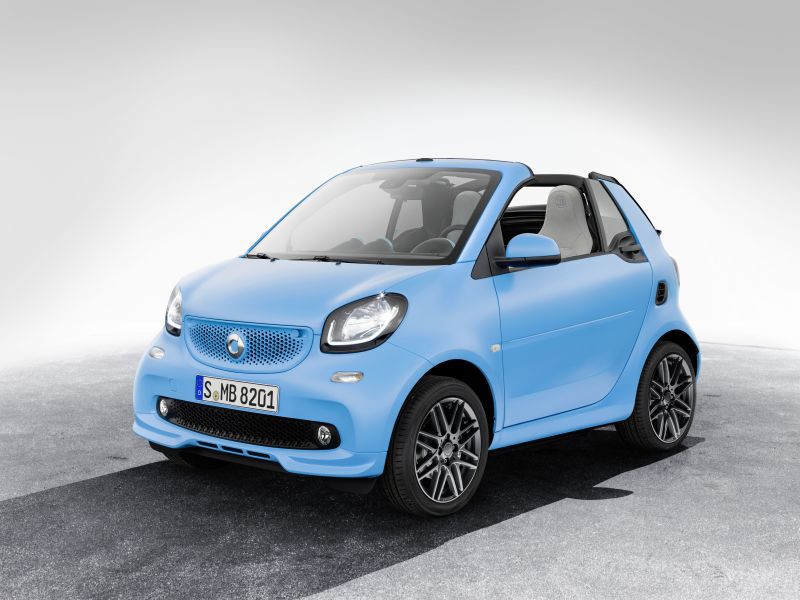
The Smart Fortwo III Cabrio (A453) Brabus 0.9 (109 Hp) Twinamic represents a niche offering in the microcar segment, primarily aimed at urban drivers seeking a highly maneuverable and fuel-efficient vehicle. Produced between 2016 and 2018, this model is a significant iteration of the Fortwo line, known for its diminutive size and innovative engineering. While not officially sold in substantial numbers in the United States, the Fortwo has gained a following among enthusiasts appreciating its unique characteristics and practicality in congested city environments. The Brabus variant, in particular, offered a performance-enhanced version of the standard Fortwo, appealing to those desiring a slightly more spirited driving experience within the constraints of its compact footprint.
Smart Fortwo III Cabrio (A453) Brabus: An Overview
The third generation Fortwo, designated A453, marked a substantial redesign for the Smart city car. Introduced in 2014, it featured a completely new platform developed in collaboration with Renault, sharing components with the Renault Twingo. The Cabrio version, with its retractable soft top, added an open-air element to the Fortwo’s appeal. The Brabus trim level, applied to both the coupe and cabrio, signified a performance upgrade courtesy of the renowned German tuning house, Brabus. This included engine modifications, a sport-tuned suspension, and distinctive styling cues. The 0.9-liter engine, turbocharged and producing 109 horsepower, was the top engine offering for the Fortwo Cabrio Brabus during its production run.
Engine & Performance
The heart of the Smart Fortwo III Cabrio Brabus 0.9 is a 0.9-liter inline-three cylinder engine, turbocharged and intercooled. This engine, designated H4B, produces 109 horsepower at 5750 rpm and 170 Nm (125.39 lb.-ft.) of torque at 2000 rpm. This output translates to a power-to-liter ratio of 121.4 hp/l, a notable figure for a small displacement engine. Power is delivered to the rear wheels via a six-speed Twinamic dual-clutch automatic transmission. The rear-wheel-drive configuration, unusual for vehicles in this class, contributes to a more engaging driving experience. Performance figures include a 0-100 km/h (0-62 mph) acceleration time of 9.5 seconds and a maximum speed of 165 km/h (102.53 mph). Fuel economy is a strong point, with combined cycle consumption rated at 4.6 l/100 km (51.1 US mpg / 61.4 UK mpg), and CO2 emissions of 104 g/km, meeting Euro 6 emission standards.
Design & Features
The Smart Fortwo III Cabrio is characterized by its exceptionally compact dimensions, measuring 2740 mm (107.87 in) in length and 1663 mm (65.47 in) in width. The two-seater cabriolet body style features a retractable fabric roof, allowing for open-top driving. The Brabus variant distinguishes itself with unique styling elements, including a Brabus-specific front spoiler, side skirts, and rear diffuser. The interior, while minimalist, offers essential features for urban commuting. Safety features include ABS (Anti-lock Braking System) and a reinforced safety cell (tridion safety cell) designed to protect occupants in the event of a collision. The trunk space, while limited, offers between 260 and 340 liters (9.18 – 12.01 cu. ft.) of storage depending on the roof position. The vehicle’s small turning circle of 6.95 m (22.8 ft) makes it exceptionally maneuverable in tight spaces.
Technical Specifications
| Brand | Smart |
| Model | Fortwo |
| Generation | Fortwo III cabrio (A453) |
| Type (Engine) | Brabus 0.9 (109 Hp) Twinamic |
| Start of production | 2016 |
| End of production | 2018 |
| Powertrain Architecture | Internal Combustion engine |
| Body type | Cabriolet |
| Seats | 2 |
| Doors | 2 |
| Fuel consumption (urban) | 5.2 l/100 km (45.2 US mpg / 54.3 UK mpg) |
| Fuel consumption (extra urban) | 4.3 l/100 km (54.7 US mpg / 65.7 UK mpg) |
| Fuel consumption (combined) | 4.6 l/100 km (51.1 US mpg / 61.4 UK mpg) |
| CO2 emissions | 104 g/km |
| Fuel Type | Petrol (Gasoline) |
| Acceleration 0 – 100 km/h | 9.5 sec |
| Acceleration 0 – 62 mph | 9.5 sec |
| Acceleration 0 – 60 mph | 9 sec |
| Maximum speed | 165 km/h (102.53 mph) |
| Emission standard | Euro 6 |
| Weight-to-power ratio | 9.5 kg/Hp |
| Weight-to-torque ratio | 6.1 kg/Nm |
| Power | 109 Hp @ 5750 rpm |
| Torque | 170 Nm @ 2000 rpm (125.39 lb.-ft. @ 2000 rpm) |
| Engine layout | Rear, Transverse |
| Engine Model/Code | H4B |
| Engine displacement | 898 cm3 (54.8 cu. in.) |
| Number of cylinders | 3 |
| Engine configuration | Inline |
| Cylinder Bore | 72.2 mm (2.84 in.) |
| Piston Stroke | 73.1 mm (2.88 in.) |
| Compression ratio | 9.5:1 |
| Fuel injection system | Multi-port manifold injection |
| Engine aspiration | Turbocharger, Intercooler |
| Engine oil capacity | 4.3 l (4.54 US qt | 3.78 UK qt) |
| Coolant | 10.5 l (11.1 US qt | 9.24 UK qt) |
| Kerb Weight | 1040 kg (2292.81 lbs.) |
| Max. weight | 1225 kg (2700.66 lbs.) |
| Max load | 185 kg (407.86 lbs.) |
| Trunk (boot) space – minimum | 260 l (9.18 cu. ft.) |
| Trunk (boot) space – maximum | 340 l (12.01 cu. ft.) |
| Fuel tank capacity | 35 l (9.25 US gal | 7.7 UK gal) |
| Length | 2740 mm (107.87 in.) |
| Width | 1663 mm (65.47 in.) |
| Height | 1543 mm (60.75 in.) |
| Wheelbase | 1873 mm (73.74 in.) |
| Front track | 1449 mm (57.05 in.) |
| Rear (Back) track | 1414 mm (55.67 in.) |
| Minimum turning circle | 6.95 m (22.8 ft.) |
| Drivetrain Architecture | Rear wheel drive |
| Number of gears | 6 gears, automatic transmission Twinamic |
| Front suspension | Independent, type McPherson with coil spring and anti-roll bar |
| Rear suspension | Independent coil spring |
| Front brakes | Ventilated discs |
| Rear brakes | Drum |
| Steering type | Steering rack and pinion |
| Power steering | Electric Steering |
| Tires size | 185/50 R 16; 205/40 R 17 |
| Wheel rims size | 6J x 16; 7J x 17 |
The Smart Fortwo III Cabrio Brabus 0.9 remains a distinctive and practical choice for urban drivers prioritizing fuel efficiency, maneuverability, and a touch of open-air fun. Its unique engineering and compact size continue to appeal to a dedicated niche of automotive enthusiasts.