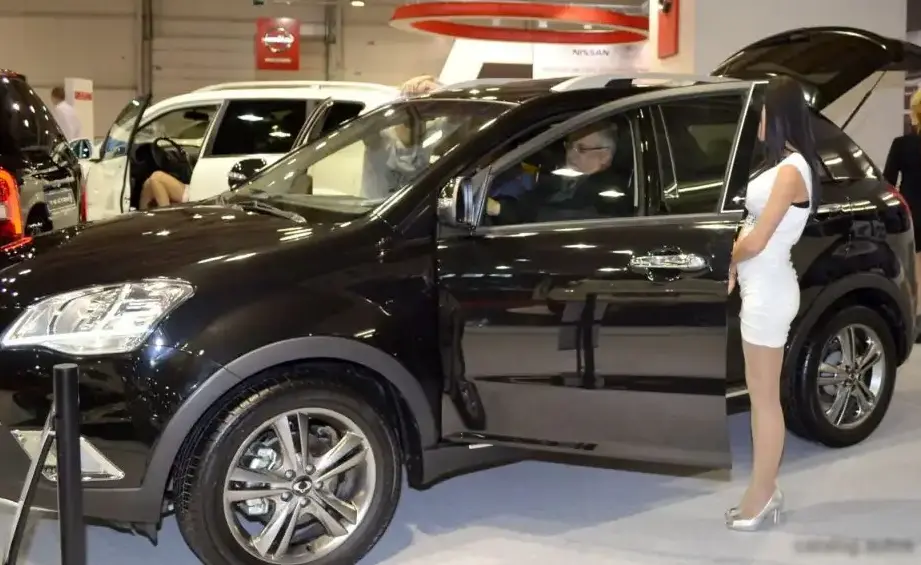
The SsangYong Korando III (C), specifically the 2.0 CDI (175 hp) AWD Automatic “High Power” variant, represents a significant step forward for the South Korean automaker in the competitive European and global SUV market. Produced from 2010 to 2013, this generation Korando aimed to shed the brand’s previous image of utilitarian vehicles and offer a more refined and modern crossover SUV. This particular trim level, positioned as a mid-to-high range offering, combined a diesel engine with an automatic transmission and all-wheel drive, catering to buyers seeking practicality, comfort, and all-weather capability. It was a key model in SsangYong’s attempt to gain traction against established European and Japanese rivals.
Technical Specifications
| Brand | SsangYong |
| Model | Korando |
| Generation | Korando III (C) |
| Type | 2.0 CDI (175 Hp) AWD Automatic High Power |
| Start of production | 2010 |
| End of production | 2013 |
| Powertrain Architecture | Internal Combustion engine |
| Body type | SUV |
| Seats | 5 |
| Doors | 5 |
| Fuel consumption (combined) | 7.5 l/100 km (31.4 US mpg, 37.7 UK mpg, 13.3 km/l) |
| CO2 emissions | 199 g/km |
| Fuel Type | Diesel |
| Acceleration 0 – 100 km/h | 10.3 sec |
| Acceleration 0 – 62 mph | 10.3 sec |
| Acceleration 0 – 60 mph | 9.8 sec |
| Maximum speed | 186 km/h (115.58 mph) |
| Emission standard | Euro 5 |
| Weight-to-power ratio | 9.1 kg/Hp, 110 Hp/tonne |
| Weight-to-torque ratio | 4.4 kg/Nm, 226.3 Nm/tonne |
| Power | 175 Hp @ 4000 rpm |
| Power per litre | 87.6 Hp/l |
| Torque | 360 Nm @ 2000-3000 rpm (265.52 lb.-ft. @ 2000-3000 rpm) |
| Engine layout | Front, Longitudinal |
| Engine Model/Code | D20DTF |
| Engine displacement | 1998 cm3 (121.93 cu. in.) |
| Number of cylinders | 4 |
| Engine configuration | Inline |
| Fuel injection system | Diesel Commonrail |
| Engine aspiration | Turbocharger, Intercooler |
| Engine oil capacity | 6 l (6.34 US qt | 5.28 UK qt) |
| Coolant capacity | 8.5 l (8.98 US qt | 7.48 UK qt) |
| Kerb Weight | 1591 kg (3507.55 lbs.) |
| Max. weight | 2100 kg (4629.71 lbs.) |
| Max load | 509 kg (1122.15 lbs.) |
| Trunk (boot) space – minimum | 486 l (17.16 cu. ft.) |
| Trunk (boot) space – maximum | 1312 l (46.33 cu. ft.) |
| Fuel tank capacity | 57 l (15.06 US gal | 12.54 UK gal) |
| Permitted trailer load with brakes (12%) | 2000 kg (4409.25 lbs.) |
| Permitted trailer load without brakes | 750 kg (1653.47 lbs.) |
| Length | 4410 mm (173.62 in.) |
| Width | 1830 mm (72.05 in.) |
| Height | 1675 mm (65.94 in.) |
| Wheelbase | 2650 mm (104.33 in.) |
| Ride height (ground clearance) | 180 mm (7.09 in.) |
| Minimum turning circle | 10.8 m (35.43 ft.) |
| Drive wheel | All wheel drive (4×4) |
| Number of gears | 6 |
| Gearbox type | Automatic transmission |
| Front suspension | Independent type McPherson |
| Rear suspension | Independent multi-link spring suspension with stabilizer |
| Front brakes | Ventilated discs |
| Rear brakes | Disc |
| Assisting systems | ABS (Anti-lock braking system) |
| Steering type | Steering rack and pinion |
| Tires size | 225/60 R17; 225/55 R18 |
| Wheel rims size | 6.5J x 17; 6.5J x 18 |
INTRODUCTION
The Korando III, launched in 2010, marked SsangYong’s entry into the increasingly popular compact SUV segment. Built on a monocoque chassis (the 1HX0 platform, shared with some other models), it represented a departure from the brand’s traditionally body-on-frame construction. The 2.0 CDI High Power AWD Automatic was a key variant, offering a balance of performance, fuel efficiency, and practicality. It aimed to appeal to families and individuals needing a versatile vehicle capable of handling both on-road and light off-road conditions. This model was primarily sold in Europe, South Korea, and select export markets.
Powertrain & Engine Architecture
At the heart of the Korando 2.0 CDI High Power lies the D20DTF engine, a 2.0-liter inline-four cylinder diesel. This engine utilizes a common rail direct injection system, delivering fuel at extremely high pressure for improved combustion efficiency and reduced emissions. A turbocharger with an intercooler further enhances performance, boosting power output to 175 horsepower at 4000 rpm and 360 Nm (265.52 lb-ft) of torque between 2000 and 3000 rpm. The engine features a single overhead camshaft (SOHC) valvetrain. The automatic transmission is a conventional six-speed unit, providing smooth gear changes and contributing to the vehicle’s overall refinement. While not a particularly advanced transmission, it was well-suited to the engine’s torque characteristics.
Driving Characteristics
The 2.0 CDI Automatic Korando offers a comfortable and relatively relaxed driving experience. The automatic transmission, while not offering lightning-fast shifts, provides smooth and predictable gear changes. Acceleration is adequate, with a 0-60 mph time of around 9.8 seconds, but it’s not a particularly sporty vehicle. The engine delivers its peak torque at relatively low revs, providing good pulling power for overtaking and climbing hills. Compared to the manual transmission versions, the automatic sacrifices some responsiveness, but gains in ease of use, especially in urban environments. The all-wheel-drive system provides enhanced traction in slippery conditions, making it a capable vehicle for year-round use. The gear ratios are tuned for fuel efficiency and cruising comfort rather than outright performance.
Equipment & Trim Levels
The “High Power” trim level of the Korando 2.0 CDI Automatic typically included a generous level of standard equipment. This often featured air conditioning, power windows and mirrors, a CD/MP3 stereo system, alloy wheels, and remote central locking. Higher-spec versions could be equipped with leather upholstery, a sunroof, parking sensors, and a more advanced infotainment system. Interior materials were generally of good quality for the price point, although not quite on par with some of its more established competitors. The dashboard layout was functional and user-friendly, with logically placed controls.
Chassis & Braking
The Korando III utilizes an independent McPherson strut suspension at the front and an independent multi-link suspension at the rear, providing a comfortable ride and good handling characteristics. A stabilizer bar is fitted to both axles to reduce body roll during cornering. The braking system consists of ventilated discs at the front and solid discs at the rear, coupled with an Anti-lock Braking System (ABS). The steering is rack and pinion, providing precise and responsive control. The all-wheel-drive system is typically a part-time system, allowing the driver to select between two-wheel drive and four-wheel drive modes depending on road conditions.
Market Reception & Comparison
The SsangYong Korando III 2.0 CDI Automatic received mixed reviews from automotive critics. While praised for its spacious interior, comfortable ride, and competitive price, it was often criticized for its somewhat unrefined engine and less-than-inspiring performance. Compared to rivals like the Kia Sportage, Hyundai ix35, and Nissan Qashqai, the Korando offered a more affordable alternative, but lacked the brand recognition and refinement of its competitors. Fuel economy was generally considered to be good for a vehicle of its size and type, averaging around 31.4 US mpg. Reliability was generally acceptable, but some owners reported issues with the diesel particulate filter (DPF) and electronic components.
Legacy
The Korando III, and specifically the 2.0 CDI Automatic variant, played a crucial role in SsangYong’s efforts to modernize its image and expand its market share. While it didn’t achieve the sales success of some of its rivals, it demonstrated the brand’s ability to produce a competitive and well-equipped SUV. On the used car market today, these Korandos represent a relatively affordable and practical option for buyers seeking a spacious and capable vehicle. The D20DTF engine, when properly maintained, is generally considered to be a reliable unit, although potential buyers should be aware of the potential for DPF issues. The Korando III laid the groundwork for the subsequent generations of Korando, which have continued to improve in terms of refinement, technology, and overall quality.