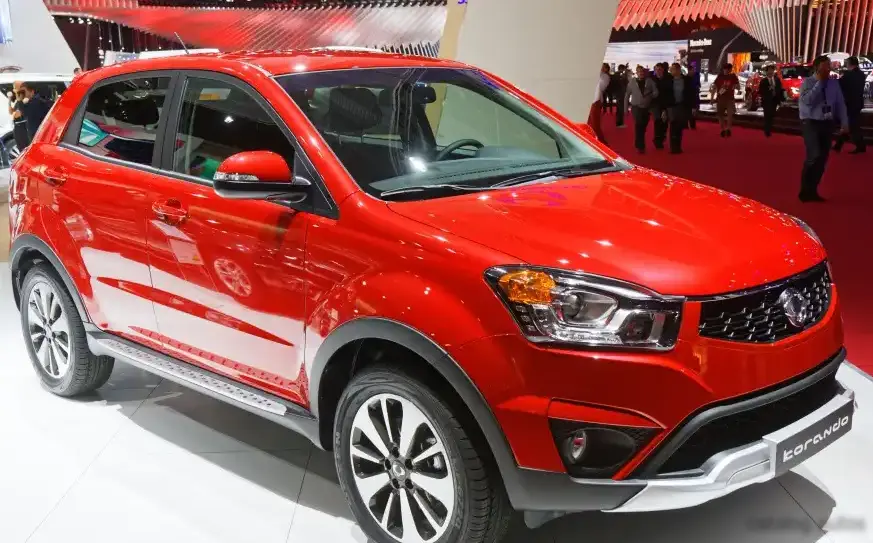
The SsangYong Korando III (C), particularly the facelifted version introduced in 2013, represented a significant step forward for the South Korean automaker in the competitive European and global SUV market. Produced from 2013 to 2017, this generation Korando aimed to offer a blend of practicality, affordability, and a more refined driving experience than its predecessors. The 2.2 e-XDi variant, producing 178 horsepower, was a key model within the lineup, positioned as a mid-range offering that balanced performance with fuel efficiency. It served as a popular choice for families and individuals seeking a capable and spacious SUV.
Technical Specifications
| Brand | SsangYong |
| Model | Korando |
| Generation | Korando III (C, facelift 2013) |
| Type (Engine) | 2.2 e-XDi (178 Hp) |
| Start of production | 2013 |
| End of production | 2017 |
| Powertrain Architecture | Internal Combustion engine |
| Body type | SUV |
| Seats | 5 |
| Doors | 5 |
| Fuel consumption (urban) | 6.5 l/100 km (36.2 US mpg, 43.5 UK mpg, 15.4 km/l) |
| Fuel consumption (extra urban) | 4.6 l/100 km (51.1 US mpg, 61.4 UK mpg, 21.7 km/l) |
| Fuel consumption (combined) | 5.3 l/100 km (44.4 US mpg, 53.3 UK mpg, 18.9 km/l) |
| CO2 emissions | 139 g/km |
| Fuel Type | Diesel |
| Maximum speed | 185 km/h (114.95 mph) |
| Emission standard | Euro 6 |
| Weight-to-power ratio | 9.4 kg/Hp, 106.4 Hp/tonne |
| Weight-to-torque ratio | 4.2 kg/Nm, 239.1 Nm/tonne |
| Power | 178 Hp @ 4000 rpm |
| Power per litre | 82.5 Hp/l |
| Torque | 400 Nm @ 1400-2800 rpm (295.02 lb.-ft. @ 1400-2800 rpm) |
| Engine layout | Front, Longitudinal |
| Engine Model/Code | D22DTR |
| Engine displacement | 2157 cm3 (131.63 cu. in.) |
| Number of cylinders | 4 |
| Engine configuration | Inline |
| Cylinder Bore | 86.2 mm (3.39 in.) |
| Piston Stroke | 92.4 mm (3.64 in.) |
| Compression ratio | 15.5:1 |
| Number of valves per cylinder | 4 |
| Fuel injection system | Diesel Commonrail |
| Engine aspiration | Turbocharger, Intercooler |
| Engine oil capacity | 6 l (6.34 US qt | 5.28 UK qt) |
| Coolant | 8.5 l (8.98 US qt | 7.48 UK qt) |
| Kerb Weight | 1673 kg (3688.33 lbs.) |
| Max. weight | 2180 kg (4806.08 lbs.) |
| Max load | 507 kg (1117.74 lbs.) |
| Trunk (boot) space – minimum | 486 l (17.16 cu. ft.) |
| Trunk (boot) space – maximum | 1312 l (46.33 cu. ft.) |
| Fuel tank capacity | 57 l (15.06 US gal | 12.54 UK gal) |
| Permitted trailer load with brakes (12%) | 2000 kg (4409.25 lbs.) |
| Permitted trailer load without brakes | 750 kg (1653.47 lbs.) |
| Length | 4410 mm (173.62 in.) |
| Width | 1830 mm (72.05 in.) |
| Height | 1675 mm (65.94 in.) |
| Wheelbase | 2650 mm (104.33 in.) |
| Front track | 1573 mm (61.93 in.) |
| Rear (Back) track | 1558 mm (61.34 in.) |
| Front overhang | 920 mm (36.22 in.) |
| Rear overhang | 840 mm (33.07 in.) |
| Ride height (ground clearance) | 180 mm (7.09 in.) |
| Minimum turning circle (turning diameter) | 10.6 m (34.78 ft.) |
| Drivetrain Architecture | The Internal combustion engine (ICE) drives the front wheels of the vehicle. |
| Drive wheel | Front wheel drive |
| Number of gears and type of gearbox | 6 gears, manual transmission |
| Front brakes | Ventilated discs |
| Rear brakes | Disc |
| Assisting systems | ABS (Anti-lock braking system) |
| Steering type | Steering rack and pinion |
| Power steering | Electric Steering |
Powertrain & Engine Architecture
The heart of the Korando 2.2 e-XDi is the D22DTR engine, a 2.2-liter inline-four cylinder diesel. This engine is a key member of SsangYong’s ‘e-XDi’ family, known for its robust construction and focus on torque delivery. The D22DTR utilizes a common-rail direct injection system, delivering fuel at extremely high pressure for improved combustion efficiency and reduced emissions. A turbocharger with an intercooler further enhances performance, boosting power output to 178 horsepower and a substantial 400 Nm (295 lb-ft) of torque. This torque is available from a low 1400 rpm, providing strong pulling power and responsiveness. The engine features a compression ratio of 15.5:1 and 16 valves (4 per cylinder). The engine is longitudinally mounted in the front of the vehicle, driving the front wheels.
Driving Characteristics
The 178 hp 2.2 e-XDi Korando offered a comfortable and capable driving experience. While not a performance-oriented SUV, the engine’s strong low-end torque made it well-suited for everyday driving and hauling loads. Acceleration was adequate, with a 0-60 mph time estimated around 10-11 seconds. The six-speed manual transmission, standard on this variant, provided precise shifts and allowed drivers to effectively utilize the engine’s powerband. Compared to lower-powered versions of the Korando, the 2.2 e-XDi offered a noticeable improvement in responsiveness and overall performance. It also provided a more relaxed driving experience on the highway, with ample power for overtaking maneuvers.
Equipment & Trim Levels
The 2.2 e-XDi trim typically included features such as air conditioning, power windows, central locking, and a basic audio system. Higher trim levels added features like alloy wheels, a touchscreen infotainment system with navigation, leather upholstery, and parking sensors. Safety features included ABS, electronic stability control, and multiple airbags. The Korando aimed to provide a good level of equipment for its price point, making it an attractive option for budget-conscious buyers.
Chassis & Braking
The Korando III utilized a body-on-frame construction, providing a robust and durable chassis. The suspension consisted of MacPherson struts at the front and a multi-link setup at the rear, offering a comfortable ride quality. Braking duties were handled by ventilated discs at the front and solid discs at the rear. The braking system was assisted by ABS, ensuring safe and controlled stopping power. The steering was a rack-and-pinion system with electric power assistance, providing a light and responsive feel.
Market Reception & Comparison
The SsangYong Korando 2.2 e-XDi was generally well-received by automotive critics as a practical and affordable SUV. It was praised for its spacious interior, comfortable ride, and strong diesel engine. However, some critics noted that the interior materials were not as refined as those found in some of its competitors. Compared to other SUVs in its class, such as the Kia Sportage or Hyundai Tucson, the Korando offered a more rugged and utilitarian appeal. Its fuel economy was competitive, averaging around 44.4 US mpg in combined driving. Reliability was generally considered good, although some owners reported minor issues with the electronics.
Legacy
The SsangYong Korando III (C) 2.2 e-XDi has established a reputation as a reliable and durable SUV in the used car market. The D22DTR engine, when properly maintained, is known for its longevity. While not as popular as some of its competitors, the Korando offers a compelling value proposition for buyers seeking a spacious, capable, and affordable SUV. Its robust construction and strong diesel engine make it a practical choice for those who need a vehicle that can handle a variety of tasks. Today, well-maintained examples of the Korando 2.2 e-XDi can still be found offering years of dependable service.