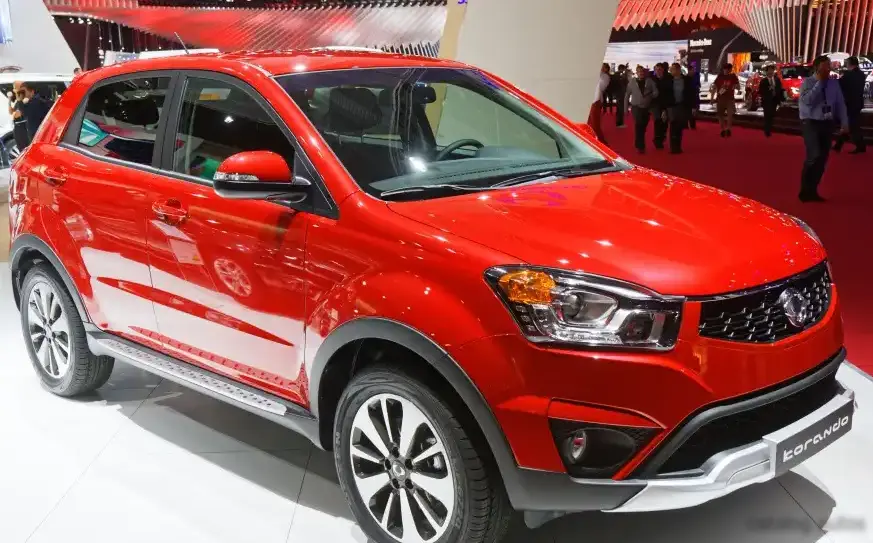
The SsangYong Korando III (C), particularly the facelifted version introduced in 2013, represented a significant step forward for the South Korean automaker in terms of design, refinement, and technology. Produced from 2013 to 2017, this generation Korando aimed to compete more effectively in the increasingly popular compact SUV segment, primarily targeting the European market. The 2.2 e-XDi variant, equipped with a 178 horsepower diesel engine and a six-speed automatic transmission, occupied a mid-range position within the Korando lineup, offering a balance of performance, fuel efficiency, and convenience. It was positioned above the lower-powered diesel options and below the more expensive, fully-equipped trims.
Technical Specifications
| Brand | SsangYong |
| Model | Korando |
| Generation | Korando III (C, facelift 2013) |
| Type (Engine) | 2.2 e-XDi (178 Hp) Automatic |
| Start of production | 2013 |
| End of production | 2017 |
| Powertrain Architecture | Internal Combustion engine |
| Body type | SUV |
| Seats | 5 |
| Doors | 5 |
| Fuel consumption (urban) | 8.3 l/100 km (28.3 US mpg, 34 UK mpg, 12 km/l) |
| Fuel consumption (extra urban) | 5.3 l/100 km (44.4 US mpg, 53.3 UK mpg, 18.9 km/l) |
| Fuel consumption (combined) | 6.4 l/100 km (36.8 US mpg, 44.1 UK mpg, 15.6 km/l) |
| CO2 emissions | 167 g/km |
| Fuel Type | Diesel |
| Maximum speed | 185 km/h (114.95 mph) |
| Emission standard | Euro 6 |
| Weight-to-power ratio | 9.9 kg/Hp, 101.5 Hp/tonne |
| Weight-to-torque ratio | 4.4 kg/Nm, 228.1 Nm/tonne |
| Power | 178 Hp @ 4000 rpm |
| Power per litre | 82.5 Hp/l |
| Torque | 400 Nm @ 1400-2800 rpm (295.02 lb.-ft. @ 1400-2800 rpm) |
| Engine layout | Front, Longitudinal |
| Engine Model/Code | D22DTR |
| Engine displacement | 2157 cm3 (131.63 cu. in.) |
| Number of cylinders | 4 |
| Engine configuration | Inline |
| Cylinder Bore | 86.2 mm (3.39 in.) |
| Piston Stroke | 92.4 mm (3.64 in.) |
| Compression ratio | 15.5:1 |
| Number of valves per cylinder | 4 |
| Fuel injection system | Diesel Commonrail |
| Engine aspiration | Turbocharger, Intercooler |
| Engine oil capacity | 6 l (6.34 US qt | 5.28 UK qt) |
| Coolant | 8.5 l (8.98 US qt | 7.48 UK qt) |
| Kerb Weight | 1754 kg (3866.91 lbs.) |
| Max. weight | 2180 kg (4806.08 lbs.) |
| Max load | 426 kg (939.17 lbs.) |
| Trunk (boot) space – minimum | 486 l (17.16 cu. ft.) |
| Trunk (boot) space – maximum | 1312 l (46.33 cu. ft.) |
| Fuel tank capacity | 57 l (15.06 US gal | 12.54 UK gal) |
| Permitted trailer load with brakes (12%) | 2000 kg (4409.25 lbs.) |
| Permitted trailer load without brakes | 750 kg (1653.47 lbs.) |
| Length | 4410 mm (173.62 in.) |
| Width | 1830 mm (72.05 in.) |
| Height | 1675 mm (65.94 in.) |
| Wheelbase | 2650 mm (104.33 in.) |
| Front track | 1573 mm (61.93 in.) |
| Rear (Back) track | 1558 mm (61.34 in.) |
| Front overhang | 920 mm (36.22 in.) |
| Rear overhang | 840 mm (33.07 in.) |
| Ride height (ground clearance) | 180 mm (7.09 in.) |
| Minimum turning circle (turning diameter) | 10.6 m (34.78 ft.) |
| Drivetrain Architecture | The Internal combustion engine (ICE) drives the front wheels of the vehicle. |
| Drive wheel | Front wheel drive |
| Number of gears and type of gearbox | 6 gears, automatic transmission |
| Front brakes | Ventilated discs |
| Rear brakes | Disc |
| Assisting systems | ABS (Anti-lock braking system) |
| Steering type | Steering rack and pinion |
| Power steering | Electric Steering |
Powertrain & Engine Architecture
The heart of the Korando 2.2 e-XDi is the D22DTR engine, a 2.2-liter inline-four cylinder diesel. This engine utilizes a common-rail direct injection system, delivering fuel at extremely high pressure for improved combustion efficiency and reduced emissions. A turbocharger with an intercooler further enhances performance by forcing more air into the cylinders. The engine produces 178 horsepower at 4,000 rpm and a substantial 400 Nm (295 lb-ft) of torque between 1,400 and 2,800 rpm. This broad torque curve is a key characteristic of diesel engines, providing strong pulling power at lower engine speeds. The six-speed automatic transmission, sourced from AISIN, was chosen for its smoothness and reliability. It features adaptive shift logic, adjusting gear changes based on driving conditions and driver input. While not a particularly sporty transmission, it prioritized comfort and ease of use.
Driving Characteristics
The 2.2 e-XDi automatic Korando offered a comfortable and capable driving experience. The ample torque made everyday driving effortless, with brisk acceleration from a standstill and confident overtaking ability. However, it wasn’t a particularly quick SUV; the automatic transmission, while smooth, did sap some performance compared to the available manual transmission. The gear ratios were tuned for fuel efficiency rather than outright speed. The front-wheel-drive configuration provided decent handling, but it lacked the all-weather capability of the optional all-wheel-drive system. The steering was light and easy, making it maneuverable in urban environments, but it lacked the feedback desired by more enthusiastic drivers.
Equipment & Trim Levels
The 2.2 e-XDi automatic trim typically included features such as air conditioning, power windows and mirrors, a CD/MP3 stereo system with USB connectivity, and alloy wheels. Higher trim levels added features like leather upholstery, a sunroof, a navigation system, and parking sensors. Safety equipment included ABS, electronic stability control (ESC), and multiple airbags. The interior design was functional and reasonably well-built, although the materials used were not as premium as those found in some European competitors.
Chassis & Braking
The Korando III utilized a front MacPherson strut suspension and a multi-link rear suspension. This setup provided a comfortable ride quality, absorbing bumps and imperfections in the road effectively. The front brakes were ventilated discs, while the rear brakes were solid discs. ABS (Anti-lock Braking System) was standard, enhancing braking performance and stability. The suspension was tuned for comfort rather than sporty handling, resulting in a slight degree of body roll during cornering.
Market Reception & Comparison
The Korando 2.2 e-XDi automatic was generally well-received by critics as a practical and affordable SUV. It offered a good balance of space, comfort, and fuel efficiency. However, it was often criticized for its somewhat bland styling and lack of brand recognition compared to established European and Japanese competitors. Compared to the lower-powered 2.0-liter diesel versions, the 2.2 e-XDi offered significantly more performance. Compared to the petrol engine options, the diesel provided superior fuel economy and torque. Reliability was generally good, although some owners reported minor issues with the electronic systems.
Legacy
The SsangYong Korando III, including the 2.2 e-XDi automatic variant, helped to elevate the brand’s image and establish it as a viable competitor in the European SUV market. While not a sales leader, it offered a compelling alternative to more mainstream models. The D22DTR engine proved to be a durable and reliable unit, and well-maintained examples continue to be found on the used car market today. The Korando III laid the foundation for the subsequent generations of Korando, which have continued to improve in terms of design, technology, and refinement.