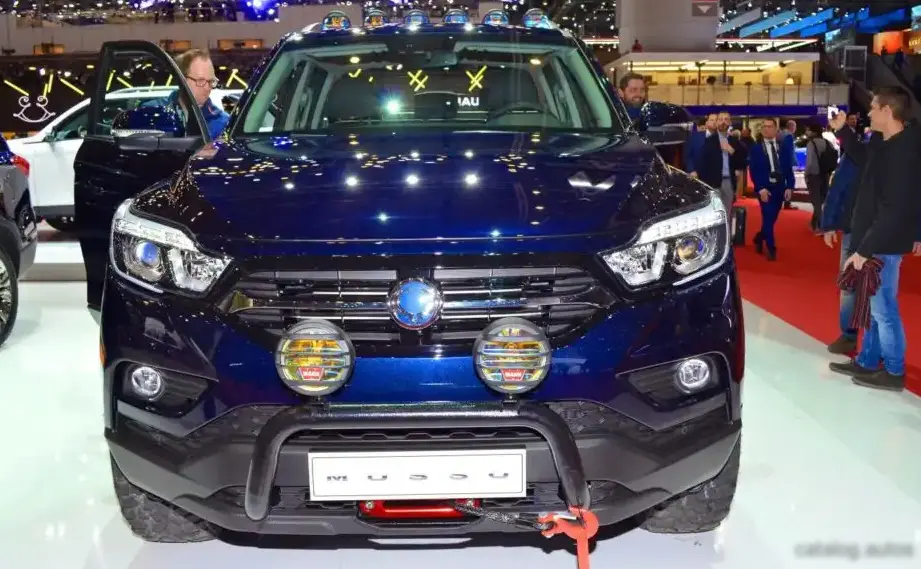
The SsangYong Musso I 2.3 i 16V, produced from 1995 to 2005, represented a significant step for the South Korean automaker into the mid-size SUV market. Positioned as a rugged, body-on-frame vehicle, the Musso aimed to provide a capable and affordable alternative to established Japanese and European competitors. This particular 2.3-liter, 16-valve gasoline engine variant, producing 150 horsepower, served as a core offering within the Musso lineup, appealing to buyers seeking a balance between performance and fuel economy. It was a key model for SsangYong as they attempted to expand their international presence, particularly in Europe and Australia, where demand for SUVs was growing rapidly.
Technical Specifications
| Brand | SsangYong |
| Model | Musso |
| Generation | Musso I |
| Type (Engine) | 2.3 i 16V (150 Hp) |
| Start of production | 1995 |
| End of production | 2005 |
| Powertrain Architecture | Internal Combustion engine |
| Body type | SUV |
| Seats | 5 |
| Doors | 5 |
| Fuel consumption (combined) | 14.3 l/100 km (16.4 US mpg, 19.8 UK mpg, 7 km/l) |
| Fuel Type | Petrol (Gasoline) |
| Maximum speed | 175 km/h (108.74 mph) |
| Weight-to-power ratio | 12.6 kg/Hp, 79.4 Hp/tonne |
| Weight-to-torque ratio | 8.6 kg/Nm, 116.4 Nm/tonne |
| Power | 150 Hp @ 5300 rpm |
| Power per litre | 65.2 Hp/l |
| Torque | 220 Nm (162.26 lb.-ft.) |
| Engine layout | Front, Longitudinal |
| Engine displacement | 2299 cm3 (140.29 cu. in.) |
| Number of cylinders | 4 |
| Engine configuration | Inline |
| Cylinder Bore | 95.5 mm (3.76 in.) |
| Piston Stroke | 80.3 mm (3.16 in.) |
| Compression ratio | 9.7:1 |
| Number of valves per cylinder | 4 |
| Fuel injection system | Multi-port manifold injection |
| Engine aspiration | Naturally aspirated engine |
| Valvetrain | DOHC |
| Engine oil capacity | 6 l (6.34 US qt | 5.28 UK qt) |
| Coolant | 10 l (10.57 US qt | 8.8 UK qt) |
| Kerb Weight | 1890 kg (4166.74 lbs.) |
| Max. weight | 2520 kg (5555.65 lbs.) |
| Max load | 630 kg (1388.91 lbs.) |
| Fuel tank capacity | 75 l (19.81 US gal | 16.5 UK gal) |
| Length | 4640 mm (182.68 in.) |
| Width | 1905 mm (75 in.) |
| Height | 1735 mm (68.31 in.) |
| Wheelbase | 2630 mm (103.54 in.) |
| Front track | 1490 mm (58.66 in.) |
| Rear (Back) track | 1500 mm (59.06 in.) |
| Drive wheel | All wheel drive (4×4) |
| Number of gears and type of gearbox | 5 gears, manual transmission |
| Front suspension | Torsion |
| Rear suspension | Coil spring |
| Front brakes | Ventilated discs |
| Rear brakes | Disc |
| Assisting systems | ABS (Anti-lock braking system) |
| Power steering | Hydraulic Steering |
| Tires size | 235/75 R15 S |
Powertrain & Engine Architecture
The heart of the Musso I 2.3 i 16V is the Mercedes-Benz derived 2.3-liter inline-four cylinder engine. SsangYong had a licensing agreement with Mercedes-Benz, and this engine shares significant design elements with the M111 engine family. The engine features a double overhead camshaft (DOHC) valvetrain operating 16 valves (four per cylinder), contributing to its relatively high output for its displacement. Fuel delivery is managed by a multi-port fuel injection system, providing precise fuel metering for improved efficiency and performance. The engine’s longitudinal mounting within the chassis allowed for a traditional rear-wheel-drive layout with selectable four-wheel drive. The five-speed manual transmission was the standard offering for this variant, providing drivers with full control over gear selection. While an automatic transmission was available in some markets, the manual was favored for its efficiency and responsiveness.
Driving Characteristics
The 2.3-liter engine, while adequate, wasn’t known for blistering acceleration. With 150 horsepower and 220 Nm (162 lb-ft) of torque, the Musso I 2.3 i 16V offered respectable, but not exceptional, performance. Acceleration from 0 to 60 mph typically took around 11-12 seconds. The five-speed manual transmission helped to keep the engine in its optimal power band, but the Musso’s considerable weight (approximately 1890 kg or 4167 lbs) limited its overall agility. The selectable four-wheel drive system provided enhanced traction in off-road conditions and inclement weather, making it a capable vehicle for those needing all-weather capability. Compared to the later, more powerful 2.9-liter diesel variants, the 2.3-liter gasoline engine prioritized refinement and a smoother driving experience over outright power.
Equipment & Trim Levels
The Musso I 2.3 i 16V typically came equipped with a reasonable level of standard features, reflecting its positioning as a mid-range SUV. Interior appointments generally included cloth upholstery, power windows, and central locking. Air conditioning was often standard, though some base models may have offered it as an option. Higher trim levels added features such as alloy wheels, a more sophisticated audio system, and upgraded interior trim. Optional extras included a sunroof, leather upholstery, and a more advanced four-wheel-drive system with low-range gearing. The dashboard layout was functional and straightforward, prioritizing usability over stylistic flair.
Chassis & Braking
The Musso I utilized a traditional body-on-frame construction, providing a robust and durable platform. Front suspension consisted of torsion bars, while the rear employed coil springs. This setup offered a comfortable ride, though it wasn’t particularly sporty. Braking duties were handled by ventilated discs at the front and solid discs at the rear. Anti-lock braking system (ABS) was standard, enhancing safety by preventing wheel lockup during hard braking. Hydraulic power steering provided relatively light and precise steering feel. The tires were typically 235/75 R15, offering a good balance between on-road comfort and off-road capability.
Market Reception & Comparison
The SsangYong Musso I 2.3 i 16V received mixed reviews from automotive critics. It was generally praised for its rugged construction, spacious interior, and capable four-wheel-drive system. However, the 2.3-liter engine was often criticized for being underpowered, particularly when fully loaded or tackling steep inclines. Fuel economy was also a concern, averaging around 14.3 l/100 km (16.4 US mpg). Compared to the diesel variants, the 2.3-liter gasoline engine offered a quieter and smoother driving experience, but at the expense of fuel efficiency and low-end torque. The Musso I competed with vehicles like the Suzuki Vitara, Mitsubishi Pajero, and early Toyota RAV4 models.
Legacy
The SsangYong Musso I 2.3 i 16V, while not a runaway success, played a crucial role in establishing SsangYong as a player in the global SUV market. The 2.3-liter engine proved to be reasonably reliable, although regular maintenance was essential. Today, the Musso I is a relatively rare sight on the roads, but it has gained a following among enthusiasts who appreciate its rugged simplicity and off-road capability. Parts availability can be a challenge, but the engine’s Mercedes-Benz origins mean that some components are interchangeable with those from other vehicles. The Musso I represents a unique chapter in SsangYong’s history, showcasing the company’s ambition to compete with established automotive brands.