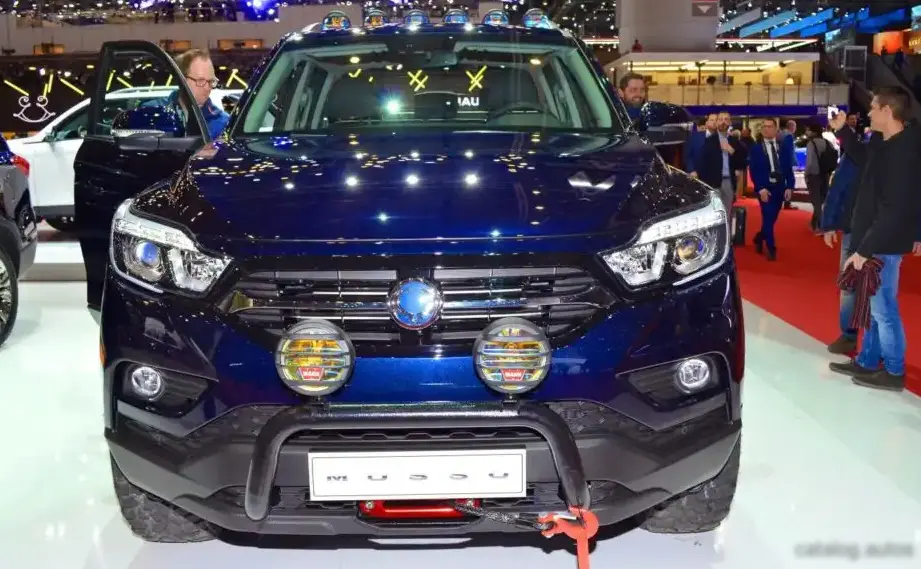
The SsangYong Musso I 2.9 D (95 hp) Automatic, produced from 1996 to 2005, represents an early foray by the South Korean automaker into the burgeoning SUV market. Positioned as a rugged, body-on-frame vehicle, the Musso aimed to provide a practical and affordable alternative to established Japanese and European competitors. This particular variant, equipped with the 2.9-liter diesel engine and a four-speed automatic transmission, served as a mid-range offering within the Musso lineup, prioritizing ease of use and accessibility over outright performance. It was primarily marketed towards buyers seeking a capable workhorse or a family vehicle with off-road potential, particularly in markets outside of North America where SsangYong had a stronger presence.
Technical Specifications
| Brand | SsangYong |
| Model | Musso |
| Generation | Musso I |
| Type (Engine) | 2.9 D (95 Hp) Automatic |
| Start of production | 1996 |
| End of production | 2005 |
| Powertrain Architecture | Internal Combustion engine |
| Body type | SUV |
| Seats | 5 |
| Doors | 5 |
| Fuel Type | Diesel |
| Acceleration 0 – 100 km/h | 21 sec |
| Acceleration 0 – 62 mph | 21 sec |
| Acceleration 0 – 60 mph | 20 sec |
| Maximum speed | 145 km/h (90.1 mph) |
| Weight-to-power ratio | 19.3 kg/Hp, 51.9 Hp/tonne |
| Weight-to-torque ratio | 9.6 kg/Nm, 103.8 Nm/tonne |
| Power | 95 Hp @ 4100 rpm |
| Power per litre | 33.1 Hp/l |
| Torque | 190 Nm @ 2500 rpm (140.14 lb.-ft. @ 2500 rpm) |
| Engine layout | Front, Longitudinal |
| Engine Model/Code | OM 662 |
| Engine displacement | 2874 cm3 (175.38 cu. in.) |
| Number of cylinders | 5 |
| Engine configuration | Inline |
| Cylinder Bore | 89 mm (3.5 in.) |
| Piston Stroke | 92.4 mm (3.64 in.) |
| Compression ratio | 22:1 |
| Number of valves per cylinder | 2 |
| Fuel injection system | Precombustion chamber injection |
| Engine aspiration | Naturally aspirated engine |
| Valvetrain | OHC |
| Engine oil capacity | 7.5 l (7.93 US qt | 6.6 UK qt) |
| Kerb Weight | 1830 kg (4034.46 lbs.) |
| Max. weight | 2520 kg (5555.65 lbs.) |
| Max load | 690 kg (1521.19 lbs.) |
| Trunk (boot) space – minimum | 780 l (27.55 cu. ft.) |
| Trunk (boot) space – maximum | 1910 l (67.45 cu. ft.) |
| Fuel tank capacity | 80 l (21.13 US gal | 17.6 UK gal) |
| Length | 4640 mm (182.68 in.) |
| Width | 1850 mm (72.83 in.) |
| Height | 1720 mm (67.72 in.) |
| Wheelbase | 2630 mm (103.54 in.) |
| Front track | 1490 mm (58.66 in.) |
| Rear (Back) track | 1500 mm (59.06 in.) |
| Drive wheel | All wheel drive (4×4) |
| Number of gears and type of gearbox | 4 gears, automatic transmission |
| Front suspension | Torsion |
| Rear suspension | Coil spring |
| Front brakes | Ventilated discs |
| Rear brakes | Disc |
| Assisting systems | ABS (Anti-lock braking system) |
| Power steering | Hydraulic Steering |
| Tires size | 235/75 R15 |
| Wheel rims size | 15 |
Powertrain & Engine Architecture
The heart of the Musso I 2.9 D Automatic is the OM662, a 2.9-liter inline five-cylinder diesel engine. This engine, sourced from Mercedes-Benz (SsangYong had a technical partnership with Daimler-Benz at the time), is known for its durability and relatively simple design. It utilizes a precombustion chamber injection system, a common diesel technology of the era, which involves injecting fuel into a small chamber within the cylinder head before the main combustion chamber. This aids in better fuel mixing and more complete combustion. The engine produces 95 horsepower at 4,100 rpm and 190 Nm (140 lb-ft) of torque at 2,500 rpm. The four-speed automatic transmission, while providing convenience, was not known for its sophistication or efficiency. It’s a traditional hydraulic automatic, offering relatively smooth shifts but lacking the responsiveness of more modern transmissions.
Driving Characteristics
The 95 hp output and four-speed automatic combination resulted in a driving experience focused on practicality rather than performance. Acceleration was leisurely, with a 0-60 mph time around 20 seconds. The engine delivered its torque in a relatively narrow band, requiring drivers to anticipate gear changes and maintain momentum. While adequate for everyday driving and highway cruising, the Musso I 2.9 D Automatic struggled when fully loaded or tackling steep inclines. Compared to the available manual transmission or the later, more powerful engine options (including a 3.2-liter inline-six), this variant felt noticeably underpowered. However, the automatic transmission made it a more accessible option for drivers unfamiliar with manual gearboxes.
Equipment & Trim Levels
The 2.9 D Automatic trim typically included basic amenities such as power steering, air conditioning, and a relatively simple audio system. Interior upholstery was usually cloth, with durable plastics used throughout the cabin. Optional extras included power windows, central locking, and alloy wheels. The dashboard layout was functional but lacked the refinement of more contemporary SUVs. The focus was on providing a robust and utilitarian interior that could withstand the rigors of daily use and off-road adventures.
Chassis & Braking
The Musso I utilized a traditional body-on-frame construction, providing a robust and durable chassis. The front suspension employed torsion bars, while the rear featured coil springs. This setup offered a comfortable ride on paved roads but could feel somewhat bouncy when unladen. Braking duties were handled by ventilated discs at the front and solid discs at the rear. An Anti-lock Braking System (ABS) was included as standard, enhancing safety and control during emergency braking situations. The vehicle’s substantial weight (1830 kg / 4034 lbs) contributed to its stable handling but also impacted its braking performance.
Market Reception & Comparison
The SsangYong Musso I 2.9 D Automatic received mixed reviews. Critics praised its rugged construction, spacious interior, and off-road capability. However, the engine’s lack of power and the transmission’s dated technology were frequently cited as drawbacks. Compared to competitors like the Toyota RAV4 or Honda CR-V, the Musso offered a more utilitarian experience but lacked their refinement and fuel efficiency. Within the Musso lineup, this variant was positioned as an entry-level option, appealing to budget-conscious buyers who prioritized practicality over performance. The 3.2-liter engine offered a significant performance upgrade, while the manual transmission provided better fuel economy and driver engagement.
Legacy
The SsangYong Musso I 2.9 D Automatic, while not a groundbreaking vehicle, played a role in establishing SsangYong as a player in the SUV market. The OM662 engine proved to be remarkably durable, and well-maintained examples continue to be found on the used car market today. However, finding parts can be challenging, and the vehicle’s age means that maintenance costs are likely to increase over time. Despite its limitations, the Musso I 2.9 D Automatic remains a popular choice among enthusiasts seeking a rugged and affordable off-road vehicle with a unique character.