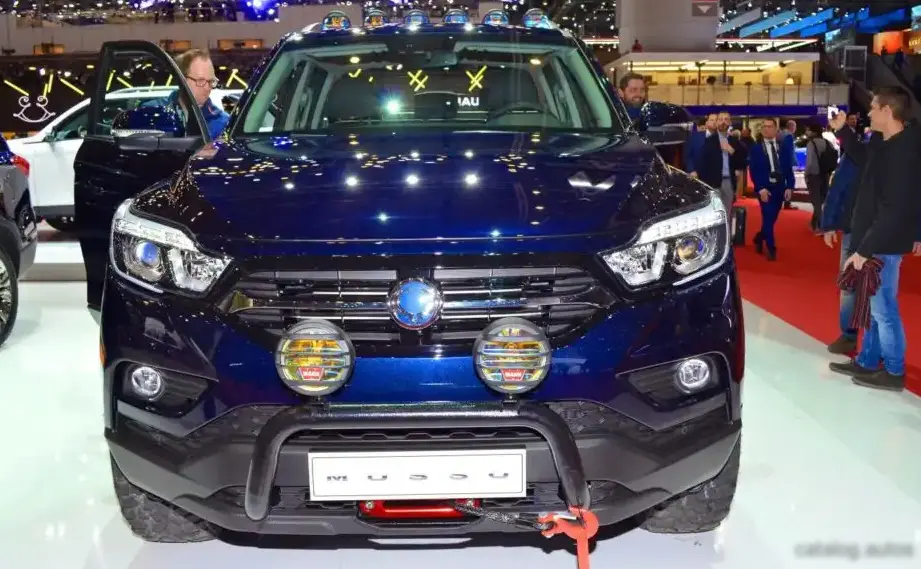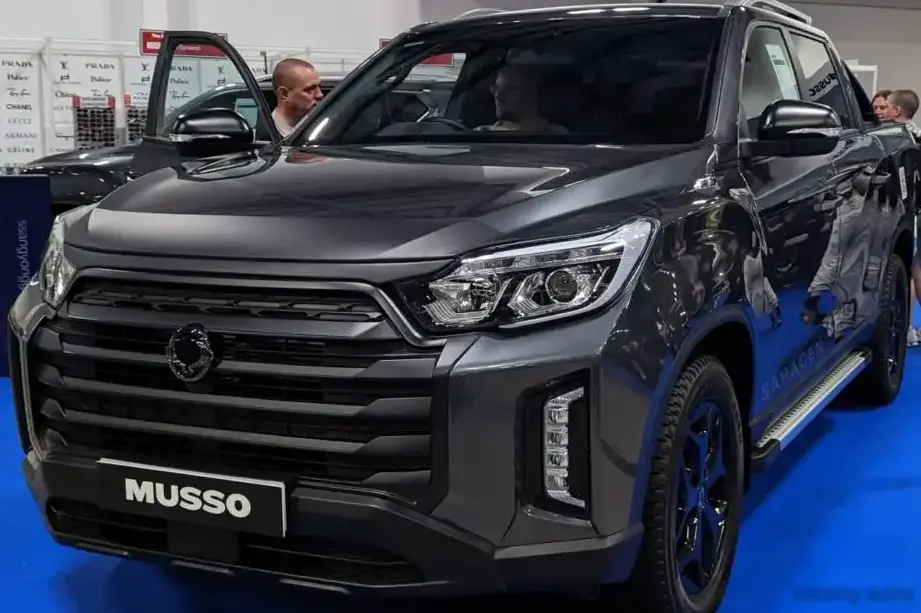
The SsangYong Musso II, specifically the facelifted version introduced in 2021, represents the second generation of SsangYong’s mid-size pickup truck. This iteration aimed to modernize the Musso, offering a blend of practicality, capability, and a more refined driving experience. The 2.0 e-XGDi 200T 4WD Automatic variant, produced from 2021 to 2023, occupied a significant position in the lineup, offering a balance between performance, fuel efficiency, and available technology. It was positioned as a mainstream offering, appealing to buyers needing a versatile vehicle for both work and leisure, and represented a move towards more modern powertrain options for the brand.
Technical Specifications
| Brand | SsangYong |
| Model | Musso |
| Generation | Musso II (facelift 2021) |
| Type | 2.0 e-XGDi 200T (225 Hp) 4WD Automatic |
| Start of production | 2021 |
| End of production | 2023 |
| Powertrain Architecture | Internal Combustion engine |
| Body type | Pick-up |
| Seats | 5 |
| Doors | 4 |
| Fuel consumption (urban) | 15.1 l/100 km (15.6 US mpg, 18.7 UK mpg, 6.6 km/l) |
| Fuel consumption (extra urban) | 8.7 l/100 km (27 US mpg, 32.5 UK mpg, 11.5 km/l) |
| Fuel consumption (combined) | 11.1 l/100 km (21.2 US mpg, 25.4 UK mpg, 9 km/l) |
| CO2 emissions | 253 g/km |
| Fuel Type | Petrol (Gasoline) |
| Maximum speed | 185 km/h (114.95 mph) |
| Emission standard | Euro 6 |
| Weight-to-power ratio | 9.2 kg/Hp, 108.7 Hp/tonne |
| Weight-to-torque ratio | 5.9 kg/Nm, 169.1 Nm/tonne |
| Power | 225 Hp @ 5500 rpm |
| Power per litre | 112.6 Hp/l |
| Torque | 350 Nm @ 1500-4500 rpm (258.15 lb.-ft. @ 1500-4500 rpm) |
| Engine layout | Front, Longitudinal |
| Engine Model/Code | G20GDi |
| Engine displacement | 1998 cm3 (121.93 cu. in.) |
| Number of cylinders | 4 |
| Engine configuration | Inline |
| Cylinder Bore | 86 mm (3.39 in.) |
| Piston Stroke | 86 mm (3.39 in.) |
| Compression ratio | 9.6:1 |
| Number of valves per cylinder | 4 |
| Fuel injection system | Direct injection |
| Engine aspiration | Turbocharger, Intercooler |
| Engine oil capacity | 5 l (5.28 US qt | 4.4 UK qt) |
| Coolant | 11 l (11.62 US qt | 9.68 UK qt) |
| Kerb Weight | 2070-2184 kg (4563.57 – 4814.9 lbs.) |
| Max. weight | 2860 kg (6305.22 lbs.) |
| Max load | 676-790 kg (1490.32 – 1741.65 lbs.) |
| Fuel tank capacity | 70 l (18.49 US gal | 15.4 UK gal) |
| Permitted trailer load with brakes (12%) | 3000 kg (6613.87 lbs.) |
| Permitted trailer load without brakes | 750 kg (1653.47 lbs.) |
| Length | 5095 mm (200.59 in.) |
| Width | 1950 mm (76.77 in.) |
| Height | 1840 mm (72.44 in.) |
| Wheelbase | 3100 mm (122.05 in.) |
| Front track | 1640 mm (64.57 in.) |
| Rear track | 1640 mm (64.57 in.) |
| Front overhang | 890 mm (35.04 in.) |
| Rear overhang | 1105 mm (43.5 in.) |
| Ride height (ground clearance) | 215 mm (8.46 in.) |
| Minimum turning circle | 11.82 m (38.78 ft.) |
| Drivetrain Architecture | All wheel drive (4×4). ICE drives rear wheels, front wheels engaged via clutch. |
| Drive wheel | All wheel drive (4×4) |
| Number of gears | 6 |
| Gearbox type | Automatic transmission |
| Front suspension | Coil spring, Double wishbone |
| Rear suspension | Independent multi-link suspension, Coil spring |
| Front brakes | Ventilated discs |
| Rear brakes | Disc |
| Assisting systems | ABS (Anti-lock braking system) |
| Steering type | Steering rack and pinion |
| Power steering | Hydraulic Steering |
| Tires size | 235/70 R17 XL; 255/60 R18 |
| Wheel rims size | 17; 18 |
INTRODUCTION
The 2021 facelift of the SsangYong Musso II marked a significant update to the model, bringing with it revised styling, improved interior appointments, and a focus on safety technology. The 2.0 e-XGDi 200T 4WD Automatic variant was a key component of this refresh, offering a gasoline-powered alternative to the diesel engines traditionally favored in the mid-size pickup segment, particularly in European markets. Built on the Musso II platform, it aimed to provide a compelling option for buyers seeking a capable and comfortable pickup truck with a more refined powertrain. This model year saw SsangYong attempting to broaden its appeal beyond its traditional customer base.
Powertrain & Engine Architecture
At the heart of the Musso II 2.0 e-XGDi 200T lies the G20GDi engine, a 1.998-liter inline-four cylinder gasoline engine. This engine utilizes direct fuel injection and is coupled with a twin-scroll turbocharger and intercooler to deliver 225 horsepower at 5500 rpm and 350 Nm (258 lb-ft) of torque between 1500 and 4500 rpm. The engine features a compression ratio of 9.6:1 and utilizes a timing chain for durability. The engine is longitudinally mounted in the chassis. The powertrain is paired with a six-speed automatic transmission, chosen for its smooth operation and ease of use. This transmission is designed to handle the engine’s torque output and provide adequate performance for both on-road and off-road driving. The automatic transmission doesn’t offer manual shift modes.
Driving Characteristics
The 2.0 e-XGDi 200T Automatic Musso II delivers a driving experience that prioritizes comfort and usability over outright performance. While the 225 hp output is respectable, the vehicle’s weight (between 2070-2184 kg) means acceleration is not particularly brisk. The automatic transmission is tuned for smooth shifts and fuel efficiency, rather than aggressive downshifts. The turbocharger provides a noticeable boost in power, but there is some turbo lag at lower engine speeds. Compared to diesel variants, the gasoline engine offers a quieter and more refined driving experience, but sacrifices some of the low-end torque that makes diesel pickups popular for towing and hauling. The 4WD system provides good traction in various conditions, making it suitable for light off-road use.
Equipment & Trim Levels
The 2.0 e-XGDi 200T Automatic trim typically included features such as air conditioning, power windows and locks, a touchscreen infotainment system with Bluetooth connectivity, and a rearview camera. Higher trim levels offered upgrades like leather upholstery, heated front seats, a larger touchscreen display, and advanced driver-assistance systems (ADAS) such as lane departure warning and automatic emergency braking. Standard safety equipment included ABS, electronic stability control, and multiple airbags. The interior design was generally functional and durable, with a focus on practicality rather than luxury.
Chassis & Braking
The Musso II utilizes a body-on-frame construction, providing a robust and durable chassis. The front suspension consists of a double wishbone setup with coil springs, while the rear suspension employs an independent multi-link configuration, also with coil springs. This suspension setup aims to balance ride comfort with handling stability. The braking system features ventilated discs on the front wheels and solid discs on the rear. Hydraulic power steering provides responsive steering feel. The vehicle’s relatively high ground clearance (215 mm) enhances its off-road capability.
Market Reception & Comparison
The 2.0 e-XGDi 200T Automatic Musso II received mixed reviews. Critics praised its comfortable ride, spacious interior, and competitive pricing. However, some noted the engine’s lack of low-end torque compared to diesel alternatives and its relatively high fuel consumption (11.1 l/100 km combined). Compared to the diesel-powered Musso models, the gasoline variant offered a more refined driving experience but compromised on fuel economy and towing capacity. Against competitors like the Toyota Hilux and Ford Ranger, the Musso II offered a different proposition, focusing on value and comfort rather than outright performance or off-road prowess.
Legacy
The SsangYong Musso II 2.0 e-XGDi 200T Automatic, while not a massive sales success, represents an interesting attempt by SsangYong to diversify its powertrain offerings and appeal to a wider range of buyers. The G20GDi engine proved to be reasonably reliable, although long-term durability data is still emerging. On the used car market, these models are generally available at competitive prices, making them an attractive option for buyers seeking a capable and affordable pickup truck. However, potential buyers should be aware of the higher fuel consumption compared to diesel alternatives and the potential for turbocharger-related issues as the vehicle ages.