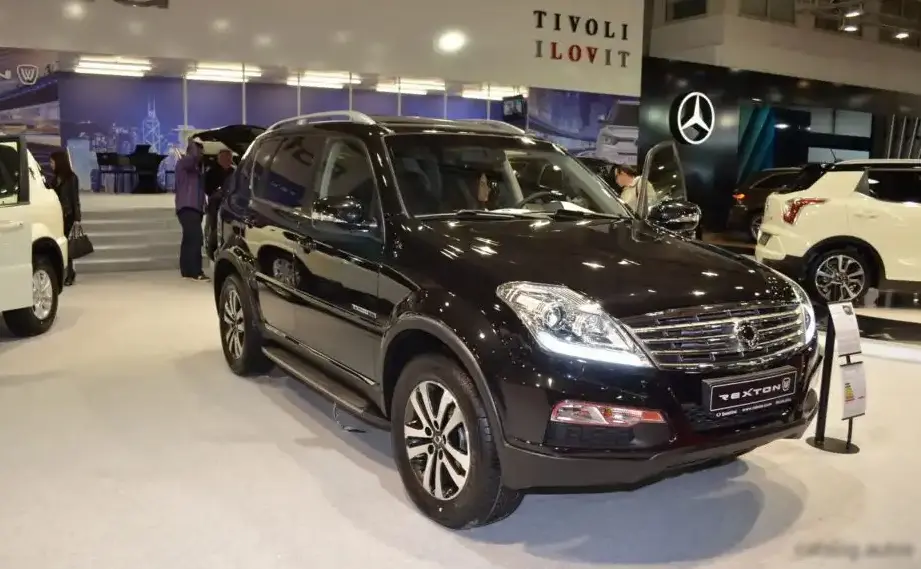
The SsangYong Rexton I (facelift 2012) RX 200 e-XDi, produced from 2012 to 2017, represents a mid-cycle refresh of the first-generation Rexton SUV. Positioned as a more accessible entry point into the Rexton lineup, the RX 200 e-XDi offered a diesel-powered, rear-wheel-drive option aimed at buyers prioritizing fuel efficiency and practicality over outright performance. It competed with other mid-size SUVs like the Hyundai Santa Fe and Kia Sorento, offering a more rugged alternative with available seven-passenger seating. This variant was primarily sold in European and Asian markets, with limited presence in North America.
Technical Specifications
| Brand | SsangYong |
| Model | Rexton |
| Generation | Rexton I (facelift 2012) |
| Type (Engine) | RX 200 e-XDi (155 Hp) |
| Start of production | 2012 |
| End of production | 2017 |
| Powertrain Architecture | Internal Combustion engine |
| Body type | SUV |
| Seats | 5-7 |
| Doors | 5 |
| Fuel consumption (urban) | 9.4 l/100 km (25 US mpg, 30.1 UK mpg, 10.6 km/l) |
| Fuel consumption (extra urban) | 6.1 l/100 km (38.6 US mpg, 46.3 UK mpg, 16.4 km/l) |
| Fuel consumption (combined) | 7.3 l/100 km (32.2 US mpg, 38.7 UK mpg, 13.7 km/l) |
| CO2 emissions | 193 g/km |
| Fuel Type | Diesel |
| Maximum speed | 173 km/h (107.5 mph) |
| Emission standard | Euro 5 |
| Weight-to-power ratio | 12.3 kg/Hp, 81.5 Hp/tonne |
| Weight-to-torque ratio | 5.3 kg/Nm, 189.4 Nm/tonne |
| Power | 155 Hp @ 4000 rpm |
| Power per litre | 77.6 Hp/l |
| Torque | 360 Nm @ 1500-2800 rpm (265.52 lb.-ft. @ 1500-2800 rpm) |
| Engine layout | Front, Longitudinal |
| Engine Model/Code | D20DTR |
| Engine displacement | 1998 cm3 (121.93 cu. in.) |
| Number of cylinders | 4 |
| Engine configuration | Inline |
| Cylinder Bore | 86.2 mm (3.39 in.) |
| Piston Stroke | 85.6 mm (3.37 in.) |
| Compression ratio | 16.5:1 |
| Fuel injection system | Diesel Commonrail |
| Engine aspiration | Turbocharger, Intercooler |
| Engine oil capacity | 6 l (6.34 US qt | 5.28 UK qt) |
| Coolant | 8.5 l (8.98 US qt | 7.48 UK qt) |
| Kerb Weight | 1901-1965 kg (4190.99 – 4332.08 lbs.) |
| Max. weight | 2650 kg (5842.25 lbs.) |
| Max load | 685-749 kg (1510.17 – 1651.26 lbs.) |
| Fuel tank capacity | 78 l (20.61 US gal | 17.16 UK gal) |
| Permitted trailer load with brakes (12%) | 2600 kg (5732.02 lbs.) |
| Permitted trailer load without brakes | 750 kg (1653.47 lbs.) |
| Length | 4755 mm (187.2 in.) |
| Width | 1900 mm (74.8 in.) |
| Height | 1785-1840 mm (70.28 – 72.44 in.) |
| Wheelbase | 2835 mm (111.61 in.) |
| Front track | 1570 mm (61.81 in.) |
| Rear track | 1570 mm (61.81 in.) |
| Front overhang | 885 mm (34.84 in.) |
| Rear overhang | 1035 mm (40.75 in.) |
| Ride height (ground clearance) | 216 mm (8.5 in.) |
| Minimum turning circle | 11.4 m (37.4 ft.) |
| Approach angle | 28.0° |
| Departure angle | 25.5° |
| Drivetrain Architecture | Rear wheel drive |
| Number of gears and type of gearbox | 6 gears, manual transmission |
| Front suspension | Double wishbone |
| Rear suspension | Independent multi-link suspension |
| Front brakes | Ventilated discs |
| Rear brakes | Disc |
| Assisting systems | ABS (Anti-lock braking system) |
| Steering type | Steering rack and pinion |
| Power steering | Electric Steering |
| Tires size | 235/75 R16; 255/60 R18 |
| Wheel rims size | 7.0J x 16; 7.5J x 18 |
INTRODUCTION
The SsangYong Rexton I, launched in 2001, was the Korean automaker’s first attempt at a full-size SUV. The 2012 facelift brought updated styling, improved safety features, and refinements to the powertrain. The RX 200 e-XDi, powered by the 2.0-liter D20DTR diesel engine, served as the entry-level model, offering a balance of affordability and practicality. Built on the 1HX0/A3 platform, the Rexton aimed to provide a robust and capable SUV for families and those needing towing capacity. This particular variant was designed to appeal to buyers seeking a fuel-efficient diesel option without the higher cost of the more powerful engine choices.
Powertrain & Engine Architecture
The heart of the RX 200 e-XDi is the D20DTR, a 2.0-liter inline-four cylinder diesel engine. This engine utilizes a common-rail direct injection system, delivering fuel directly into the combustion chamber at extremely high pressure for improved efficiency and reduced emissions. A turbocharger with an intercooler further enhances performance by forcing more air into the engine. The engine produces 155 horsepower at 4,000 rpm and 360 Nm (265.52 lb.-ft.) of torque between 1500 and 2800 rpm. The engine features a compression ratio of 16.5:1. The RX 200 e-XDi was exclusively offered with a 6-speed manual transmission, sending power to the rear wheels. This configuration prioritized fuel economy over rapid acceleration.
Driving Characteristics
The RX 200 e-XDi offers a comfortable, if not particularly sporty, driving experience. The 155 hp engine provides adequate power for everyday driving, but acceleration is noticeably slower than the higher-output Rexton variants. The 6-speed manual transmission allows for precise control, but the relatively low horsepower requires frequent downshifting when overtaking or climbing hills. The rear-wheel-drive configuration contributes to a more balanced feel, but it lacks the all-weather capability of four-wheel-drive models. The gear ratios are tuned for fuel efficiency, resulting in a relaxed cruising experience on the highway. Compared to the more powerful engines, the RX 200 e-XDi prioritizes fuel economy and lower running costs.
Equipment & Trim Levels
The RX 200 e-XDi typically came equipped with a reasonable level of standard features. These included air conditioning, power windows and mirrors, central locking, and an audio system with CD player. Interior upholstery was typically cloth, with a functional, if somewhat basic, dashboard layout. Optional extras included alloy wheels, a sunroof, leather upholstery, and a more advanced audio system with navigation. Safety features such as ABS were standard, but additional safety equipment like electronic stability control was often optional depending on the market.
Chassis & Braking
The Rexton I utilizes a body-on-frame construction, providing a robust and durable chassis. The front suspension consists of a double wishbone setup, while the rear features an independent multi-link suspension. This configuration aims to provide a comfortable ride and good handling characteristics. The RX 200 e-XDi typically featured ventilated disc brakes at the front and solid disc brakes at the rear. The braking system is assisted by ABS (Anti-lock Braking System). The suspension tuning is geared towards comfort and stability, rather than sporty handling.
Market Reception & Comparison
The RX 200 e-XDi was generally well-received as a practical and affordable SUV option. Critics praised its fuel efficiency and comfortable ride, but noted its lack of outright performance compared to competitors. Compared to the more powerful Rexton variants, the RX 200 e-XDi offered significantly better fuel economy, making it an attractive option for buyers prioritizing running costs. However, the manual transmission and rear-wheel-drive configuration limited its appeal to some buyers. Reliability reports suggest that the D20DTR engine is generally durable, but regular maintenance is crucial to prevent issues.
Legacy
The SsangYong Rexton I, including the RX 200 e-XDi variant, has established a reputation as a reliable and capable SUV, particularly in the used car market. The D20DTR engine, while not known for blistering performance, is generally considered to be a robust and long-lasting unit when properly maintained. Today, these vehicles are often sought after by buyers looking for an affordable and practical SUV with good towing capacity. Parts availability can be a concern in some regions, but a dedicated community of Rexton owners provides support and resources for maintaining these vehicles.