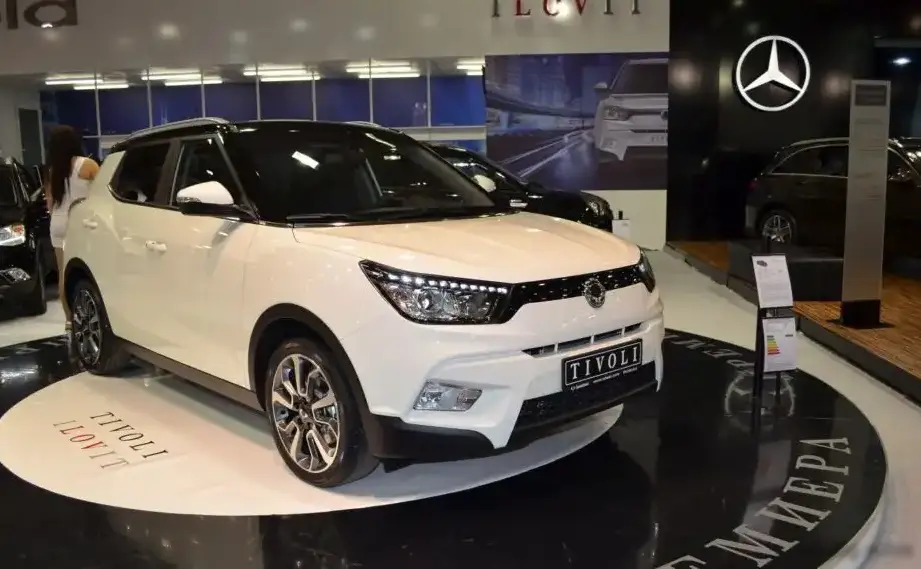
The SsangYong Tivoli (facelift, introduced in October 2019) 1.5 T-GDi, equipped with the AISIN six-speed automatic transmission, represents a significant step forward in the South Korean automaker’s compact SUV offerings. Positioned as a mid-range trim within the Tivoli lineup, this variant aimed to balance performance, fuel efficiency, and comfort for buyers seeking a practical and well-equipped crossover. The facelift brought updated styling, improved interior materials, and enhanced safety features to the already popular Tivoli, solidifying its position in the competitive European and Asian markets. While SsangYong (now KG Mobility) has historically had a smaller presence in the North American market, the Tivoli’s specifications and features are representative of the growing trend towards smaller, turbocharged SUVs globally.
Technical Specifications
| Brand | SsangYong |
| Model | Tivoli |
| Generation | Tivoli (facelift 2019) |
| Type (Engine) | 1.5 T-GDi (163 Hp) AISIN |
| Start of production | October, 2019 |
| End of production | 2023 |
| Powertrain Architecture | Internal Combustion engine |
| Body type | SUV, Crossover |
| Seats | 5 |
| Doors | 5 |
| Fuel consumption at Low speed (WLTP) | 10 l/100 km (23.5 US mpg, 28.2 UK mpg, 10 km/l) |
| Fuel consumption at Medium speed (WLTP) | 7.3 l/100 km (32.2 US mpg, 38.7 UK mpg, 13.7 km/l) |
| Fuel consumption at high speed (WLTP) | 6.6 l/100 km (35.6 US mpg, 42.8 UK mpg, 15.2 km/l) |
| Fuel consumption at very high speed (WLTP) | 8 l/100 km (29.4 US mpg, 35.3 UK mpg, 12.5 km/l) |
| Combined fuel consumption (WLTP) | 7.7 l/100 km (30.5 US mpg, 36.7 UK mpg, 13 km/l) |
| CO2 emissions (WLTP) | 175 g/km |
| Fuel Type | Petrol (Gasoline) |
| Maximum speed | 174 km/h (108.12 mph) |
| Emission standard | Euro 6d |
| Weight-to-power ratio | 8.2 kg/Hp, 122.1 Hp/tonne |
| Weight-to-torque ratio | 5.1 kg/Nm, 194.8 Nm/tonne |
| Power | 163 Hp @ 5500 rpm |
| Power per litre | 108.9 Hp/l |
| Torque | 260 Nm @ 1500-4000 rpm (191.77 lb.-ft. @ 1500-4000 rpm) |
| Engine layout | Front, Transverse |
| Engine Model/Code | G15DTF |
| Engine displacement | 1497 cm3 (91.35 cu. in.) |
| Number of cylinders | 4 |
| Engine configuration | Inline |
| Cylinder Bore | 76 mm (2.99 in.) |
| Piston Stroke | 82.5 mm (3.25 in.) |
| Compression ratio | 9.5:1 |
| Number of valves per cylinder | 4 |
| Fuel injection system | Direct injection |
| Engine aspiration | Turbocharger, Intercooler |
| Engine oil capacity | 4.5 l (4.76 US qt | 3.96 UK qt) |
| Coolant | 7 l (7.4 US qt | 6.16 UK qt) |
| Kerb Weight | 1335-1422 kg (2943.17 – 3134.97 lbs.) |
| Max. weight | 1880 kg (4144.69 lbs.) |
| Max load | 458-545 kg (1009.72 – 1201.52 lbs.) |
| Trunk (boot) space – minimum | 311 l (10.98 cu. ft.) |
| Trunk (boot) space – maximum | 1002 l (35.39 cu. ft.) |
| Fuel tank capacity | 50 l (13.21 US gal | 11 UK gal) |
| Permitted trailer load with brakes (12%) | 1000 kg (2204.62 lbs.) |
| Permitted trailer load without brakes | 500 kg (1102.31 lbs.) |
| Permitted towbar download | 60 kg (132.28 lbs.) |
| Length | 4225 mm (166.34 in.) |
| Width | 1810 mm (71.26 in.) |
| Height | 1621 mm (63.82 in.) |
| Wheelbase | 2600 mm (102.36 in.) |
| Front track | 1555 mm (61.22 in.) |
| Rear (Back) track | 1555 mm (61.22 in.) |
| Front overhang | 880 mm (34.65 in.) |
| Rear overhang | 745 mm (29.33 in.) |
| Ride height (ground clearance) | 178 mm (7.01 in.) |
| Minimum turning circle (turning diameter) | 10.6 m (34.78 ft.) |
| Approach angle | 17.5° |
| Departure angle | 27.5° |
| Ramp-over (brakeover) angle | 17° |
| Drivetrain Architecture | The Internal combustion engine (ICE) drives the front wheels of the vehicle. |
| Drive wheel | Front wheel drive |
| Number of gears and type of gearbox | 6 gears, automatic transmission AISIN |
| Front suspension | Independent type McPherson |
| Rear suspension | Torsion |
| Front brakes | Ventilated discs |
| Rear brakes | Disc |
| Assisting systems | ABS (Anti-lock braking system) |
| Steering type | Steering rack and pinion |
| Power steering | Electric Steering |
| Tires size | 215/50 R18 |
| Wheel rims size | 18 |
INTRODUCTION
The SsangYong Tivoli facelift, launched in 2019, represented a significant refresh of the original Tivoli, which debuted in 2015. Built on the SsangYong X100 platform (also known as the 1HX0/A3 platform shared with the Mahindra XUV300), the Tivoli aimed to compete in the increasingly popular subcompact SUV segment. The 1.5 T-GDi variant, paired with the AISIN six-speed automatic, was introduced as a compelling option for buyers prioritizing a balance of performance and convenience. This configuration offered a noticeable upgrade over the base 1.6-liter naturally aspirated engine, providing more responsive acceleration and improved highway cruising ability. The Tivoli, in general, was designed to appeal to younger buyers and families seeking a stylish, practical, and affordable vehicle.
Powertrain & Engine Architecture
The heart of the Tivoli 1.5 T-GDi is the G15DTF engine, a 1.5-liter turbocharged inline-four cylinder gasoline engine. This engine utilizes direct fuel injection, a technology that improves fuel efficiency and power output by injecting fuel directly into the combustion chamber. The turbocharger, coupled with an intercooler, forces more air into the engine, boosting horsepower and torque. The engine produces 163 horsepower at 5500 rpm and 260 Nm (191.77 lb.-ft.) of torque between 1500 and 4000 rpm. This broad torque curve provides good responsiveness in everyday driving situations. The engine’s architecture features a single overhead camshaft (SOHC) valvetrain with four valves per cylinder. The AISIN six-speed automatic transmission is a crucial component of this variant, known for its smooth shifting and reliability. It’s a conventional torque converter automatic, offering a balance between efficiency and driving comfort. The transmission is programmed to prioritize fuel economy while still providing adequate performance when needed.
Driving Characteristics
The Tivoli 1.5 T-GDi with the AISIN automatic delivers a noticeably more engaging driving experience compared to the base engine. The turbocharger provides a surge of power during acceleration, making overtaking and merging onto highways easier. While not a sports SUV, the 1.5 T-GDi offers sufficient power for most driving scenarios. The automatic transmission shifts smoothly and predictably, although it may occasionally hesitate during quick downshifts. The gear ratios are tuned for fuel efficiency, which means the engine may rev slightly higher at highway speeds. Compared to a manual transmission version (if available in certain markets), the automatic offers greater convenience, especially in urban traffic. However, it does slightly diminish driver engagement and potentially reduce fuel economy by a small margin.
Equipment & Trim Levels
The 1.5 T-GDi variant typically came equipped with a generous amount of standard features. These often included air conditioning, power windows and locks, a touchscreen infotainment system with Apple CarPlay and Android Auto compatibility, Bluetooth connectivity, and a rearview camera. Higher trim levels added features such as leather upholstery, heated front seats, a sunroof, automatic climate control, and advanced driver-assistance systems (ADAS) like lane departure warning and automatic emergency braking. Interior upholstery was typically cloth on lower trims, with leather options available on higher-spec models. The dashboard layout was generally functional and well-designed, with a focus on ease of use.
Chassis & Braking
The Tivoli utilizes a front-wheel-drive layout with an independent McPherson strut suspension in the front and a torsion beam suspension in the rear. This suspension setup provides a comfortable ride quality, absorbing bumps and imperfections in the road reasonably well. The front brakes are ventilated discs, providing good stopping power, while the rear brakes are solid discs. The steering is electrically assisted, offering light and precise control. Stabilizer bars are fitted to both the front and rear axles to reduce body roll during cornering. The chassis is designed to provide a balance between handling and ride comfort, prioritizing stability and predictability over sporty dynamics.
Market Reception & Comparison
The SsangYong Tivoli 1.5 T-GDi received generally positive reviews from automotive critics. It was praised for its stylish design, spacious interior, and well-equipped features list. The 1.5 T-GDi engine was considered a significant improvement over the base engine, providing adequate power and responsiveness. Fuel economy was generally competitive within the subcompact SUV segment. Compared to other trims in the Tivoli lineup, the 1.5 T-GDi offered a more refined driving experience and better performance. However, it came at a higher price point. Compared to rivals like the Kia Seltos, Hyundai Kona, and Nissan Juke, the Tivoli offered a unique blend of Korean design and value.
Legacy
The SsangYong Tivoli 1.5 T-GDi, while not a high-volume seller in all markets, established itself as a credible contender in the subcompact SUV segment. The G15DTF engine and AISIN automatic transmission proved to be relatively reliable, with few widespread issues reported. On the used car market, these models are generally well-regarded for their practicality, affordability, and decent fuel economy. As SsangYong transitioned to KG Mobility, the Tivoli continues to evolve, building on the foundation laid by the 2019 facelift and the capable 1.5 T-GDi powertrain.