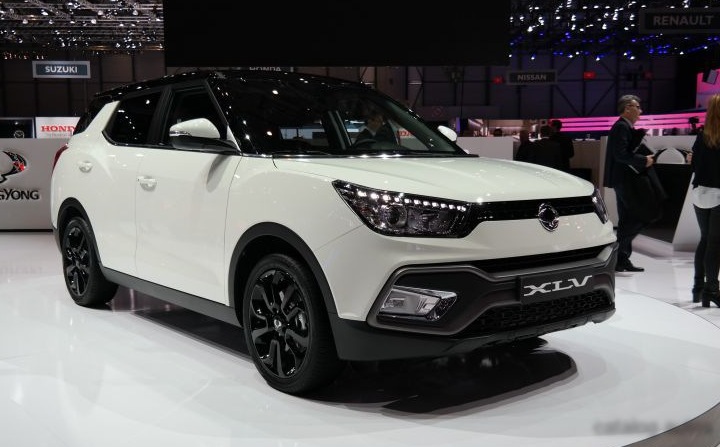
The SsangYong XLV 1.6 (115 hp) Automatic, produced between 2016 and 2021, represents a key variant within the XLV model range. The XLV, an acronym for “Exciting Lifestyle Vehicle,” was SsangYong’s attempt to capitalize on the growing popularity of compact crossover SUVs. Positioned as a practical and value-oriented option, the 1.6-liter diesel automatic model aimed to provide a balance between fuel efficiency, usability, and affordability within the European and Asian markets, though it saw limited presence in North America. It was built on the SsangYong XIV-Air concept and shared its platform with the SsangYong Tivoli, offering a slightly larger cargo capacity and a more utilitarian focus.
Technical Specifications
| Brand | SsangYong |
| Model | XLV |
| Generation | XLV |
| Type (Engine) | 1.6 (115 Hp) Automatic |
| Start of production | 2016 year |
| End of production | 2021 year |
| Powertrain Architecture | Internal Combustion engine |
| Body type | SUV, Crossover |
| Seats | 5 |
| Doors | 5 |
| Fuel consumption (economy) – urban | 7.5 l/100 km (31.4 US mpg, 37.7 UK mpg, 13.3 km/l) |
| Fuel consumption (economy) – extra urban | 4.9 l/100 km (48 US mpg, 57.6 UK mpg, 20.4 km/l) |
| Fuel consumption (economy) – combined | 5.9 l/100 km (39.9 US mpg, 47.9 UK mpg, 16.9 km/l) |
| CO2 emissions | 154 g/km |
| Fuel Type | Diesel |
| Maximum speed | 174 km/h (108.12 mph) |
| Emission standard | Euro 6 |
| Weight-to-power ratio | 12.4 kg/Hp, 80.7 Hp/tonne |
| Weight-to-torque ratio | 4.8 kg/Nm, 210.5 Nm/tonne |
| Power | 115 Hp @ 3400-4000 rpm |
| Power per litre | 72 Hp/l |
| Torque | 300 Nm @ 1500-2500 rpm (221.27 lb.-ft. @ 1500-2500 rpm) |
| Engine layout | Front, Transverse |
| Engine Model/Code | D16DTF |
| Engine displacement | 1597 cm3 (97.45 cu. in.) |
| Number of cylinders | 4 |
| Engine configuration | Inline |
| Cylinder Bore | 76 mm (2.99 in.) |
| Piston Stroke | 88 mm (3.46 in.) |
| Compression ratio | 15.5:1 |
| Number of valves per cylinder | 4 |
| Fuel injection system | Diesel Commonrail |
| Engine aspiration | Turbocharger, Intercooler |
| Engine oil capacity | 5 l (5.28 US qt | 4.4 UK qt) |
| Coolant | 7.5 l (7.93 US qt | 6.6 UK qt) |
| Kerb Weight | 1425 kg (3141.59 lbs.) |
| Max. weight | 1970 kg (4343.11 lbs.) |
| Max load | 545 kg (1201.52 lbs.) |
| Trunk (boot) space – minimum | 720 l (25.43 cu. ft.) |
| Trunk (boot) space – maximum | 1440 l (50.85 cu. ft.) |
| Fuel tank capacity | 47 l (12.42 US gal | 10.34 UK gal) |
| Permitted trailer load with brakes (12%) | 1500 kg (3306.93 lbs.) |
| Permitted trailer load without brakes | 500 kg (1102.31 lbs.) |
| Length | 4440 mm (174.8 in.) |
| Width | 1798 mm (70.79 in.) |
| Height | 1605 mm (63.19 in.) |
| Wheelbase | 2600 mm (102.36 in.) |
| Front track | 1555 mm (61.22 in.) |
| Rear (Back) track | 1555 mm (61.22 in.) |
| Ride height (ground clearance) | 167 mm (6.57 in.) |
| Approach angle | 20° |
| Departure angle | 21° |
| Drivetrain Architecture | The Internal combustion engine (ICE) drives the front wheels of the vehicle. |
| Drive wheel | Front wheel drive |
| Number of gears and type of gearbox | 6 gears, automatic transmission |
| Front suspension | Independent, type McPherson with coil spring and anti-roll bar |
| Rear suspension | independent torsion suspension |
| Front brakes | Ventilated discs |
| Rear brakes | Disc |
| Assisting systems | ABS (Anti-lock braking system) |
| Steering type | Steering rack and pinion |
| Power steering | Electric Steering |
| Tires size | 205/60 R16; 215/45 R18 |
| Wheel rims size | 16; 18 |
Powertrain & Engine Architecture
The XLV 1.6 Automatic is powered by the D16DTF engine, a 1.6-liter inline-four cylinder diesel engine. This engine is part of SsangYong’s family of diesel engines, and utilizes a common-rail direct injection system for optimized fuel delivery and combustion. The D16DTF features a turbocharger with an intercooler, which helps to boost power output and improve torque across a wider rev range. The engine’s 15.5:1 compression ratio is typical for a diesel engine, contributing to its efficiency. The engine is transversely mounted in the front of the vehicle. The six-speed automatic transmission, sourced from AISIN, was chosen for its smooth operation and contribution to fuel economy. This transmission features adaptive shift logic, adjusting gear changes based on driving conditions and driver input.
Driving Characteristics
The 115 hp output and 300 Nm (221 lb-ft) of torque provide adequate, but not exhilarating, performance. Acceleration is best described as steady, with a 0-60 mph time estimated around 11-12 seconds. The automatic transmission is tuned for economy, meaning it will upshift quickly to maintain lower engine speeds. This results in a comfortable driving experience for everyday commuting, but can feel somewhat sluggish when overtaking or climbing hills. Compared to the more powerful petrol versions of the XLV, or even the higher-output diesel variants, the 1.6 Automatic prioritizes fuel efficiency over outright performance. The gear ratios are optimized for cruising, making it a suitable vehicle for long highway journeys.
Equipment & Trim Levels
The XLV 1.6 Automatic typically came with a reasonable level of standard equipment. This included air conditioning, power windows, central locking, a basic audio system with USB connectivity, and alloy wheels. Safety features such as ABS, Electronic Stability Control (ESC), and multiple airbags were also standard. Higher trim levels offered options like leather upholstery, a touchscreen infotainment system with navigation, rear parking sensors, and a sunroof. Interior materials were generally durable and practical, reflecting the vehicle’s value-oriented positioning.
Chassis & Braking
The XLV utilizes a McPherson strut front suspension and a torsion beam rear suspension. This setup provides a comfortable ride quality, absorbing bumps and imperfections in the road surface effectively. The front brakes are ventilated discs, while the rear brakes are solid discs, providing adequate stopping power for the vehicle’s weight and performance. Electric power steering offers light and easy steering, making it maneuverable in urban environments. The relatively modest power output and weight of the 1.6 Automatic variant meant that the standard braking system was generally sufficient for most driving conditions.
Market Reception & Comparison
The SsangYong XLV 1.6 Automatic was generally well-received as a practical and affordable crossover SUV. Critics praised its spacious interior, generous boot space, and competitive fuel economy. However, some reviewers noted that the engine lacked refinement and could be noisy under acceleration. Compared to rivals like the Nissan Juke or Renault Captur, the XLV offered more interior space but lacked the brand recognition and sophisticated styling of its competitors. The 1.6 diesel automatic offered a good balance between fuel economy and usability, making it a popular choice for those seeking a practical and economical family vehicle.
Legacy
The SsangYong XLV, while not a massive sales success, established SsangYong as a contender in the competitive crossover SUV segment. The D16DTF engine, while not without its quirks, proved to be relatively reliable when properly maintained. On the used car market, the XLV 1.6 Automatic represents a good value proposition for buyers seeking an affordable and practical crossover. Common issues reported include occasional turbocharger problems and potential issues with the diesel particulate filter (DPF), particularly on vehicles that have primarily been used for short journeys. However, with regular servicing and preventative maintenance, these vehicles can provide years of reliable service.