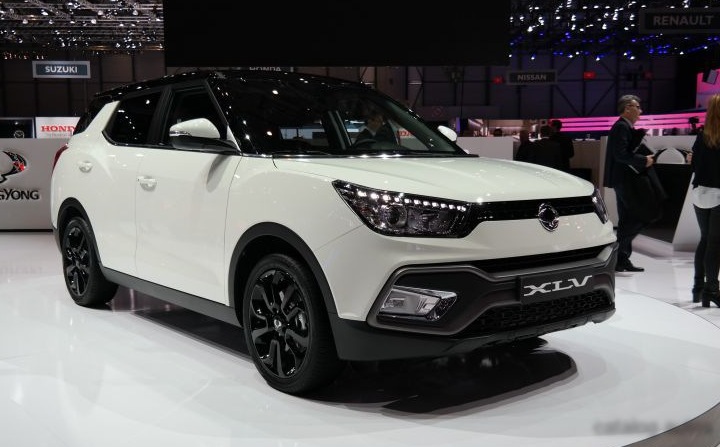
The SsangYong XLV 1.6, produced from 2016 to 2021, represents a significant offering in the compact crossover SUV segment from the South Korean automaker. Positioned as a practical and spacious vehicle, the XLV (Expanding Leisure Vehicle) aimed to provide family-friendly transportation with a focus on value. This particular variant, equipped with the 1.6-liter gasoline engine producing 128 horsepower, served as a core model within the XLV lineup, offering a balance between affordability and acceptable performance. It was primarily marketed towards buyers seeking a versatile vehicle for daily commuting and weekend trips, particularly in markets where SsangYong had a presence, including Europe and select regions in Asia. The XLV is based on the SsangYong XIV concepts and shares its platform with the SsangYong Tivoli, but with an extended body for increased cargo capacity.
Technical Specifications
| Brand | SsangYong |
| Model | XLV |
| Generation | XLV |
| Type (Engine) | 1.6 (128 Hp) |
| Start of production | 2016 year |
| End of production | 2021 year |
| Powertrain Architecture | Internal Combustion engine |
| Body type | SUV, Crossover |
| Seats | 5 |
| Doors | 5 |
| Fuel consumption (economy) – urban | 9.5 l/100 km (24.8 US mpg) |
| Fuel consumption (economy) – extra urban | 5.6 l/100 km (42 US mpg) |
| Fuel consumption (economy) – combined | 7.1 l/100 km (33.1 US mpg) |
| CO2 emissions | 165 g/km |
| Fuel Type | Petrol (Gasoline) |
| Maximum speed | 178 km/h (110.6 mph) |
| Emission standard | Euro 6 |
| Weight-to-power ratio | 10.3 kg/Hp |
| Weight-to-torque ratio | 8.2 kg/Nm |
| Power | 128 Hp @ 6000 rpm |
| Torque | 160 Nm @ 4600 rpm (118.01 lb.-ft. @ 4600 rpm) |
| Engine layout | Front, Transverse |
| Engine Model/Code | G16DF |
| Engine displacement | 1597 cm3 (97.45 cu. in.) |
| Number of cylinders | 4 |
| Engine configuration | Inline |
| Cylinder Bore | 76 mm (2.99 in.) |
| Piston Stroke | 88 mm (3.46 in.) |
| Compression ratio | 10.5:1 |
| Number of valves per cylinder | 4 |
| Fuel injection system | Multi-port manifold injection |
| Engine aspiration | Naturally aspirated engine |
| Engine oil capacity | 4 l (4.23 US qt | 3.52 UK qt) |
| Coolant | 6.5 l (6.87 US qt | 5.72 UK qt) |
| Kerb Weight | 1315 kg (2899.08 lbs.) |
| Max. weight | 1870 kg (4122.64 lbs.) |
| Max load | 555 kg (1223.57 lbs.) |
| Trunk (boot) space – minimum | 720 l (25.43 cu. ft.) |
| Trunk (boot) space – maximum | 1440 l (50.85 cu. ft.) |
| Fuel tank capacity | 47 l (12.42 US gal | 10.34 UK gal) |
| Permitted trailer load with brakes (12%) | 1000 kg (2204.62 lbs.) |
| Permitted trailer load without brakes | 500 kg (1102.31 lbs.) |
| Length | 4440 mm (174.8 in.) |
| Width | 1798 mm (70.79 in.) |
| Height | 1605 mm (63.19 in.) |
| Wheelbase | 2600 mm (102.36 in.) |
| Front track | 1555 mm (61.22 in.) |
| Rear (Back) track | 1555 mm (61.22 in.) |
| Ride height (ground clearance) | 167 mm (6.57 in.) |
| Approach angle | 20° |
| Departure angle | 21° |
| Drivetrain Architecture | The Internal combustion engine (ICE) drives the front wheels of the vehicle. |
| Drive wheel | Front wheel drive |
| Number of gears and type of gearbox | 6 gears, manual transmission |
| Front suspension | Independent, type McPherson with coil spring and anti-roll bar |
| Rear suspension | independent torsion suspension |
| Front brakes | Ventilated discs |
| Rear brakes | Disc |
| Assisting systems | ABS (Anti-lock braking system) |
| Steering type | Steering rack and pinion |
| Power steering | Electric Steering |
| Tires size | 205/60 R16; 215/45 R18 |
| Wheel rims size | 16; 18 |
Powertrain & Engine Architecture
The XLV 1.6 utilizes SsangYong’s G16DF engine, a 1.6-liter inline-four cylinder gasoline engine. This engine is a naturally aspirated unit employing multi-point fuel injection. The G16DF features a double overhead camshaft (DOHC) valvetrain with four valves per cylinder, contributing to its relatively efficient operation. The engine produces 128 horsepower at 6000 rpm and 160 Nm (118 lb-ft) of torque at 4600 rpm. The engine is transversely mounted in the front of the vehicle. The 6-speed manual transmission was standard on this variant, providing a direct connection between the engine and the front wheels. The transmission’s gear ratios are tuned for a balance of fuel efficiency and everyday drivability, rather than outright performance.
Driving Characteristics
The XLV 1.6 with the manual transmission offers adequate, but not exhilarating, performance. Acceleration is best described as moderate, with a 0-60 mph time estimated around 11-12 seconds. The engine feels somewhat strained when pushed hard, particularly when fully loaded or climbing hills. The manual gearbox provides drivers with more control over the engine’s power band, allowing for better utilization of the available torque. Compared to potential higher-output engine options (which weren’t widely available on the XLV), this 1.6L variant prioritizes fuel economy and affordability over sporty driving dynamics. The steering is light and easy to use, making it well-suited for urban driving, but lacks significant feedback.
Equipment & Trim Levels
The XLV 1.6 typically came with a reasonable level of standard equipment. Base models included air conditioning, power windows, central locking, and a basic audio system. Higher trim levels, often denoted by suffixes, added features such as alloy wheels, a touchscreen infotainment system with Bluetooth connectivity, rear parking sensors, and a leather-wrapped steering wheel. Safety features included ABS, electronic stability control, and multiple airbags. Interior upholstery was typically cloth, with options for leather in higher trims. The dashboard layout is functional and straightforward, prioritizing usability over aesthetic flair.
Chassis & Braking
The XLV utilizes a McPherson strut front suspension and a torsion beam rear suspension. This setup provides a comfortable ride quality, absorbing bumps and imperfections in the road surface effectively. The front brakes are ventilated discs, while the rear brakes are solid discs, providing adequate stopping power for the vehicle’s weight and performance. Electric power steering is standard, offering light and easy steering feel. The XLV’s suspension is tuned for comfort rather than sporty handling, resulting in some body roll during cornering.
Market Reception & Comparison
The SsangYong XLV 1.6 was generally well-received as a practical and affordable crossover SUV. Critics praised its spacious interior and generous cargo capacity, particularly compared to some of its competitors. However, the engine was often criticized for being underpowered, especially when the vehicle was fully loaded. Fuel economy was considered average for its class. Compared to other compact crossovers available at the time, the XLV offered a compelling value proposition, but its brand recognition was lower than established competitors like the Nissan Qashqai or Kia Sportage.
Legacy
The SsangYong XLV, while not a massive sales success, established SsangYong as a contender in the competitive crossover SUV market. The 1.6-liter engine, while not known for exceptional performance, proved to be reasonably reliable in real-world use. On the used car market, XLV 1.6 models are often available at attractive prices, making them a budget-friendly option for buyers seeking a spacious and practical vehicle. Long-term reliability reports suggest that the powertrain is generally durable, although regular maintenance is crucial to prevent issues. The XLV’s extended cargo area remains a key selling point for those needing extra space.