
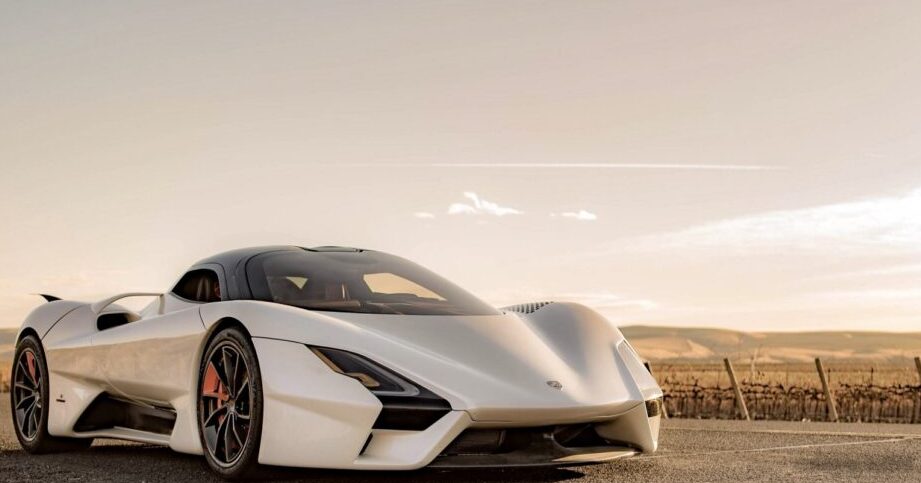
The SSC Tuatara, introduced in 2019, represents an ambitious effort by Shelby SuperCars (SSC) to challenge established hypercar manufacturers. The 5.9 V8 variant, available with either 1350 or 1750 horsepower depending on fuel type, is the core of the Tuatara’s performance proposition. Positioned as a direct competitor to vehicles like the Bugatti Chiron and Koenigsegg Jesko, the Tuatara aimed to redefine top speed capabilities and offer a uniquely American approach to hypercar design and engineering. Production continues, with ongoing development and refinement of the model.
Technical Specifications
| Brand | SSC |
| Model | Tuatara |
| Generation | Tuatara |
| Type (Engine) | 5.9 V8 (1350/1750 Hp) Flex Fuel Automatic |
| Start of production | 2019 |
| Powertrain Architecture | Internal Combustion engine |
| Body type | Coupe |
| Seats | 2 |
| Doors | 2 |
| Fuel Type | Petrol / Ethanol – E85 |
| Maximum speed | 460 km/h (285.83 mph) |
| Weight-to-power ratio | 0.9 kg/Hp, 1082.6 Hp/tonne |
| Power | 1350 Hp |
| Power per litre | 225.1 Hp/l |
| Power (Ethanol – E85) | 1750 Hp |
| Power per litre (Ethanol – E85) | 291.8 Hp/l |
| Maximum engine speed | 8800 rpm |
| Engine layout | Middle, Longitudinal |
| Engine displacement | 5998 cm3 (366.02 cu. in.) |
| Number of cylinders | 8 |
| Engine configuration | V-engine |
| Compression ratio | 8.8:1 |
| Fuel injection system | Direct injection and Multi-port manifold injection |
| Engine aspiration | Twin-Turbo, Intercooler |
| Kerb Weight | 1247 kg (2749.16 lbs) |
| Length | 4430 mm (174.41 in) |
| Width | 1991 mm (78.39 in) |
| Height | 1092 mm (42.99 in) |
| Wheelbase | 2672 mm (105.2 in) |
| Ride height (ground clearance) | 70-102 mm (2.76 – 4.02 in) |
| Drag coefficient (Cd) | 0.279-0.335 |
| Drivetrain Architecture | The Internal combustion engine (ICE) drives the rear wheels of the vehicle. |
| Drive wheel | Rear wheel drive |
| Number of gears and type of gearbox | 7 gears, automatic transmission |
| Front suspension | Double wishbone |
| Rear suspension | Double wishbone |
| Front brakes | Ventilated discs, 394 mm |
| Rear brakes | Ventilated discs, 381 mm |
| Assisting systems | ABS (Anti-lock braking system) |
| Steering type | Steering rack and pinion |
| Power steering | Electric Steering |
| Tires size | Front wheel tires: 245/35 YR20 Rear wheel tires: 345/30 YR20 |
| Wheel rims size | Front wheel rims: 20 Rear wheel rims: 20 |
Powertrain & Engine Architecture
The heart of the Tuatara is its 5.9-liter twin-turbocharged V8 engine. Developed in-house by SSC, the engine utilizes a relatively compact displacement to achieve extraordinary power figures. The engine block is constructed from aluminum, contributing to weight reduction. The key to its performance lies in the dual-ball bearing turbochargers, which minimize turbo lag and provide a broad powerband. The engine employs both direct injection and multi-port fuel injection, optimizing combustion efficiency and power output across the rev range. The 8.8:1 compression ratio is a compromise between maximizing power and ensuring reliability with the flex-fuel capability. The engine is capable of running on gasoline or E85 ethanol, with the latter unlocking the higher 1750 horsepower output. The 7-speed automated manual transmission, sourced from Hewland, is specifically designed to handle the immense torque produced by the engine. It features paddle shifters for driver control and is tuned for rapid gear changes.
Driving Characteristics
The Tuatara’s driving experience is dominated by its sheer acceleration. With over 1000 horsepower available even on gasoline, the car delivers breathtaking performance. The 7-speed transmission is geared for high-speed running, allowing the Tuatara to reach its claimed top speed of 285.83 mph (460 km/h). The automatic transmission, while quick-shifting, prioritizes smooth operation over aggressive, track-focused shifts. The rear-wheel-drive configuration demands respect from the driver, particularly when applying power at lower speeds. The relatively lightweight construction (1247 kg) contributes to agile handling, but the car’s immense power requires careful throttle control. Compared to other hypercars with dual-clutch transmissions, the Tuatara’s automated manual offers a slightly less refined, but arguably more engaging, driving experience.
Equipment & Trim Levels
The SSC Tuatara is positioned as a highly exclusive, bespoke hypercar, and as such, trim levels are less defined than in mass-produced vehicles. The interior is focused on providing a driver-centric experience, with extensive use of carbon fiber and premium leather. Standard features include a digital instrument cluster, a touchscreen infotainment system, and air conditioning. Customers have a high degree of customization available, allowing them to specify interior colors, materials, and finishes to their exact preferences. Optional extras include a premium audio system, advanced telemetry data logging, and unique exterior paint schemes. The emphasis is on creating a personalized and luxurious environment befitting a hypercar of this caliber.
Chassis & Braking
The Tuatara utilizes a carbon fiber monocoque chassis, providing exceptional rigidity and minimizing weight. The suspension system employs double wishbones at both the front and rear, with adjustable dampers and springs. This allows for fine-tuning of the suspension to optimize handling for different driving conditions. Braking is provided by ventilated discs at all four corners, measuring 394 mm at the front and 381 mm at the rear. The braking system is equipped with ABS to enhance stability during hard braking. The car’s aerodynamic profile is crucial to its high-speed performance, with an adjustable rear wing and active aerodynamic elements designed to reduce drag and increase downforce.
Market Reception & Comparison
The SSC Tuatara generated significant attention upon its unveiling, largely due to its ambitious top speed claims. Initial attempts to validate these claims were met with controversy, leading to further testing and refinement. Critics have praised the Tuatara’s bold design, powerful engine, and impressive performance. However, some have questioned the car’s overall refinement and the complexity of its systems. Compared to the Bugatti Chiron, the Tuatara offers a more raw and visceral driving experience, with a greater emphasis on driver involvement. Against the Koenigsegg Jesko, the Tuatara presents a different approach to hypercar engineering, prioritizing top speed over ultimate track performance. Reliability data is still emerging, given the limited production numbers, but early reports suggest that the Tuatara requires meticulous maintenance due to its complex powertrain.
Legacy
The SSC Tuatara represents a significant achievement for SSC, demonstrating the company’s ability to compete with established hypercar manufacturers. While its top speed claims have been subject to debate, the Tuatara has undoubtedly pushed the boundaries of automotive performance. The car’s innovative engine design and lightweight construction have influenced other hypercar projects. On the used car market, the Tuatara is expected to hold its value well due to its exclusivity and performance potential. The long-term reliability of the powertrain remains to be seen, but SSC’s commitment to ongoing development and support suggests that the Tuatara will remain a desirable and collectible hypercar for years to come.
