
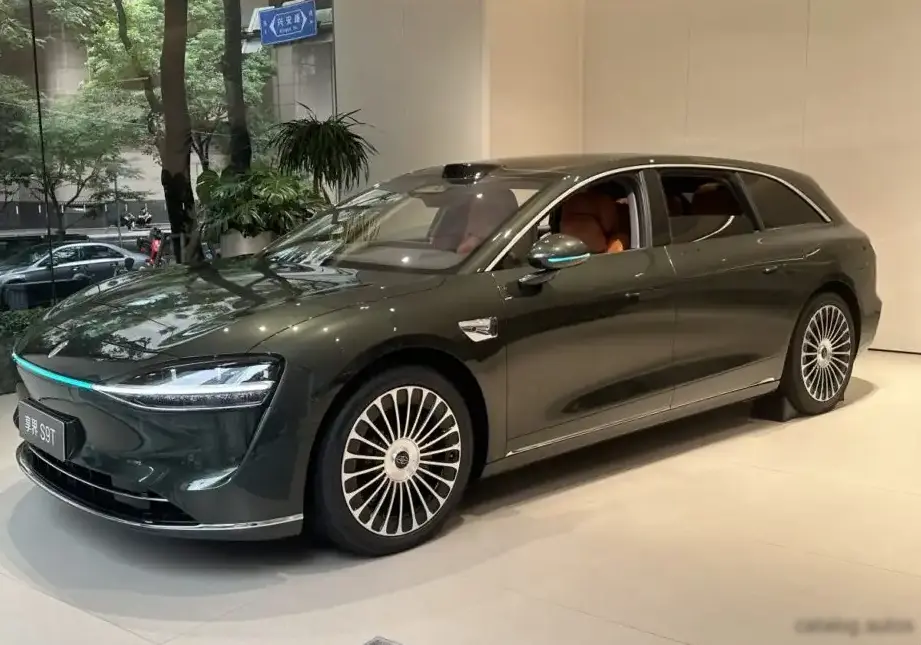
The Stelato S9T 1.5T 53.4 kWh (309 Hp) Extended Range Hybrid, launched in September 2025, represents a significant entry into the burgeoning plug-in hybrid electric vehicle (PHEV) market. Positioned as a premium station wagon (estate) within the Stelato S9 lineup, this variant aims to bridge the gap between electric efficiency and the range security offered by a gasoline engine. It’s designed for consumers seeking a versatile vehicle capable of daily commuting on electric power, with the flexibility for longer journeys without range anxiety. The S9T utilizes a unique powertrain architecture where the internal combustion engine solely functions as a generator for the electric drive system, a configuration increasingly common in modern PHEVs.
Technical Specifications
| Brand | Stelato |
| Model | S9 |
| Generation | S9T |
| Type (Engine) | 1.5T 53.4 kWh (309 Hp) Extended Range Hybrid |
| Start of production | September, 2025 |
| Powertrain Architecture | PHEV (Plug-in Hybrid Electric Vehicle) |
| Body type | Station wagon (estate) |
| Seats | 5 |
| Doors | 5 |
| Fuel consumption (economy) – combined (WLTC) | 0.33-6.23 l/100 km (712.8 – 37.8 US mpg, 856 – 45.3 UK mpg, 303 – 16.1 km/l) |
| Fuel Type | Petrol / electricity |
| Acceleration 0 – 100 km/h | 7.04 sec |
| Acceleration 0 – 62 mph | 7.04 sec |
| Acceleration 0 – 60 mph | 6.7 sec |
| Maximum speed | 202 km/h (125.52 mph) |
| Emission standard | China VI b |
| Weight-to-power ratio | 7.7 kg/Hp, 129.4 Hp/tonne |
| Weight-to-torque ratio | 7.5 kg/Nm, 134 Nm/tonne |
| Gross battery capacity | 53.4 kWh |
| Battery voltage | 400 V |
| Battery technology | Lithium nickel manganese cobalt oxides (Li-NMC) |
| All-electric range (CLTC) | 274-354 km (170.26 – 219.97 mi) |
| Average Energy consumption (CLTC) | 18.3 kWh/100 km (29.45 kWh/100 mi, 114 MPGe, 5.5 km/kWh, 3.4 mi/kWh) |
| Electric motor power | 309 Hp |
| Electric motor Torque | 320 Nm (236.02 lb.-ft.) |
| Electric motor model/code | TZ210XYAP4 |
| Electric motor location | Rear axle, Transverse |
| Electric motor type | Synchronous |
| System power | 309 Hp |
| System torque | 320 Nm (236.02 lb.-ft.) |
| Power | 160 Hp |
| Power per litre | 106.8 Hp/l |
| Engine layout | Front, Transverse |
| Engine Model/Code | A156T2H |
| Engine displacement | 1498 cm3 (91.41 cu. in.) |
| Number of cylinders | 4 |
| Engine configuration | Inline |
| Number of valves per cylinder | 4 |
| Fuel injection system | Direct injection |
| Engine aspiration | Turbocharger, Intercooler |
| Valvetrain | DOHC |
| Kerb Weight | 2388 kg (5264.64 lbs.) |
| Max. weight | 2793 kg (6157.51 lbs.) |
| Max load | 405 kg (892.87 lbs.) |
| Trunk (boot) space – minimum | 729 l (25.74 cu. ft.) |
| Trunk (boot) space – maximum | 1677 l (59.22 cu. ft.) |
| Fuel tank capacity | 52 l (13.74 US gal | 11.44 UK gal) |
| Length | 5160 mm (203.15 in.) |
| Width | 2005 mm (78.94 in.) |
| Height | 1492 mm (58.74 in.) |
| Wheelbase | 3050 mm (120.08 in.) |
| Front track | 1706 mm (67.17 in.) |
| Rear (Back) track | 1738 mm (68.43 in.) |
| Drag coefficient (Cd) | 0.23 |
| Approach angle | 13° |
| Departure angle | 15° |
| Drivetrain Architecture | The Internal combustion engine (ICE) drives the generator only, with no mechanical connection to the drive. An electric motor drives the rear wheels. |
| Drive wheel | Rear wheel drive |
| Number of gears and type of gearbox | 1 gears, automatic transmission |
| Front suspension | Double wishbone, Transverse stabilizer, Air suspension |
| Rear suspension | Independent multi-link suspension, Air suspension, Transverse stabilizer |
| Front brakes | Ventilated discs |
| Rear brakes | Ventilated discs |
| Assisting systems | ABS (Anti-lock braking system) |
| Steering type | Steering rack and pinion |
| Power steering | Electric Steering |
| Tires size | 245/45 R20; 255/45 R20; 255/40 R21 |
| Wheel rims size | 20; 21 |
Powertrain & Engine Architecture
The Stelato S9T’s powertrain is centered around a 1.5-liter turbocharged four-cylinder gasoline engine (code A156T2H) producing 160 horsepower. This engine, however, doesn’t directly power the wheels. Instead, it acts as a dedicated generator, charging the 53.4 kWh lithium nickel manganese cobalt oxide (Li-NMC) battery pack. The electric motor, located on the rear axle, delivers 309 horsepower and 320 Nm (236 lb-ft) of torque. This rear-wheel-drive configuration contributes to a balanced driving experience. The engine utilizes direct fuel injection and a double overhead camshaft (DOHC) valvetrain for efficient combustion. The single-speed automatic transmission is specifically designed for the electric motor, optimizing power delivery and efficiency. The system’s total combined output is rated at 309 horsepower and 320 Nm of torque.
Driving Characteristics
The S9T offers a distinct driving experience compared to traditional internal combustion vehicles. In electric mode, acceleration is brisk and linear, with the instant torque of the electric motor providing responsive performance. The 0-60 mph time of 6.7 seconds is respectable for a vehicle of this size and weight. When the gasoline engine engages to act as a generator, the transition is generally seamless, though a slight change in engine note is noticeable. The single-speed transmission provides smooth acceleration, but lacks the gear changes found in conventional automatics. The rear-wheel-drive layout contributes to a balanced feel, although it may require some adjustment for drivers accustomed to front-wheel-drive vehicles, particularly in slippery conditions. The air suspension, standard on this model, provides a comfortable ride, absorbing bumps and irregularities in the road surface effectively.
Equipment & Trim Levels
The S9T 1.5T 53.4 kWh trim typically includes a comprehensive suite of standard features. Interior appointments include premium cloth or leatherette upholstery, a modern dashboard layout with a large touchscreen infotainment system, and automatic climate control. Standard safety features include ABS, electronic stability control, and a suite of driver-assistance systems. Optional extras often include a panoramic sunroof, upgraded audio system, and advanced driver-assistance features such as adaptive cruise control and lane-keeping assist. The overall interior design emphasizes a minimalist aesthetic with high-quality materials.
Chassis & Braking
The S9T utilizes a double wishbone suspension setup at the front and an independent multi-link suspension at the rear, both incorporating air suspension for enhanced ride comfort and adjustability. Ventilated disc brakes are fitted on all four wheels, providing ample stopping power. The electronic stability control system works in conjunction with the ABS to maintain control during emergency braking maneuvers. The vehicle’s relatively high curb weight of 2388 kg (5264.64 lbs) necessitates a robust braking system to ensure confident deceleration.
Market Reception & Comparison
The Stelato S9T has been generally well-received by automotive critics, who praise its efficient powertrain, comfortable ride, and spacious interior. However, some reviewers have noted the relatively high price point compared to some competitors. Compared to other trims in the S9 lineup, the 1.5T Extended Range Hybrid offers a balance between performance and efficiency. The all-electric range of 274-354 km (170.26 – 219.97 mi) is competitive within the PHEV segment, and the fuel economy figures of 0.33-6.23 l/100 km (712.8 – 37.8 US mpg) are impressive. The reliance on the gasoline engine as a generator, rather than directly powering the wheels, is a key differentiator from some other PHEV designs.
Legacy
As a relatively new model, the long-term reliability of the Stelato S9T powertrain remains to be fully established. However, the use of proven technologies such as Li-NMC battery chemistry and a turbocharged gasoline engine suggests a reasonable expectation of durability. The unique powertrain architecture, with the engine solely dedicated to generating electricity, may potentially reduce wear and tear on the internal combustion component. In the used car market, the S9T is expected to hold its value well, particularly among buyers seeking a fuel-efficient and technologically advanced station wagon. The vehicle’s appeal will likely be strongest in regions with well-developed charging infrastructure and incentives for electric vehicle adoption.
