
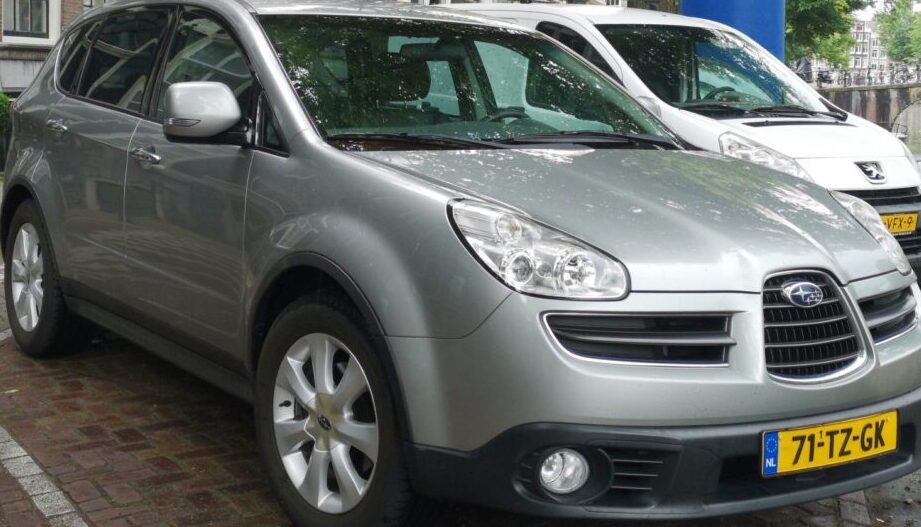
The Subaru B9 Tribeca 3.0i, equipped with the 250 horsepower engine and “SPORTSHIFT” automatic transmission, was a mid-size crossover SUV produced by Subaru from 2006 to 2007. It represented Subaru’s attempt to enter the growing luxury crossover market, offering a unique blend of Subaru’s renowned all-wheel-drive system with a more upscale interior and styling. The Tribeca was the first vehicle to utilize Subaru’s new “Global Platform,” and was marketed towards families seeking a safe, capable, and somewhat distinctive vehicle. It was sold primarily in North America, with limited sales in other markets.
Technical Specifications
| Brand | Subaru |
| Model | Tribeca |
| Generation | B9 Tribeca |
| Type | 3.0i (250 Hp) AWD SPORTSHIFT |
| Start of production | 2006 |
| End of production | 2007 |
| Powertrain Architecture | Internal Combustion engine |
| Body type | SUV |
| Seats | 5 |
| Doors | 5 |
| Fuel consumption (urban) | 17.1 l/100 km (13.8 US mpg, 16.5 UK mpg, 5.8 km/l) |
| Fuel consumption (extra urban) | 9.5 l/100 km (24.8 US mpg, 29.7 UK mpg, 10.5 km/l) |
| Fuel consumption (combined) | 12.3 l/100 km (19.1 US mpg, 23 UK mpg, 8.1 km/l) |
| CO2 emissions | 291 g/km |
| Fuel Type | Petrol (Gasoline) |
| Acceleration 0 – 100 km/h | 9.7 sec |
| Acceleration 0 – 62 mph | 9.7 sec |
| Acceleration 0 – 60 mph | 9.2 sec |
| Maximum speed | 195 km/h (121.17 mph) |
| Emission standard | Euro 4 |
| Weight-to-power ratio | 7.6 kg/Hp, 132.3 Hp/tonne |
| Weight-to-torque ratio | 6.4 kg/Nm, 157.1 Nm/tonne |
| Power | 250 Hp @ 6600 rpm |
| Power per litre | 83.4 Hp/l |
| Torque | 297 Nm @ 4200 rpm (219.06 lb.-ft. @ 4200 rpm) |
| Engine layout | Front, Longitudinal |
| Engine Model/Code | EZ30 |
| Engine displacement | 2999 cm3 (183.01 cu. in.) |
| Number of cylinders | 6 |
| Engine configuration | Boxer |
| Cylinder Bore | 89.2 mm (3.51 in.) |
| Piston Stroke | 80 mm (3.15 in.) |
| Compression ratio | 10.7:1 |
| Number of valves per cylinder | 4 |
| Fuel injection system | Multi-port manifold injection |
| Engine aspiration | Naturally aspirated engine |
| Valvetrain | DOHC |
| Engine oil capacity | 5.7 l (6.02 US qt | 5.02 UK qt) |
| Coolant | 7.2 l (7.61 US qt | 6.34 UK qt) |
| Kerb Weight | 1890-1915 kg (4166.74 – 4221.85 lbs.) |
| Max. weight | 2586 kg (5701.15 lbs.) |
| Max load | 671-696 kg (1479.3 – 1534.42 lbs.) |
| Trunk (boot) space – minimum | 450 l (15.89 cu. ft.) |
| Trunk (boot) space – maximum | 1671 l (59.01 cu. ft.) |
| Fuel tank capacity | 64 l (16.91 US gal | 14.08 UK gal) |
| Max. roof load | 80 kg (176.37 lbs.) |
| Permitted trailer load with brakes (8%) | 2000 kg (4409.25 lbs.) |
| Permitted trailer load with brakes (12%) | 2000 kg (4409.25 lbs.) |
| Permitted trailer load without brakes | 750 kg (1653.47 lbs.) |
| Length | 4855 mm (191.14 in.) |
| Width | 1880 mm (74.02 in.) |
| Height | 1675 mm (65.94 in.) |
| Wheelbase | 2750 mm (108.27 in.) |
| Front track | 1580 mm (62.2 in.) |
| Rear (Back) track | 1580 mm (62.2 in.) |
| Ride height (ground clearance) | 213 mm (8.39 in.) |
| Drag coefficient (Cd) | 0.38 |
| Minimum turning circle (turning diameter) | 11.4 m (37.4 ft.) |
| Approach angle | 18.0° |
| Departure angle | 21.1° |
| Ramp-over (brakeover) angle | 18.5° |
| Drivetrain Architecture | ICE drives all four wheels permanently |
| Drive wheel | All wheel drive (4×4) |
| Number of gears and type of gearbox | 5 gears, automatic transmission SPORTSHIFT |
| Front suspension | Independent coil spring |
| Rear suspension | Double wishbone |
| Front brakes | Ventilated discs, 312 mm |
| Rear brakes | Ventilated discs, 315 mm |
| Assisting systems | ABS (Anti-lock braking system) |
| Steering type | Steering rack and pinion |
| Power steering | Electric Steering |
| Tires size | 255/55 R18 |
| Wheel rims size | 8J x 18 |
Powertrain & Engine Architecture
The heart of the B9 Tribeca 3.0i is the EZ30 3.0-liter horizontally-opposed (boxer) six-cylinder engine. This engine was a key feature, offering a lower center of gravity compared to traditional inline or V-configured engines, contributing to improved handling. The EZ30 utilizes multi-port fuel injection and a double overhead camshaft (DOHC) valvetrain. The engine produces 250 horsepower at 6600 rpm and 297 Nm (219 lb-ft) of torque at 4200 rpm. The “SPORTSHIFT” transmission is a 5-speed automatic with simulated manual control, allowing drivers to select gears for more engaging driving. This transmission was designed to provide smoother shifts and better responsiveness than a conventional automatic.
Driving Characteristics
The 3.0i with the SPORTSHIFT automatic offered a reasonable balance of performance and fuel economy. Acceleration from 0-60 mph took approximately 9.2 seconds, which was adequate for everyday driving but not particularly sporty. The automatic transmission, while offering manual shift control, wasn’t known for its lightning-fast responsiveness. Compared to a manual transmission equipped Tribeca, the automatic felt slightly less engaging and delivered slightly lower fuel economy. The all-wheel-drive system provided excellent traction in various weather conditions, a hallmark of Subaru vehicles. The boxer engine’s low center of gravity helped to minimize body roll during cornering, contributing to a more stable feel.
Equipment & Trim Levels
The 3.0i trim was positioned as the premium offering in the Tribeca lineup. Standard features included automatic climate control, power windows and locks, a CD player with auxiliary input, and alloy wheels. Leather upholstery and a premium sound system were often included. Optional extras included a navigation system, sunroof, and heated front seats. The interior design aimed for a more luxurious feel than other Subaru models, with a focus on comfort and convenience.
Chassis & Braking
The B9 Tribeca utilized an independent coil spring suspension in the front and a double wishbone suspension in the rear. This setup aimed to provide a comfortable ride while maintaining good handling characteristics. The vehicle was equipped with ventilated disc brakes on all four wheels, providing adequate stopping power. Anti-lock braking system (ABS) was standard. The curb weight of the vehicle ranged from 1890 to 1915 kg (4166.74 – 4221.85 lbs), which impacted its overall agility.
Market Reception & Comparison
The Subaru B9 Tribeca received mixed reviews upon its release. Critics praised its standard all-wheel drive, spacious interior, and unique styling. However, the styling proved polarizing, and some reviewers found the engine performance to be underwhelming, especially with the automatic transmission. Fuel economy was also a concern, with the 3.0i achieving around 19.1 US mpg in combined driving. Compared to competitors like the Honda CR-V and Toyota RAV4, the Tribeca offered a more distinctive driving experience but lacked the same level of refinement and fuel efficiency.
Legacy
The Subaru B9 Tribeca was discontinued after only two model years due to slow sales and negative reception to its styling. While not a commercial success, the Tribeca represented Subaru’s ambition to expand into the luxury crossover segment. The EZ30 engine proved to be generally reliable, although regular maintenance is crucial. Today, used B9 Tribecas are relatively affordable, but potential buyers should be aware of the vehicle’s somewhat limited production run and potential for higher maintenance costs due to its unique components. The SPORTSHIFT automatic transmission, while offering a degree of driver control, is not known for its longevity and should be carefully inspected before purchase.
