
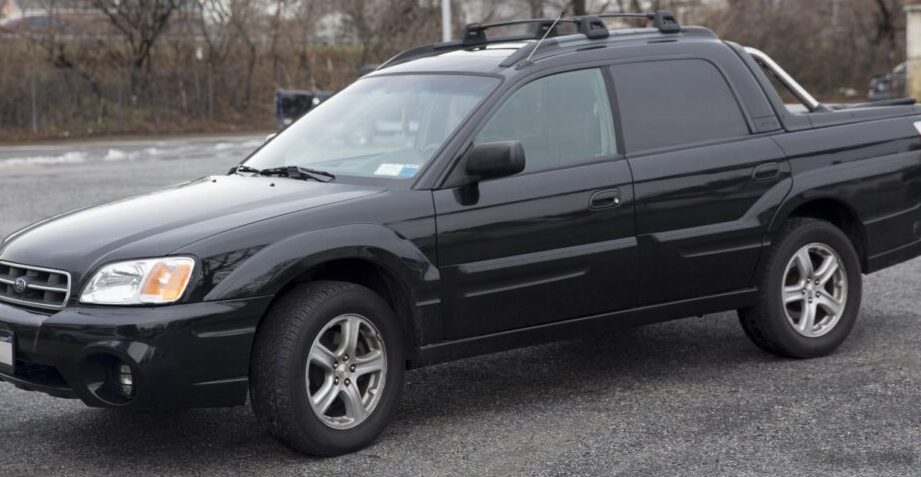
The Subaru Baja 2.5i 16V, produced from 2002 to 2006, represents a unique and somewhat controversial entry into the compact pickup truck segment. Built on the Subaru Legacy platform (designated as the BE/BH series), the Baja aimed to blend the practicality of a pickup with the comfort and handling characteristics of a passenger car. This particular variant, the 2.5i with a 2.5-liter naturally aspirated boxer engine paired with a four-speed automatic transmission and all-wheel drive, served as the mainstream offering within the Baja lineup, positioned between the base model and the more performance-oriented turbocharged XT trim. It was primarily marketed towards active lifestyle consumers in the United States, seeking a versatile vehicle capable of both daily commuting and light-duty hauling.
Technical Specifications
| Brand | Subaru |
| Model | Baja |
| Generation | Baja |
| Type (Engine) | 2.5 i 16V (165 Hp) 4WD Automatic |
| Start of production | 2002 year |
| End of production | 2006 year |
| Powertrain Architecture | Internal Combustion engine |
| Body type | Pick-up |
| Seats | 5 |
| Doors | 4 |
| Fuel consumption (economy) – combined | 10 l/100 km |
| Fuel consumption (economy) – combined | 23.5 US mpg |
| Fuel consumption (economy) – combined | 28.2 UK mpg |
| Fuel consumption (economy) – combined | 10 km/l |
| Fuel Type | Petrol (Gasoline) |
| Weight-to-power ratio | 9.6 kg/Hp |
| Weight-to-power ratio | 104.3 Hp/tonne |
| Weight-to-torque ratio | 7 kg/Nm |
| Weight-to-torque ratio | 142.2 Nm/tonne |
| Power | 165 Hp @ 5600 rpm |
| Power per litre | 67.2 Hp/l |
| Torque | 225 Nm @ 4000 rpm |
| Torque | 165.95 lb.-ft. @ 4000 rpm |
| Engine layout | Front, Longitudinal |
| Engine Model/Code | EJ25 |
| Engine displacement | 2457 cm3 |
| Engine displacement | 149.94 cu. in. |
| Number of cylinders | 4 |
| Engine configuration | Boxer |
| Cylinder Bore | 99.5 mm |
| Cylinder Bore | 3.92 in. |
| Piston Stroke | 79 mm |
| Piston Stroke | 3.11 in. |
| Compression ratio | 10:1 |
| Number of valves per cylinder | 4 |
| Fuel injection system | Multi-port manifold injection |
| Engine aspiration | Naturally aspirated engine |
| Valvetrain | DOHC |
| Engine oil capacity | 4 l |
| Engine oil capacity | 4.23 US qt |
| Engine oil capacity | 3.52 UK qt |
| Coolant | 6.7 l |
| Coolant | 7.08 US qt |
| Coolant | 5.9 UK qt |
| Kerb Weight | 1582 kg |
| Kerb Weight | 3487.71 lbs |
| Fuel tank capacity | 65 l |
| Fuel tank capacity | 17.17 US gal |
| Fuel tank capacity | 14.3 UK gal |
| Length | 4910 mm |
| Length | 193.31 in |
| Width | 1781 mm |
| Width | 70.12 in |
| Height | 1590 mm |
| Height | 62.6 in |
| Wheelbase | 2649 mm |
| Wheelbase | 104.29 in |
| Front track | 1470 mm |
| Front track | 57.87 in |
| Rear (Back) track | 1465 mm |
| Rear (Back) track | 57.68 in |
| Drive wheel | All wheel drive (4×4) |
| Number of gears and type of gearbox | 4 gears, automatic transmission |
| Front suspension | Coil spring |
| Rear suspension | Coil spring |
| Front brakes | Ventilated discs |
| Rear brakes | Disc |
| Assisting systems | ABS (Anti-lock braking system) |
| Steering type | Steering rack and pinion |
| Power steering | Hydraulic Steering |
| Tires size | 225/60 R16 |
Powertrain & Engine Architecture
The heart of the Baja 2.5i is the EJ251 engine, a 2.5-liter horizontally opposed (boxer) four-cylinder. This engine, a staple of Subaru’s lineup, is known for its relatively smooth operation and inherent balance due to the opposing piston design. The 2.5i variant utilizes a single overhead camshaft (SOHC) per cylinder bank, operating 16 valves in total. Fuel delivery is managed by a multi-point fuel injection system. The engine produces 165 horsepower at 5600 rpm and 166 lb-ft of torque at 4000 rpm. The four-speed automatic transmission, while reliable, is a somewhat dated design by modern standards. It features conventional hydraulic control and lacks the efficiency of more modern transmissions with more gears. The transmission is coupled with Subaru’s symmetrical all-wheel drive system, providing excellent traction in various conditions.
Driving Characteristics
The Baja 2.5i Automatic offers a comfortable and predictable driving experience. Acceleration is adequate for everyday driving, but not particularly brisk. The four-speed automatic transmission contributes to a relatively relaxed cruising experience, but can feel somewhat sluggish during quick acceleration or when attempting to pass on the highway. Compared to the turbocharged Baja XT, the 2.5i lacks the punch and responsiveness of the turbo engine. The automatic transmission also diminishes the driver engagement found in the five-speed manual version. The all-wheel drive system provides confident handling and stability, especially in inclement weather. The Baja’s suspension, tuned for comfort, absorbs bumps well, but can exhibit some body roll during cornering.
Equipment & Trim Levels
The Baja 2.5i typically came standard with features such as air conditioning, power windows and locks, a CD player, and cloth upholstery. Available options included a premium audio system, leather upholstery, a sunroof, and alloy wheels. The Baja’s interior, while functional, is relatively basic in terms of design and materials. The rear seats are foldable, increasing cargo space, and the bed features a unique swing-out tailgate design. The Baja offered a relatively high level of standard safety equipment for its time, including anti-lock brakes (ABS) and front airbags.
Chassis & Braking
The Baja utilizes a unibody construction, providing a good balance of strength and weight. The front suspension consists of MacPherson struts, while the rear features a double-wishbone setup. Both ends utilize coil springs and stabilizer bars. The braking system consists of ventilated discs at the front and solid discs at the rear. The ABS system helps to prevent wheel lockup during hard braking. The Baja’s relatively modest weight (around 3,488 lbs) helps to compensate for the engine’s limited power.
Market Reception & Comparison
The Subaru Baja received mixed reviews upon its release. Critics praised its versatility, all-wheel drive capability, and comfortable ride. However, many questioned its styling, which was considered unconventional and polarizing. Compared to other compact pickups of the time, such as the Ford Ranger or Chevrolet Colorado, the Baja offered a more refined and car-like driving experience. However, it lacked the towing capacity and ruggedness of traditional body-on-frame pickups. The 2.5i Automatic variant was often seen as a good value for buyers prioritizing comfort and fuel economy over outright performance. Fuel economy averaged around 23.5 mpg in combined driving.
Legacy
The Subaru Baja, despite its relatively short production run, has gained a cult following among Subaru enthusiasts. The 2.5i Automatic variant, while not the most sought-after version, remains a reliable and affordable option in the used car market. The EJ25 engine is known for its durability, although regular maintenance is crucial to prevent issues such as head gasket leaks. The four-speed automatic transmission, while not particularly efficient, is generally reliable if properly maintained. Today, the Baja is appreciated for its unique blend of practicality, versatility, and Subaru’s signature all-wheel drive system, making it a distinctive and appealing choice for those seeking an alternative to traditional pickup trucks.
