
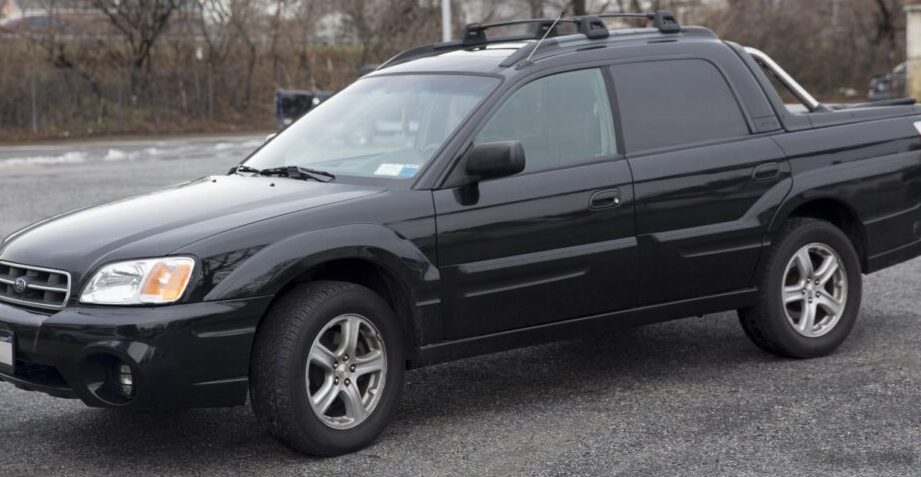
The Subaru Baja 2.5i 16V Turbo, produced from 2003 to 2006, represents a unique and somewhat controversial entry into the compact pickup truck market. Built on the Subaru Legacy platform (BL/BP), the Baja aimed to blend the practicality of a pickup with the comfort and handling characteristics of a passenger car. It was a distinctly American vehicle, designed to appeal to a lifestyle-oriented buyer seeking a versatile vehicle for both work and recreation. The 2.5i Turbo variant, equipped with the EJ255 engine, sat at the top of the Baja lineup, offering significantly more performance than the naturally aspirated 2.5i model. It was a niche vehicle, and production numbers reflect its limited appeal, but it has since gained a dedicated following among Subaru enthusiasts.
Technical Specifications
| Brand | Subaru |
| Model | Baja |
| Generation | Baja |
| Type (Engine) | 2.5 i 16V Turbo (210 Hp) 4WD |
| Start of production | 2003 |
| End of production | 2006 |
| Powertrain Architecture | Internal Combustion engine |
| Body type | Pick-up |
| Seats | 5 |
| Doors | 4 |
| Fuel Type | Petrol (Gasoline) |
| Power | 210 Hp @ 5600 rpm |
| Power per litre | 85.5 Hp/l |
| Torque | 235 Nm @ 3600 rpm / 173.33 lb.-ft. @ 3600 rpm |
| Engine layout | Front, Longitudinal |
| Engine Model/Code | EJ255 |
| Engine displacement | 2457 cm3 / 149.94 cu. in. |
| Number of cylinders | 4 |
| Engine configuration | Boxer |
| Cylinder Bore | 99.5 mm / 3.92 in. |
| Piston Stroke | 79 mm / 3.11 in. |
| Compression ratio | 8.2:1 |
| Number of valves per cylinder | 4 |
| Fuel injection system | Multi-port manifold injection |
| Engine aspiration | Turbocharger, Intercooler |
| Valvetrain | OHC |
| Engine oil capacity | 4 l / 4.23 US qt | 3.52 UK qt |
| Coolant | 7.7 l / 8.14 US qt | 6.78 UK qt |
| Fuel tank capacity | 65 l / 17.17 US gal | 14.3 UK gal |
| Length | 4910 mm / 193.31 in. |
| Width | 1781 mm / 70.12 in. |
| Height | 1590 mm / 62.6 in. |
| Wheelbase | 2649 mm / 104.29 in. |
| Front track | 1470 mm / 57.87 in. |
| Rear (Back) track | 1465 mm / 57.68 in. |
| Drive wheel | All wheel drive (4×4) |
| Number of gears and type of gearbox | 5 gears, manual transmission |
| Front suspension | Coil spring |
| Rear suspension | Coil spring |
| Front brakes | Ventilated discs |
| Rear brakes | Disc |
| Assisting systems | ABS (Anti-lock braking system) |
| Steering type | Steering rack and pinion |
| Power steering | Hydraulic Steering |
| Tires size | 225/60 R16 |
| Wheel rims size | 6.5J x 16 |
Powertrain & Engine Architecture
The heart of the Baja 2.5i Turbo is the EJ255, a 2.5-liter horizontally-opposed (boxer) four-cylinder engine. This engine was a staple in Subaru’s performance models during this era, also found in the WRX and Legacy GT. The EJ255 utilizes a single turbocharger with an intercooler to boost power output to 210 horsepower and 235 Nm (173 lb-ft) of torque. Fuel delivery is managed by a multi-port fuel injection system. The engine’s boxer configuration contributes to a low center of gravity, enhancing handling. The 5-speed manual transmission was the only transmission option for the Turbo model, providing direct control over the engine’s power. The transmission’s gear ratios were tuned for a balance of acceleration and highway cruising, though some reviewers noted that the fifth gear felt somewhat tall, prioritizing fuel economy over outright performance.
Driving Characteristics
The Baja 2.5i Turbo offered a noticeably more engaging driving experience than the naturally aspirated version. The turbocharger provides a significant boost in power, allowing for quicker acceleration and more confident passing maneuvers. While not a sports car, the Baja Turbo felt surprisingly nimble for a pickup truck, thanks to its all-wheel-drive system and well-tuned suspension. The all-wheel-drive system, a hallmark of Subaru, provided excellent traction in various conditions. The manual transmission allowed drivers to fully exploit the engine’s powerband, though the clutch engagement could be somewhat abrupt. Compared to the base 2.5i, the Turbo model felt significantly more responsive and capable, making it a more appealing choice for drivers who frequently tow or carry heavy loads.
Equipment & Trim Levels
The Baja 2.5i Turbo was generally well-equipped, though it wasn’t positioned as a luxury vehicle. Standard features included air conditioning, power windows and locks, a CD player, and alloy wheels. The interior featured durable cloth upholstery and a functional dashboard layout. Optional extras included a premium sound system, leather upholstery, and a sunroof. The Baja’s unique selling point was its versatility, and the interior was designed with that in mind, offering ample storage space and a relatively comfortable cabin for five passengers. The bed, while relatively short, was a key feature, offering a practical cargo area for hauling gear.
Chassis & Braking
The Baja’s chassis was based on the Subaru Legacy, providing a solid and stable platform. The suspension consisted of coil springs all around, with stabilizer bars to reduce body roll. The braking system featured ventilated discs on the front wheels and solid discs on the rear. ABS (Anti-lock Braking System) was standard. The suspension tuning was geared towards comfort and everyday usability, rather than outright sportiness. The Baja’s relatively short wheelbase contributed to its maneuverability, making it easy to navigate tight spaces.
Market Reception & Comparison
The Subaru Baja received mixed reviews upon its release. Critics praised its unique concept and versatility, but many questioned its styling and limited practicality. The Turbo model was generally well-received, with reviewers acknowledging its improved performance. Compared to other compact pickups of the time, such as the Ford Ranger and Chevrolet Colorado, the Baja offered a more refined driving experience and a more comfortable interior. However, its higher price point and unconventional styling limited its appeal. Fuel economy was reasonable for a turbocharged all-wheel-drive vehicle, averaging around 19 mpg city and 24 mpg highway.
Legacy
The Subaru Baja was discontinued after only three model years, but it has since gained a cult following among Subaru enthusiasts. The 2.5i Turbo variant is particularly sought after due to its performance and rarity. The EJ255 engine is known for its durability and tunability, making it a popular choice for modifications. While the Baja’s unconventional styling may not have appealed to mainstream buyers at the time, it has become a defining characteristic of the vehicle, and it is now appreciated for its unique character. Today, well-maintained Baja Turbos command a premium in the used car market, and they are often seen as a testament to Subaru’s willingness to take risks and innovate.
