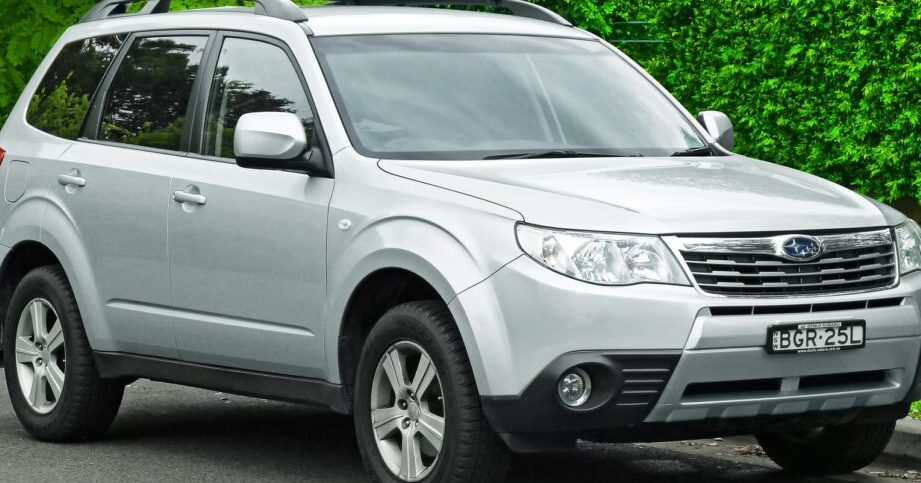
The Subaru Forester 2.5 XT, produced between 2007 and 2010, represented a significant step forward for Subaru’s popular compact SUV. Positioned as the performance variant within the third-generation Forester (designated chassis code SG), the 2.5 XT distinguished itself with a turbocharged engine and a four-speed automatic transmission, offering a blend of practicality and spirited driving. This model aimed to attract buyers seeking more than the base Forester’s economy-focused offerings, competing with other sporty crossovers like the Honda CR-V and Toyota RAV4 in the North American market, where Subaru had a growing following. The Forester III, in general, built upon the success of its predecessors, offering increased interior space and improved refinement.
Technical Specifications
| Brand | Subaru |
| Model | Forester |
| Generation | Forester III |
| Type (Engine) | 2.5 XT (230 Hp) E-4AT |
| Start of production | 2007 |
| End of production | 2010 |
| Powertrain Architecture | Internal Combustion engine |
| Body type | SUV, Crossover |
| Seats | 5 |
| Doors | 5 |
| Fuel consumption (urban) | 14.3 l/100 km (16.4 US mpg, 19.8 UK mpg, 7 km/l) |
| Fuel consumption (extra urban) | 8.3 l/100 km (28.3 US mpg, 34 UK mpg, 12 km/l) |
| Fuel consumption (combined) | 10.5 l/100 km (22.4 US mpg, 26.9 UK mpg, 9.5 km/l) |
| Fuel Type | Petrol (Gasoline) |
| Acceleration 0 – 100 km/h | 7.6 sec |
| Acceleration 0 – 62 mph | 7.6 sec |
| Acceleration 0 – 60 mph | 7.2 sec |
| Maximum speed | 214 km/h (132.97 mph) |
| Emission standard | Euro 4 |
| Weight-to-power ratio | 6.6 kg/Hp, 152.3 Hp/tonne |
| Weight-to-torque ratio | 4.7 kg/Nm, 211.9 Nm/tonne |
| Power | 230 Hp @ 5200 rpm |
| Torque | 320 Nm @ 2800 rpm (236.02 lb.-ft. @ 2800 rpm) |
| Engine layout | Front, Longitudinal |
| Engine Model/Code | EJ255 |
| Engine displacement | 2457 cm3 (149.94 cu. in.) |
| Number of cylinders | 4 |
| Engine configuration | Boxer |
| Cylinder Bore | 99.5 mm (3.92 in.) |
| Piston Stroke | 79 mm (3.11 in.) |
| Compression ratio | 8.4:1 |
| Number of valves per cylinder | 4 |
| Fuel injection system | Multi-port manifold injection |
| Engine aspiration | Turbocharger, Intercooler |
| Valvetrain | DOHC |
| Engine oil capacity | 4.2 l (4.44 US qt | 3.7 UK qt) |
| Kerb Weight | 1510 kg (3328.98 lbs.) |
| Max. weight | 2000 kg (4409.25 lbs.) |
| Max load | 490 kg (1080.27 lbs.) |
| Trunk (boot) space – minimum | 387 l (13.67 cu. ft.) |
| Fuel tank capacity | 60 l (15.85 US gal | 13.2 UK gal) |
| Length | 4485 mm (176.57 in.) |
| Width | 1735 mm (68.31 in.) |
| Height | 1590 mm (62.6 in.) |
| Wheelbase | 2525 mm (99.41 in.) |
| Front track | 1495 mm (58.86 in.) |
| Rear (Back) track | 1485 mm (58.46 in.) |
| Minimum turning circle | 10.8 m (35.43 ft.) |
| Drive wheel | All wheel drive (4×4) |
| Number of gears | 4 |
| Gearbox type | Automatic transmission |
| Front suspension | Spring-loaded rack |
| Rear suspension | De-Dion |
| Front brakes | Ventilated discs |
| Rear brakes | Disc |
| Assisting systems | ABS (Anti-lock braking system) |
| Steering type | Steering rack and pinion |
| Power steering | Hydraulic |
| Tires size | 215/55 R17 |
Powertrain & Engine Architecture
The heart of the Forester 2.5 XT was the EJ255, a 2.5-liter turbocharged boxer-four engine. Subaru’s horizontally-opposed “boxer” configuration, where pistons move horizontally rather than vertically, contributes to a lower center of gravity, enhancing handling. The EJ255 featured a single turbocharger with an intercooler to manage intake air temperature, boosting power output to 230 horsepower and 236 lb-ft of torque. Fuel delivery was handled by a multi-point fuel injection system. The engine’s 8.4:1 compression ratio was a compromise between performance and reliability with the forced induction. Paired with the engine was a four-speed automatic transmission (E-4AT), a somewhat dated design by the late 2000s, but known for its durability. This transmission featured adaptive shift logic, attempting to learn the driver’s style and adjust shift points accordingly.
Driving Characteristics
The 2.5 XT offered a noticeable performance upgrade over the naturally aspirated Forester models. Acceleration to 60 mph took approximately 7.2 seconds, making it one of the quicker vehicles in its class. The turbocharger provided a surge of power in the mid-range, making overtaking maneuvers relatively effortless. However, the four-speed automatic transmission, while reliable, lacked the responsiveness and efficiency of more modern transmissions with more gears. Gear ratios were tuned for acceleration rather than fuel economy. Compared to the five-speed manual transmission available on some Forester XT models, the automatic felt less engaging and slightly slower, but offered greater convenience for everyday driving. The all-wheel-drive system, a Subaru hallmark, provided excellent traction in various weather conditions.
Equipment & Trim Levels
The 2.5 XT typically came well-equipped, though specific features varied depending on the package selected. Standard equipment generally included air conditioning, power windows and locks, a CD player with auxiliary input, and alloy wheels. Higher trim levels added features like a sunroof, leather upholstery, heated front seats, and a premium audio system. Optional extras included a navigation system and a rear cargo area organizer. Interior materials were generally durable and functional, reflecting the Forester’s practical nature. The dashboard layout was straightforward and user-friendly.
Chassis & Braking
The Forester 2.5 XT utilized a MacPherson strut front suspension and a double-wishbone rear suspension (often referred to as a De-Dion setup in Subaru literature). This suspension configuration aimed to balance ride comfort with handling performance. The 2.5 XT featured ventilated disc brakes on the front wheels and solid disc brakes on the rear, providing adequate stopping power for its weight class. Anti-lock brakes (ABS) were standard. Stabilizer bars were fitted to both the front and rear axles to reduce body roll during cornering. The steering was a rack-and-pinion system with hydraulic power assistance.
Market Reception & Comparison
The Forester 2.5 XT was generally well-received by automotive critics, who praised its performance, all-wheel-drive system, and spacious interior. However, the four-speed automatic transmission was often criticized for its lack of refinement and fuel efficiency compared to competitors offering five or six-speed automatics. Fuel economy was rated at around 22.4 mpg combined, which was average for the class at the time. Reliability was generally good, though some owners reported issues with the turbocharger and automatic transmission over the long term. Compared to the base Forester 2.5X, the 2.5 XT offered a significant performance boost but came at a higher price point and with slightly lower fuel economy.
Legacy
The Subaru Forester III 2.5 XT remains a popular choice among used car buyers seeking a practical and capable SUV with a bit of extra performance. The EJ255 engine, while known for requiring regular maintenance (particularly oil changes), is generally considered durable when properly cared for. The four-speed automatic transmission, while not the most advanced, has proven to be relatively reliable. Today, these Foresters are often found with reasonable mileage and are appreciated for their all-weather capability and Subaru’s reputation for longevity. Parts availability is generally good, and a strong aftermarket exists for performance upgrades. The 2.5 XT represents a sweet spot in the Forester lineage, offering a compelling combination of practicality, performance, and affordability.