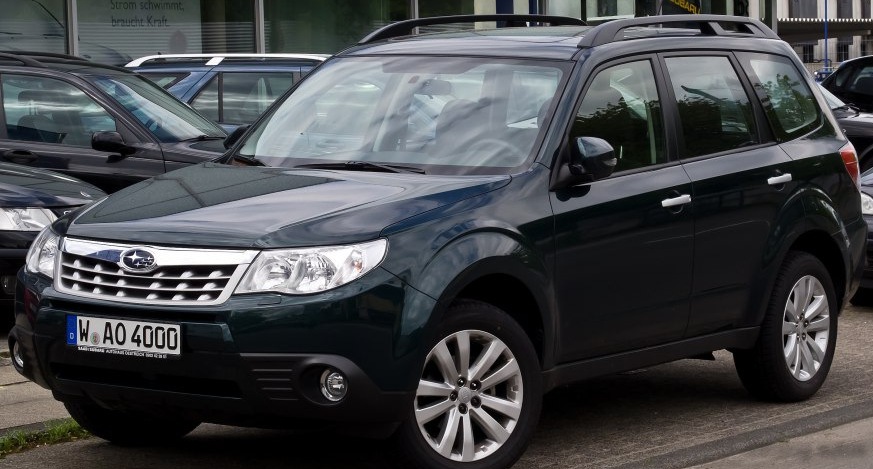
The Subaru Forester III (facelift, produced from 2010 to 2013) 2.5 Turbo AWD represents the performance-oriented variant of the third-generation Forester. Positioned as the top-tier trim level, it offered a significant power upgrade over the naturally aspirated models, appealing to buyers seeking both practicality and spirited driving. This facelift brought styling revisions and refinements to the already popular Forester, solidifying its position as a capable and versatile compact SUV in markets worldwide, including North America. The 2.5 Turbo model distinguished itself with its turbocharged boxer engine and standard all-wheel drive, making it a compelling alternative to more conventional crossovers.
Technical Specifications
| Brand | Subaru |
| Model | Forester |
| Generation | Forester III (facelift 2010) |
| Type (Engine) | 2.5 Turbo (230 Hp) AWD |
| Start of production | 2010 |
| End of production | 2013 |
| Powertrain Architecture | Internal Combustion engine |
| Body type | SUV, Crossover |
| Seats | 5 |
| Doors | 5 |
| Fuel consumption (urban) | 14.4 l/100 km (16.3 US mpg, 19.6 UK mpg, 6.9 km/l) |
| Fuel consumption (extra urban) | 8.2 l/100 km (28.7 US mpg, 34.4 UK mpg, 12.2 km/l) |
| Fuel consumption (combined) | 10.5 l/100 km (22.4 US mpg, 26.9 UK mpg, 9.5 km/l) |
| CO2 emissions | 248 g/km |
| Fuel Type | Petrol (Gasoline) |
| Acceleration 0 – 100 km/h | 7.1 sec |
| Acceleration 0 – 62 mph | 7.1 sec |
| Acceleration 0 – 60 mph | 6.7 sec |
| Maximum speed | 210 km/h (130.49 mph) |
| Emission standard | Euro 4 |
| Weight-to-power ratio | 6.6 kg/Hp, 152.3 Hp/tonne |
| Weight-to-torque ratio | 4.7 kg/Nm, 211.9 Nm/tonne |
| Power | 230 Hp @ 5200 rpm |
| Torque | 320 Nm @ 2800 rpm (236.02 lb.-ft. @ 2800 rpm) |
| Engine layout | Front, Longitudinal |
| Engine Model/Code | EJ255 |
| Engine displacement | 2457 cm3 (149.94 cu. in.) |
| Number of cylinders | 4 |
| Engine configuration | Boxer |
| Cylinder Bore | 99.5 mm (3.92 in.) |
| Piston Stroke | 79 mm (3.11 in.) |
| Compression ratio | 8.4:1 |
| Number of valves per cylinder | 4 |
| Fuel injection system | Multi-port manifold injection |
| Engine aspiration | Turbocharger, Intercooler |
| Valvetrain | DOHC, AVCS |
| Engine oil capacity | 4.2 l (4.44 US qt | 3.7 UK qt) |
| Coolant capacity | 8.1 l (8.56 US qt | 7.13 UK qt) |
| Kerb Weight | 1510-1545 kg (3328.98 – 3406.14 lbs.) |
| Trunk (boot) space – minimum | 450 l (15.89 cu. ft.) |
| Trunk (boot) space – maximum | 1660 l (58.62 cu. ft.) |
| Fuel tank capacity | 60 l (15.85 US gal | 13.2 UK gal) |
| Permitted trailer load with brakes (12%) | 1600 kg (3527.4 lbs.) |
| Permitted trailer load without brakes | 750 kg (1653.47 lbs.) |
| Length | 4560 mm (179.53 in.) |
| Width | 1795 mm (70.67 in.) |
| Height | 1700 mm (66.93 in.) |
| Wheelbase | 2615 mm (102.95 in.) |
| Front track | 1530 mm (60.24 in.) |
| Rear track | 1530 mm (60.24 in.) |
| Ride height (ground clearance) | 225 mm (8.86 in.) |
| Minimum turning circle | 10.5 m (34.45 ft.) |
| Drivetrain Architecture | All wheel drive (4×4) |
| Number of gears | 5 |
| Gearbox type | Manual transmission |
| Front suspension | Independent, type McPherson with coil spring and anti-roll bar |
| Rear suspension | Double wishbone, Transverse stabilizer |
| Front brakes | Ventilated discs |
| Rear brakes | Disc |
| Assisting systems | ABS (Anti-lock braking system) |
| Steering type | Steering rack and pinion |
| Power steering | Hydraulic Steering |
| Tires size | 225/55 R17 |
| Wheel rims size | 7J x 17 |
INTRODUCTION
The 2010-2013 Subaru Forester 2.5 Turbo AWD represented the pinnacle of performance for the third-generation Forester (SH chassis). Built on the Subaru Global Platform, this variant offered a substantial increase in power and torque compared to the base 2.5i models. It was primarily marketed towards drivers who desired the practicality of a compact SUV with the added benefit of quicker acceleration and enhanced driving dynamics. The facelift brought subtle cosmetic changes, including revised headlights and a redesigned front bumper, but the core mechanical upgrades remained focused on the turbocharged engine and robust all-wheel-drive system. This model year saw continued refinement of Subaru’s symmetrical all-wheel drive system, a hallmark of the brand.
Powertrain & Engine Architecture
At the heart of the Forester 2.5 Turbo lies the EJ255 2.5-liter turbocharged boxer-four engine. This engine utilizes a single turbocharger with an intercooler to boost power output to 230 horsepower at 5200 rpm and 236 lb-ft of torque at 2800 rpm. The engine features multi-port fuel injection and Subaru’s Active Valve Control System (AVCS) on both the intake and exhaust camshafts, optimizing valve timing for improved performance and efficiency. The EJ255 engine is known for its durability, but requires regular maintenance, particularly oil changes, due to its turbocharged nature. The 5-speed manual transmission was standard, providing direct control over the engine’s power. The transmission’s gear ratios were tuned to balance acceleration and fuel economy, with a relatively short final drive to maximize responsiveness.
Driving Characteristics
The Forester 2.5 Turbo delivers a noticeably more engaging driving experience than its naturally aspirated counterparts. The increased power and torque allow for quicker acceleration, making highway merging and overtaking maneuvers effortless. The symmetrical all-wheel-drive system provides excellent traction in various weather conditions, enhancing stability and control. While not a sports car, the Forester 2.5 Turbo offers a confident and capable driving experience. The manual transmission allows for precise gear selection, while the turbocharger provides a surge of power in the mid-range. Compared to the base 2.5i, the Turbo model feels significantly more responsive and agile. However, the added power does come with a slight trade-off in fuel economy.
Equipment & Trim Levels
The 2.5 Turbo trim typically came well-equipped with standard features such as automatic climate control, power windows and locks, a CD player with auxiliary input, and alloy wheels. Optional extras included a premium sound system, a sunroof, leather upholstery, and a navigation system. The interior featured a functional and durable design, prioritizing practicality over luxury. The seats were comfortable and supportive, providing adequate cushioning for long drives. The dashboard layout was straightforward and easy to use, with clearly labeled controls.
Chassis & Braking
The Forester 2.5 Turbo utilizes an independent McPherson strut suspension in the front and a double-wishbone suspension in the rear. This suspension setup provides a comfortable ride while maintaining good handling characteristics. Stabilizer bars are fitted to both axles to reduce body roll during cornering. The braking system consists of ventilated discs at the front and solid discs at the rear, providing adequate stopping power. Anti-lock brakes (ABS) are standard, enhancing safety and control during emergency braking situations.
Market Reception & Comparison
The Forester 2.5 Turbo was generally well-received by automotive critics, who praised its performance, handling, and all-wheel-drive system. However, some reviewers noted that the fuel economy was relatively poor compared to other compact SUVs. Compared to the base 2.5i model, the Turbo offered a significant performance upgrade but came at a higher price point. It also required more frequent maintenance due to the turbocharged engine. Against competitors like the Honda CR-V and Toyota RAV4, the Forester 2.5 Turbo stood out with its unique boxer engine and standard all-wheel drive.
Legacy
The Subaru Forester 2.5 Turbo (2010-2013) remains a popular choice among enthusiasts and used car buyers. The EJ255 engine, while known for potential oil consumption issues if not properly maintained, is generally considered durable and reliable. The Forester’s symmetrical all-wheel-drive system continues to be a key selling point, providing excellent traction and stability in all weather conditions. Today, these models are often sought after for their performance potential and unique driving experience, representing a sweet spot between practicality and driving enjoyment within the Forester lineage.