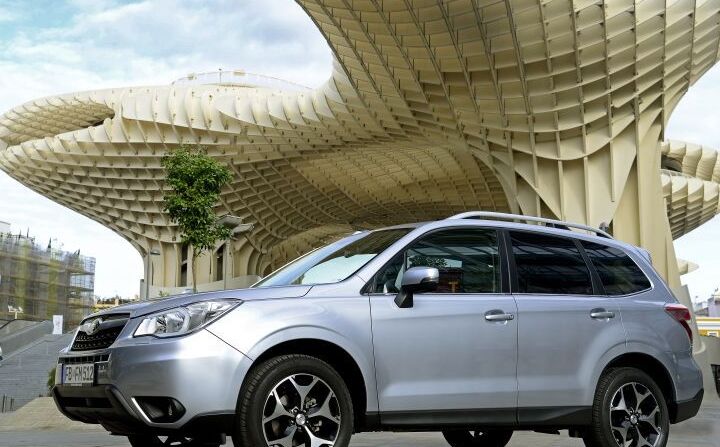
The Subaru Forester IV 2.0 (150 hp) CVT 4WD represents a significant iteration in Subaru’s popular compact SUV lineup. Produced from 2012 to 2015, this variant occupied a key position within the fourth-generation Forester (SJ platform), offering a balance between fuel efficiency, all-weather capability, and practicality. It served as a mainstream offering, positioned between the base 2.5i models and the more performance-oriented 2.0XT turbocharged variant. This model was primarily aimed at the North American and European markets, where compact SUVs with all-wheel drive were in high demand.
Technical Specifications
| Brand | Subaru |
| Model | Forester |
| Generation | Forester IV |
| Type (Engine) | 2.0 (150 Hp) CVT 4WD |
| Start of production | 2012 |
| End of production | 2015 |
| Powertrain Architecture | Internal Combustion engine |
| Body type | SUV, Crossover |
| Seats | 5 |
| Doors | 5 |
| Fuel consumption (urban) | 10.6 l/100 km (22.2 US mpg) |
| Fuel consumption (extra urban) | 6.3 l/100 km (37.3 US mpg) |
| Fuel consumption (combined) | 7.9 l/100 km (29.8 US mpg) |
| Fuel Type | Petrol (Gasoline) |
| Acceleration 0 – 100 km/h | 11.8 sec |
| Acceleration 0 – 62 mph | 11.8 sec |
| Acceleration 0 – 60 mph | 11.2 sec |
| Maximum speed | 192 km/h (119.3 mph) |
| Weight-to-power ratio | 10 kg/Hp |
| Weight-to-torque ratio | 7.6 kg/Nm |
| Power | 150 Hp @ 6200 rpm |
| Torque | 198 Nm @ 4200 rpm (146.04 lb.-ft. @ 4200 rpm) |
| Engine layout | Front, Longitudinal |
| Engine Model/Code | FB20 |
| Engine displacement | 1995 cm3 (121.74 cu. in.) |
| Number of cylinders | 4 |
| Engine configuration | Boxer |
| Cylinder Bore | 84 mm (3.31 in.) |
| Piston Stroke | 90 mm (3.54 in.) |
| Compression ratio | 10.5:1 |
| Number of valves per cylinder | 4 |
| Fuel injection system | Multi-port manifold injection |
| Engine aspiration | Naturally aspirated engine |
| Valvetrain | DOHC |
| Engine oil capacity | 4.8 l (5.07 US qt | 4.22 UK qt) |
| Kerb Weight | 1499 kg (3304.73 lbs.) |
| Max. weight | 1850 kg (4078.55 lbs.) |
| Max load | 351 kg (773.82 lbs.) |
| Trunk (boot) space – minimum | 488 l (17.23 cu. ft.) |
| Trunk (boot) space – maximum | 1577 l (55.69 cu. ft.) |
| Fuel tank capacity | 60 l (15.85 US gal | 13.2 UK gal) |
| Length | 4595 mm (180.91 in.) |
| Width | 1795 mm (70.67 in.) |
| Height | 1735 mm (68.31 in.) |
| Wheelbase | 2640 mm (103.94 in.) |
| Front track | 1545 mm (60.83 in.) |
| Rear (Back) track | 1550 mm (61.02 in.) |
| Ride height (ground clearance) | 220 mm (8.66 in.) |
| Minimum turning circle | 10.6 m (34.78 ft.) |
| Drive wheel | All wheel drive (4×4) |
| Front suspension | Independent coil spring |
| Rear suspension | Semi-independent, coil spring |
| Front brakes | Ventilated discs |
| Rear brakes | Disc |
| Assisting systems | ABS (Anti-lock braking system) |
| Steering type | Steering rack and pinion |
| Power steering | Electric Steering |
| Tires size | 225/60 R17 |
| Wheel rims size | 17 |
Powertrain & Engine Architecture
The heart of the Forester IV 2.0 is the FB20 2.0-liter naturally aspirated boxer-four engine. This engine is a key component of Subaru’s engineering philosophy, offering a low center of gravity for improved handling. The FB series engines were designed to replace the older EJ series, focusing on improved fuel efficiency and reduced internal friction. The FB20 utilizes multi-point fuel injection and a double overhead camshaft (DOHC) valvetrain with four valves per cylinder. This configuration allows for efficient combustion and a relatively broad powerband. The engine produces 150 horsepower at 6,200 rpm and 198 Nm (146 lb-ft) of torque at 4,200 rpm.
Paired with the FB20 is a continuously variable transmission (CVT). Subaru’s Lineartronic CVT is designed to mimic the feel of a traditional automatic transmission while offering improved fuel economy. This CVT features six simulated gear ratios, allowing for a more engaging driving experience than some earlier CVT implementations. The CVT sends power to all four wheels via Subaru’s symmetrical all-wheel drive system, a hallmark of the brand. This system utilizes a viscous coupling center differential to distribute power between the front and rear axles, providing enhanced traction in various conditions.
Driving Characteristics
The 2.0-liter CVT combination in the Forester IV delivers adequate, but not exhilarating, performance. Acceleration from 0-60 mph takes around 11.2 seconds, making it competitive with other compact SUVs in its class. The CVT prioritizes fuel efficiency, resulting in a smooth, but sometimes less responsive, driving experience. The simulated gear ratios help to mitigate the “rubber band” feel often associated with CVTs. In real-world driving, the Forester 2.0 feels comfortable and capable, particularly in situations requiring all-wheel drive traction. Compared to the 2.5i models, the 2.0 offers slightly less power but improved fuel economy. The 2.0XT, with its turbocharged engine, provides significantly more performance but at the cost of fuel efficiency and a higher price point.
Equipment & Trim Levels
The Forester IV 2.0 CVT 4WD typically came standard with features such as air conditioning, power windows and locks, a rearview camera, and a basic audio system. Higher trim levels, such as the Premium and Limited, added features like a power driver’s seat, heated front seats, a sunroof, and a more advanced infotainment system. Interior upholstery was typically cloth on the base models, with leather options available on higher trims. Safety features included standard anti-lock brakes (ABS), electronic stability control, and multiple airbags.
Chassis & Braking
The Forester IV utilizes a MacPherson strut front suspension and a double-wishbone rear suspension. This setup provides a comfortable ride and predictable handling. The chassis is reinforced to provide rigidity and improve crash safety. Braking duties are handled by ventilated discs at the front and solid discs at the rear. The ABS system helps to prevent wheel lockup during hard braking, enhancing stability and control. The ride height of 220mm (8.66 inches) provides good ground clearance for navigating rough terrain.
Market Reception & Comparison
The Subaru Forester IV 2.0 CVT 4WD was generally well-received by automotive critics. It was praised for its practicality, safety, and all-weather capability. However, some reviewers noted that the 2.0-liter engine felt underpowered, especially when fully loaded. Fuel economy was considered competitive for its class, averaging around 29.8 US mpg in combined driving. Compared to other compact SUVs, the Forester stood out with its standard all-wheel drive and spacious interior. Reliability was generally good, with the FB20 engine proving to be relatively durable.
Legacy
The Subaru Forester IV 2.0 CVT 4WD remains a popular choice in the used car market. Its reputation for reliability, combined with its practicality and all-wheel drive capability, makes it an attractive option for buyers seeking a safe and dependable compact SUV. While the FB20 engine is known to be generally reliable, regular maintenance, including oil changes and timing belt replacements (typically around 105,000 miles), is crucial for long-term durability. The CVT transmission, while improved over earlier designs, should also be monitored for any signs of slippage or unusual noises. Overall, the Forester IV 2.0 represents a well-rounded and capable vehicle that continues to offer good value in the used car market.