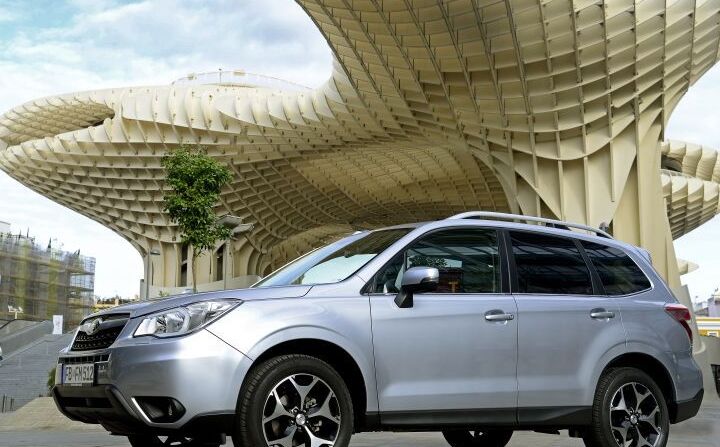
The Subaru Forester IV 2.0 (241 Hp) CVT 4WD represents a significant evolution in Subaru’s popular compact SUV lineup. Produced from 2012 to 2015, this variant occupied a premium position within the fourth-generation Forester (SJ platform) range, offering a blend of performance, practicality, and Subaru’s renowned symmetrical all-wheel drive system. It was primarily marketed towards buyers seeking a capable and efficient crossover with a more powerful engine option than the base models. This model year saw a complete redesign of the Forester, moving away from the previous generation’s more utilitarian aesthetic towards a softer, more approachable design.
Technical Specifications
| Brand | Subaru |
| Model | Forester |
| Generation | Forester IV |
| Type (Engine) | 2.0 (241 Hp) CVT 4WD |
| Start of production | 2012 |
| End of production | 2015 |
| Powertrain Architecture | Internal Combustion engine |
| Body type | SUV, Crossover |
| Seats | 5 |
| Doors | 5 |
| Fuel consumption (urban) | 11.2 l/100 km (21 US mpg) |
| Fuel consumption (extra urban) | 7 l/100 km (33.6 US mpg) |
| Fuel consumption (combined) | 8.5 l/100 km (27.7 US mpg) |
| Fuel Type | Petrol (Gasoline) |
| Acceleration 0 – 100 km/h | 7.5 sec |
| Acceleration 0 – 62 mph | 7.5 sec |
| Acceleration 0 – 60 mph | 7.1 sec |
| Maximum speed | 221 km/h (137.32 mph) |
| Weight-to-power ratio | 6.7 kg/Hp |
| Weight-to-torque ratio | 4.6 kg/Nm |
| Power | 241 Hp @ 5600 rpm |
| Torque | 350 Nm @ 2400 rpm (258.15 lb.-ft. @ 2400 rpm) |
| Engine layout | Front, Longitudinal |
| Engine Model/Code | FA20F |
| Engine displacement | 1998 cm3 (121.93 cu. in.) |
| Number of cylinders | 4 |
| Engine configuration | Boxer |
| Cylinder Bore | 86 mm (3.39 in.) |
| Piston Stroke | 86 mm (3.39 in.) |
| Compression ratio | 10.6:1 |
| Number of valves per cylinder | 4 |
| Fuel injection system | Direct injection |
| Engine aspiration | Turbocharger, Intercooler |
| Valvetrain | DOHC |
| Engine oil capacity | 5.1 l (5.39 US qt | 4.49 UK qt) |
| Kerb Weight | 1613 kg (3556.06 lbs.) |
| Max. weight | 1850 kg (4078.55 lbs.) |
| Max load | 237 kg (522.5 lbs.) |
| Trunk (boot) space – minimum | 488 l (17.23 cu. ft.) |
| Trunk (boot) space – maximum | 1577 l (55.69 cu. ft.) |
| Fuel tank capacity | 60 l (15.85 US gal | 13.2 UK gal) |
| Length | 4595 mm (180.91 in.) |
| Width | 1795 mm (70.67 in.) |
| Height | 1735 mm (68.31 in.) |
| Wheelbase | 2640 mm (103.94 in.) |
| Front track | 1545 mm (60.83 in.) |
| Rear (Back) track | 1550 mm (61.02 in.) |
| Ride height (ground clearance) | 220 mm (8.66 in.) |
| Minimum turning circle | 10.6 m (34.78 ft.) |
| Drive wheel | All wheel drive (4×4) |
| Front suspension | Independent coil spring |
| Rear suspension | Semi-independent, coil spring |
| Front brakes | Ventilated discs |
| Rear brakes | Ventilated discs |
| Assisting systems | ABS (Anti-lock braking system) |
| Steering type | Steering rack and pinion |
| Power steering | Electric Steering |
| Tires size | 225/55 R18 |
| Wheel rims size | 18 |
Powertrain & Engine Architecture
The heart of the Forester IV 2.0 (241 Hp) is the FA20F 2.0-liter turbocharged Boxer engine. This engine, a key component of Subaru’s second-generation direct-injection turbocharged engine family, utilizes a horizontally opposed (Boxer) configuration, known for its low center of gravity and inherent balance. The FA20F features direct fuel injection, a single-scroll turbocharger with intercooling, and a dual overhead camshaft (DOHC) valvetrain with four valves per cylinder. This configuration allows for a broad torque curve and responsive power delivery. The engine produces 241 horsepower at 5600 rpm and 258 lb-ft of torque at 2400 rpm. Paired with this engine is a Continuously Variable Transmission (CVT), which was becoming increasingly common in the Forester lineup for its fuel efficiency and smooth operation. Subaru’s Lineartronic CVT, used in this model, simulates gear changes to provide a more natural driving experience.
Driving Characteristics
The 241 hp output and the CVT transmission provide a different driving experience compared to the naturally aspirated or manual transmission Forester variants. Acceleration from 0-60 mph is achieved in approximately 7.1 seconds, making it one of the quicker options in the Forester range. The CVT, while efficient, doesn’t offer the same level of engagement as a traditional automatic or manual transmission. However, Subaru programmed the CVT with simulated shift points to mimic a conventional automatic, improving the driving feel. The symmetrical all-wheel drive system provides excellent traction in various conditions, making the Forester a capable vehicle for inclement weather and light off-road adventures. The power delivery is smooth and linear, with the turbocharger providing a noticeable boost in mid-range acceleration.
Equipment & Trim Levels
The 2.0 XT Premium, as this variant was often designated, typically included standard features such as automatic climate control, a touchscreen infotainment system, Bluetooth connectivity, a rearview camera, and alloy wheels. Higher trim levels offered options like leather upholstery, a power driver’s seat, a premium sound system, and Subaru’s EyeSight driver-assist technology, which included adaptive cruise control, lane departure warning, and pre-collision braking. Interior materials were generally of good quality, offering a comfortable and well-equipped cabin.
Chassis & Braking
The Forester IV utilizes a MacPherson strut front suspension and a double-wishbone rear suspension, providing a comfortable ride and predictable handling. The chassis was designed to maximize rigidity and minimize body roll. Braking duties are handled by ventilated disc brakes on all four wheels, providing ample stopping power. Anti-lock braking system (ABS) is standard, enhancing safety and control during emergency braking situations. The suspension tuning was geared towards comfort and stability, rather than outright sportiness.
Market Reception & Comparison
The Forester IV 2.0 (241 Hp) CVT 4WD was generally well-received by automotive critics. It was praised for its spacious interior, comfortable ride, and capable all-wheel drive system. The turbocharged engine was seen as a significant upgrade over the base engine options, providing ample power for everyday driving and highway passing. Fuel economy, at 27.7 US mpg combined, was considered respectable for a vehicle of its size and capability. Compared to the naturally aspirated 2.5L Forester, the 2.0 XT offered a noticeable performance advantage, but at a higher price point. Compared to competitors like the Honda CR-V and Toyota RAV4, the Forester stood out with its standard all-wheel drive and unique Boxer engine configuration.
Legacy
The FA20F engine has proven to be a relatively reliable powertrain, although regular maintenance, including oil changes and timing belt replacements (typically around 105,000 miles), is crucial. The CVT transmission, while generally durable, can be susceptible to issues if not properly maintained. On the used car market, the Forester IV 2.0 (241 Hp) CVT 4WD holds its value reasonably well, due to its reputation for reliability, practicality, and all-weather capability. It remains a popular choice for buyers seeking a versatile and dependable compact SUV.