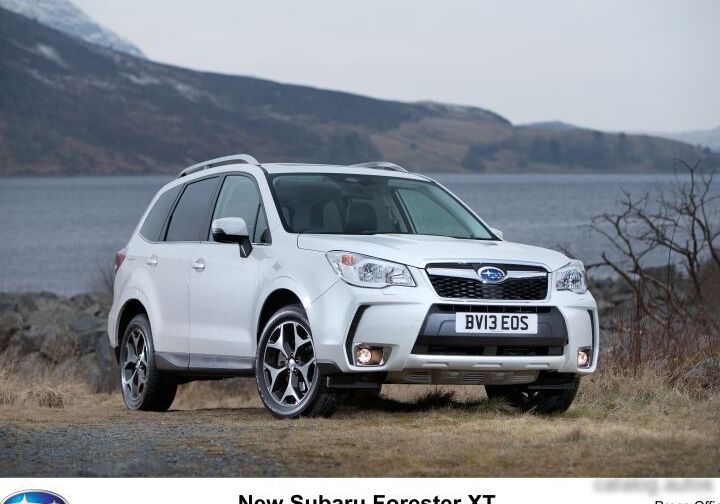
The Subaru Forester IV (facelift, introduced in 2016) 2.0d, producing 147 horsepower, represents a significant iteration of Subaru’s popular compact SUV. Produced from 2016 through 2018, this variant occupied a key position in the Forester lineup, offering a balance between fuel efficiency, all-weather capability, and practicality. It was part of the fourth-generation Forester (SJ platform), which debuted in 2013, with the 2016 facelift bringing styling updates, improved safety features, and refinements to the powertrain. This specific diesel-powered, all-wheel-drive configuration was primarily aimed at the European market, where diesel engines held a substantial share of the SUV segment, but limited imports were available in other regions.
Technical Specifications
| Brand | Subaru |
| Model | Forester |
| Generation | Forester IV (facelift 2016) |
| Type (Engine) | 2.0d (147 Hp) AWD |
| Start of production | 2016 |
| End of production | 2018 |
| Powertrain Architecture | Internal Combustion engine |
| Body type | SUV, Crossover |
| Seats | 5 |
| Doors | 5 |
| Fuel consumption (urban) | 7.1 l/100 km (33.1 US mpg, 39.8 UK mpg, 14.1 km/l) |
| Fuel consumption (extra urban) | 4.9 l/100 km (48 US mpg, 57.6 UK mpg, 20.4 km/l) |
| Fuel consumption (combined) | 5.7 l/100 km (41.3 US mpg, 49.6 UK mpg, 17.5 km/l) |
| CO2 emissions | 148 g/km |
| Fuel Type | Diesel |
| Acceleration 0 – 100 km/h | 9.9 sec |
| Acceleration 0 – 62 mph | 9.9 sec |
| Acceleration 0 – 60 mph | 9.4 sec |
| Maximum speed | 190 km/h (118.06 mph) |
| Emission standard | Euro 6 |
| Weight-to-power ratio | 10.6 kg/Hp, 94.1 Hp/tonne |
| Weight-to-torque ratio | 4.5 kg/Nm, 224.1 Nm/tonne |
| Power | 147 Hp @ 3600 rpm |
| Torque | 350 Nm @ 1600-2800 rpm (258.15 lb.-ft. @ 1600-2800 rpm) |
| Engine layout | Front, Longitudinal |
| Engine Model/Code | EE20 |
| Engine displacement | 1998 cm3 (121.93 cu. in.) |
| Number of cylinders | 4 |
| Engine configuration | Boxer |
| Cylinder Bore | 86 mm (3.39 in.) |
| Piston Stroke | 86 mm (3.39 in.) |
| Compression ratio | 15.2:1 |
| Number of valves per cylinder | 4 |
| Fuel injection system | Diesel Commonrail |
| Engine aspiration | Turbocharger, Intercooler |
| Valvetrain | DOHC |
| Engine oil capacity | 5.9 l (6.23 US qt | 5.19 UK qt) |
| Coolant | 9 l (9.51 US qt | 7.92 UK qt) |
| Kerb Weight | 1562 kg (3443.62 lbs.) |
| Max. weight | 2080 kg (4585.62 lbs.) |
| Max load | 518 kg (1141.99 lbs.) |
| Trunk (boot) space – minimum | 505 l (17.83 cu. ft.) |
| Trunk (boot) space – maximum | 1557 l (54.98 cu. ft.) |
| Fuel tank capacity | 60 l (15.85 US gal | 13.2 UK gal) |
| Max. roof load | 80 kg (176.37 lbs.) |
| Permitted trailer load with brakes (12%) | 2000 kg (4409.25 lbs.) |
| Permitted trailer load without brakes | 750 kg (1653.47 lbs.) |
| Length | 4610 mm (181.5 in.) |
| Width | 1795 mm (70.67 in.) |
| Height | 1735 mm (68.31 in.) |
| Wheelbase | 2640 mm (103.94 in.) |
| Front track | 1545 mm (60.83 in.) |
| Rear (Back) track | 1555 mm (61.22 in.) |
| Ride height (ground clearance) | 220 mm (8.66 in.) |
| Minimum turning circle | 11.4 m (37.4 ft.) |
| Front suspension | Independent type McPherson |
| Rear suspension | Double wishbone |
| Front brakes | Ventilated discs |
| Rear brakes | Disc |
| Drive wheel | All wheel drive (4×4) |
| Number of gears and type of gearbox | 6 gears, manual transmission |
| Tires size | 225/60 R17 |
| Wheel rims size | 7J x 17 |
INTRODUCTION
The 2016 facelift of the Subaru Forester IV brought a refreshed look and enhanced features to Subaru’s popular crossover SUV. The 2.0d variant, powered by the EE20 diesel engine and equipped with all-wheel drive, was a key offering, particularly in Europe. This model year represented a mid-cycle update for the SJ platform Forester, which had initially launched in 2013. The facelift included revised front and rear styling, improvements to the suspension for enhanced ride comfort, and upgrades to the infotainment system. Positioned as a practical and capable family vehicle, the 2.0d Forester aimed to provide a blend of fuel efficiency, space, and Subaru’s renowned symmetrical all-wheel-drive system.
Powertrain & Engine Architecture
The heart of the Forester 2.0d is the EE20 2.0-liter horizontally-opposed (Boxer) diesel engine. This engine is a four-cylinder unit featuring a common-rail direct injection system and a turbocharger with an intercooler. The EE20 engine is known for its relatively smooth operation and good low-end torque. The diesel commonrail system utilizes piezo injectors for precise fuel delivery, optimizing combustion efficiency and reducing emissions. The engine also incorporates a diesel particulate filter (DPF) to further minimize harmful emissions, meeting Euro 6 standards. The 147 horsepower output is achieved at 3600 rpm, while the peak torque of 350 Nm (258 lb-ft) is available between 1600 and 2800 rpm. This broad torque curve provides strong acceleration and effortless cruising. The engine is longitudinally mounted, contributing to the Forester’s balanced handling characteristics. The 6-speed manual transmission was standard, offering precise shifts and good control.
Driving Characteristics
The 2.0d Forester, with its 147 hp and manual transmission, delivers a composed and practical driving experience. While not a performance-oriented vehicle, the engine’s strong low-end torque makes it feel responsive in everyday driving situations. Acceleration from 0-60 mph takes around 9.4 seconds, which is adequate for most commuting and highway merging scenarios. The six-speed manual gearbox is well-matched to the engine’s characteristics, providing smooth and precise shifts. Compared to higher-output petrol versions of the Forester, the 2.0d offers superior fuel economy, but sacrifices some outright performance. The symmetrical all-wheel-drive system provides excellent traction in all weather conditions, making it a confident and capable vehicle on slippery surfaces. The ride quality is generally comfortable, thanks to the independent suspension setup, although it can feel slightly firm on rough roads.
Equipment & Trim Levels
The 2.0d Forester typically came with a good level of standard equipment. Features included air conditioning, power windows and mirrors, a multi-function steering wheel, and a basic audio system with Bluetooth connectivity. Higher trim levels, such as the XE and XT, added features like leather upholstery, heated front seats, a sunroof, a more advanced infotainment system with a larger touchscreen display, and automatic climate control. Safety features were also comprehensive, including ABS brakes, electronic stability control, multiple airbags, and Subaru’s EyeSight driver assist system (available on some trims), which included adaptive cruise control, lane departure warning, and pre-collision braking. Interior upholstery was typically cloth on base models, with leather options available on higher trims. Dashboard configuration was functional and straightforward, prioritizing usability over flashy design.
Chassis & Braking
The Forester 2.0d utilizes a McPherson strut front suspension and a double-wishbone rear suspension. This setup provides a good balance between ride comfort and handling stability. The suspension is tuned to prioritize comfort, but still offers reasonable control in corners. Braking duties are handled by ventilated discs at the front and solid discs at the rear. ABS (Anti-lock Braking System) is standard, providing enhanced braking performance and control in emergency situations. The steering is a rack-and-pinion system, offering precise and responsive steering feel. The all-wheel-drive system is a symmetrical system, distributing power evenly to all four wheels for optimal traction. The Forester’s relatively high ground clearance (220 mm) allows it to tackle moderate off-road terrain with confidence.
Market Reception & Comparison
The Subaru Forester 2.0d was generally well-received by automotive critics, who praised its practicality, fuel efficiency, and all-weather capability. However, some reviewers noted that the diesel engine could be somewhat noisy compared to petrol alternatives. Compared to other diesel SUVs in its class, such as the Volkswagen Tiguan and Nissan Qashqai, the Forester offered a unique combination of space, standard all-wheel drive, and a robust build quality. Fuel economy was competitive, averaging around 41.3 US mpg in combined driving. Reliability was generally good, although diesel particulate filter issues could occasionally occur, particularly with vehicles primarily used for short trips.
Legacy
The Subaru Forester IV 2.0d has proven to be a reliable and durable vehicle, with many examples still on the road today. The EE20 diesel engine, while not without its potential issues (such as DPF clogging), is generally considered to be a robust and long-lasting unit when properly maintained. In the used car market, these Foresters represent a good value proposition for buyers seeking a practical, capable, and fuel-efficient SUV. The combination of all-wheel drive, spacious interior, and good safety features makes it a popular choice for families and outdoor enthusiasts. The 2016 facelifted model, with its refreshed styling and improved features, is particularly desirable.