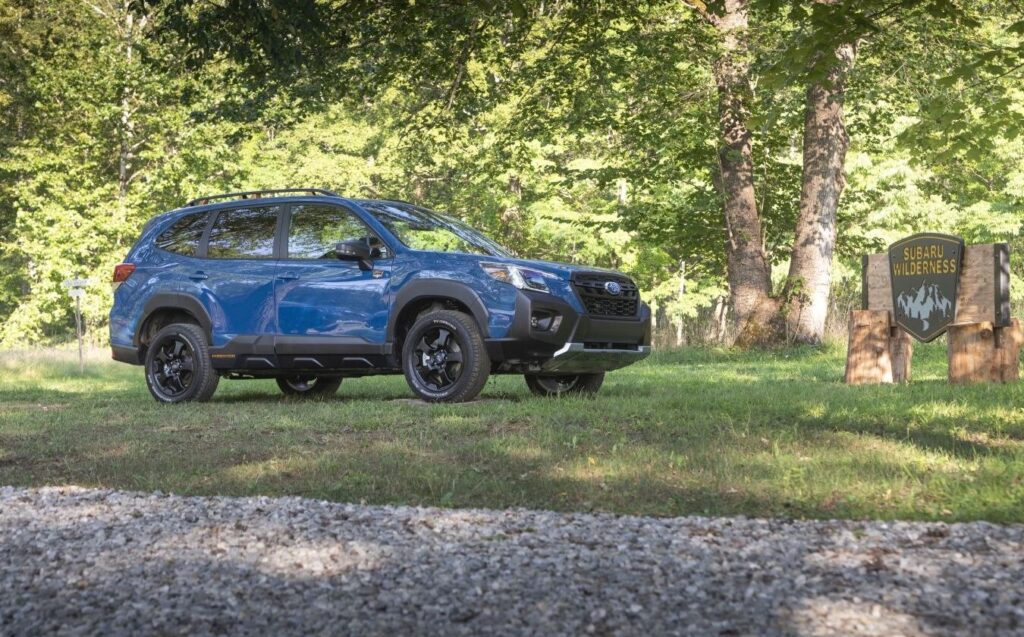
The Subaru Forester V, specifically the facelifted model introduced in September 2021, represented a continuation of the fifth generation of Subaru’s popular compact SUV. This variant, equipped with the 2.5-liter naturally aspirated boxer engine producing 182 horsepower and paired with a Lineartronic continuously variable transmission (CVT) and all-wheel drive, served as a core offering within the Forester lineup throughout its 2021-2024 production run. It aimed to balance fuel efficiency, practicality, and Subaru’s renowned symmetrical all-wheel drive capability, appealing to a broad range of buyers in the North American market and beyond. This model year saw a refresh to the existing fifth-generation Forester, including updated front and rear styling, enhanced safety features, and minor interior refinements.
Technical Specifications
| Brand | Subaru |
| Model | Forester |
| Generation | Forester V (facelift 2021) |
| Type (Engine) | 2.5 (182 Hp) AWD Lineartronic |
| Start of production | September, 2021 |
| End of production | 2024 |
| Powertrain Architecture | Internal Combustion engine |
| Body type | SUV, Crossover |
| Seats | 5 |
| Doors | 5 |
| Fuel consumption (urban) | 9 l/100 km (26.1 US mpg) |
| Fuel consumption (extra urban) | 7.1 l/100 km (33.1 US mpg) |
| Fuel consumption (combined) | 8.1 l/100 km (29 US mpg) |
| Fuel Type | Petrol (Gasoline) |
| Weight-to-power ratio | 8.6 kg/Hp |
| Weight-to-torque ratio | 6.6 kg/Nm |
| Power | 182 Hp @ 5800 rpm |
| Torque | 239 Nm @ 4400 rpm (176.28 lb.-ft. @ 4400 rpm) |
| Engine layout | Front, Longitudinal |
| Engine Model/Code | FB25 |
| Engine displacement | 2498 cm3 (152.44 cu. in.) |
| Number of cylinders | 4 |
| Engine configuration | Boxer |
| Cylinder Bore | 94 mm (3.7 in.) |
| Piston Stroke | 90 mm (3.54 in.) |
| Compression ratio | 12:1 |
| Number of valves per cylinder | 4 |
| Fuel injection system | Direct injection |
| Engine aspiration | Naturally aspirated engine |
| Valvetrain | DOHC, DAVCS |
| Engine oil capacity | 4.2 l (4.44 US qt | 3.7 UK qt) |
| Coolant capacity | 8.5 l (8.98 US qt | 7.48 UK qt) |
| Kerb Weight | 1567-1630 kg (3454.64 – 3593.53 lbs.) |
| Trunk (boot) space – minimum | 762 l (26.91 cu. ft.) |
| Trunk (boot) space – maximum | 2101 l (74.2 cu. ft.) |
| Fuel tank capacity | 63 l (16.64 US gal | 13.86 UK gal) |
| Length | 4641 mm (182.72 in.) |
| Width | 1816 mm (71.5 in.) |
| Width including mirrors | 2055-2065 mm (80.91 – 81.3 in.) |
| Height | 1730 mm (68.11 in.) |
| Wheelbase | 2670 mm (105.12 in.) |
| Front track | 1565 mm (61.61 in.) |
| Rear track | 1570 mm (61.81 in.) |
| Ride height (ground clearance) | 221 mm (8.7 in.) |
| Minimum turning circle | 10.8 m (35.43 ft.) |
| Gearbox | automatic transmission CVT Lineartronic |
Powertrain & Engine Architecture
The heart of this Forester variant is the FB25 2.5-liter naturally aspirated boxer-4 engine. Subaru’s boxer configuration, with horizontally opposed pistons, contributes to a low center of gravity, enhancing stability and handling. The FB25 features direct fuel injection, optimizing combustion efficiency and power delivery. It utilizes a Dual Active Valve Control System (DAVCS) on both intake and exhaust camshafts, allowing for variable valve timing to improve performance across the rev range. The Lineartronic CVT, a hallmark of Subaru’s efficiency strategy, replaces traditional gearsets with a belt-and-pulley system, providing a seamless and continuously variable gear ratio. This CVT is programmed with simulated shift points to mimic the feel of a conventional automatic transmission, addressing a common complaint about early CVT implementations. The engine’s longitudinal mounting and the symmetrical all-wheel-drive system contribute to balanced weight distribution.
Driving Characteristics
The 182-horsepower and 176 lb-ft of torque output of the FB25/Lineartronic combination delivers adequate, though not exhilarating, performance. Acceleration from 0-60 mph typically falls in the 8.5-9.5 second range. The CVT prioritizes fuel economy, and while it offers a “Sport” mode for more responsive acceleration, it doesn’t transform the Forester into a performance vehicle. The Lineartronic’s continuously variable nature can sometimes feel disconnected from the engine, with the engine holding at a constant RPM during acceleration. However, it provides smooth and predictable power delivery in everyday driving situations. The symmetrical all-wheel-drive system provides excellent traction in various weather conditions, a key selling point for Subaru vehicles.
Equipment & Trim Levels
The 2.5L AWD Lineartronic trim generally sat in the mid-range of the Forester lineup. Standard features typically included Subaru’s EyeSight Driver Assist Technology (including adaptive cruise control, lane departure warning, and automatic emergency braking), a 6.5-inch touchscreen infotainment system with Apple CarPlay and Android Auto compatibility, automatic climate control, and a rearview camera. Higher trim levels, such as the Limited and Touring, added features like leather upholstery, a larger touchscreen, a premium audio system, and power-adjustable seats. Optional extras for the base 2.5L trim could include a power sunroof, blind-spot monitoring, and rear cross-traffic alert.
Chassis & Braking
The Forester V utilizes a McPherson strut front suspension and a double-wishbone rear suspension, providing a comfortable and controlled ride. Stabilizer bars are fitted to both axles to reduce body roll during cornering. Braking duties are handled by ventilated disc brakes on all four wheels, offering ample stopping power. The brake system is augmented by ABS (Anti-lock Braking System), electronic brake-force distribution, and brake assist. The relatively high ground clearance of 8.7 inches contributes to the Forester’s off-road capability, allowing it to navigate uneven terrain with ease.
Market Reception & Comparison
Critics generally praised the 2021+ Forester for its practicality, safety features, and fuel efficiency. The 2.5L/Lineartronic combination was considered a sensible choice for buyers prioritizing fuel economy and all-weather capability over outright performance. Compared to the base model (if offered in some markets), the 2.5L provided a noticeable power increase. Compared to potential competitors like the Honda CR-V or Toyota RAV4, the Forester often stood out for its standard all-wheel drive and spacious interior. Fuel economy figures of around 29 mpg combined were competitive within the segment, though not class-leading. Reliability was generally good, with the FB25 engine proving to be a durable and dependable powerplant.
Legacy
The FB25 engine, in various iterations, has been a mainstay of Subaru’s lineup for over a decade. The combination of the FB25 and Lineartronic CVT has proven to be a reliable powertrain, with relatively few widespread issues reported. On the used car market, the 2021-2024 Forester 2.5L AWD Lineartronic holds its value well, thanks to its reputation for reliability, practicality, and safety. Regular maintenance, including timely CVT fluid changes, is crucial for ensuring the long-term health of this powertrain. The Forester continues to be a popular choice for buyers seeking a versatile and dependable compact SUV.