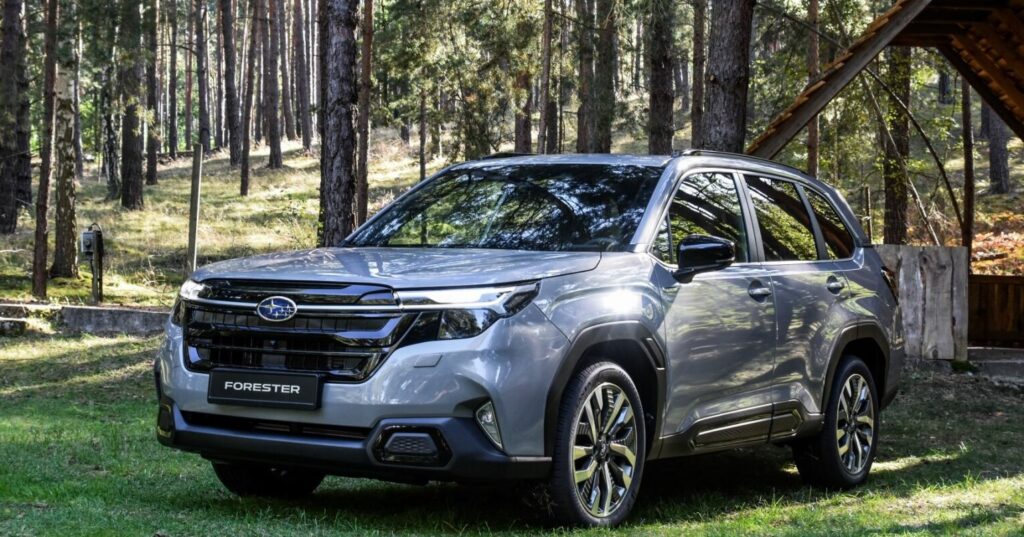
The Subaru Forester VI 2.0i e-BOXER AWD Lineartronic represents Subaru’s continued evolution of its popular compact SUV, launched in October 2024. This variant occupies a key position in the Forester VI lineup, offering a balance between fuel efficiency, all-weather capability, and a relatively accessible price point. It builds upon the foundation of the sixth-generation Forester (introduced as the SM/VS model), which utilizes Subaru’s Global Platform, emphasizing improved safety, comfort, and driving dynamics. The “e-BOXER” designation signifies Subaru’s mild hybrid electric vehicle system, designed to enhance fuel economy and reduce emissions. This model is primarily targeted towards buyers in markets where fuel costs are a concern and all-wheel drive is highly valued, such as Europe, Australia, and North America.
Technical Specifications
| Brand | Subaru |
| Model | Forester |
| Generation | Forester VI |
| Type (Engine) | 2.0i e-BOXER (136 Hp) AWD Lineartronic |
| Start of production | October, 2024 |
| Powertrain Architecture | MHEV (Mild Hybrid Electric Vehicle) |
| Body type | SUV, Crossover |
| Seats | 5 |
| Doors | 5 |
| Fuel consumption at Low speed (WLTP) | 8.3 l/100 km (28.3 US mpg, 34 UK mpg, 12 km/l) |
| Fuel consumption at Medium speed (WLTP) | 7.8 l/100 km (30.2 US mpg, 36.2 UK mpg, 12.8 km/l) |
| Fuel consumption at high speed (WLTP) | 7 l/100 km (33.6 US mpg, 40.4 UK mpg, 14.3 km/l) |
| Fuel consumption at very high speed (WLTP) | 9.1 l/100 km (25.8 US mpg, 31 UK mpg, 11 km/l) |
| Combined fuel consumption (WLTP) | 8.1 l/100 km (29 US mpg, 34.9 UK mpg, 12.3 km/l) |
| CO2 emissions (WLTP) | 183 g/km |
| Fuel Type | Petrol (Gasoline) |
| Acceleration 0 – 100 km/h | 12.2 sec |
| Acceleration 0 – 62 mph | 12.2 sec |
| Acceleration 0 – 60 mph | 11.6 sec |
| Maximum speed | 188 km/h (116.82 mph) |
| Weight-to-power ratio | 12.4 kg/Hp, 80.3 Hp/tonne |
| Weight-to-torque ratio | 9.3 kg/Nm, 107.5 Nm/tonne |
| Gross battery capacity | 0.6 kWh |
| Battery voltage | 118.4 V |
| Battery technology | Lithium-ion (Li-Ion) |
| Battery location | Under the trunk |
| Electric motor power | 17 Hp |
| Electric motor Torque | 66 Nm (48.68 lb.-ft.) |
| Electric motor location | Integrated into the transmission |
| Electric motor type | Synchronous |
| Power | 136 Hp @ 5600 rpm |
| Torque | 182 Nm @ 4000 rpm (134.24 lb.-ft. @ 4000 rpm) |
| Engine layout | Front, Longitudinal |
| Engine displacement | 1995 cm3 (121.74 cu. in.) |
| Number of cylinders | 4 |
| Engine configuration | Boxer |
| Cylinder Bore | 84 mm (3.31 in.) |
| Piston Stroke | 90 mm (3.54 in.) |
| Compression ratio | 12.5:1 |
| Number of valves per cylinder | 4 |
| Fuel injection system | Direct injection |
| Engine aspiration | Naturally aspirated engine |
| Valvetrain | DOHC |
| Engine systems | Start & Stop System, Particulate filter |
| Kerb Weight | 1693-1722 kg (3732.43 – 3796.36 lbs.) |
| Max. weight | 1870 kg (4122.64 lbs.) |
| Max load | 148-177 kg (326.28 – 390.22 lbs.) |
| Trunk (boot) space – minimum | 508 l (17.94 cu. ft.) |
| Trunk (boot) space – maximum | 1731 l (61.13 cu. ft.) |
| Fuel tank capacity | 48 l (12.68 US gal, 10.56 UK gal) |
| Length | 4670 mm (183.86 in.) |
| Width | 1830 mm (72.05 in.) |
| Height | 1730 mm (68.11 in.) |
| Wheelbase | 2670 mm (105.12 in.) |
| Front track | 1565-1570 mm (61.61 – 61.81 in.) |
| Rear (Back) track | 1570-1575 mm (61.81 – 62.01 in.) |
| Ride height (ground clearance) | 220 mm (8.66 in.) |
| Minimum turning circle | 10.8 m (35.43 ft.) |
| Approach angle | 20.4° |
| Departure angle | 25.7° |
| Ramp-over angle | 21° |
| Drivetrain Architecture | ICE and electric motor permanently drive all four wheels |
| Drive wheel | All wheel drive (4×4) |
| Number of gears | automatic transmission Lineartronic |
| Front suspension | Independent, McPherson with coil spring and anti-roll bar |
| Rear suspension | Double wishbone, Coil spring |
| Front brakes | Ventilated discs |
| Rear brakes | Ventilated discs |
| Assisting systems | ABS (Anti-lock braking system) |
| Steering type | Steering rack and pinion |
| Power steering | Electric |
| Tires size | 225/55 R18; 235/50 R19 |
| Wheel rims size | 7J x 18; 7.5J x 19 |
Powertrain & Engine Architecture
The heart of the Forester VI 2.0i e-BOXER is the FB20 2.0-liter naturally aspirated four-cylinder boxer engine. Subaru’s boxer configuration, with horizontally opposed pistons, contributes to a low center of gravity, enhancing stability and handling. This engine utilizes direct fuel injection and a dual overhead camshaft (DOHC) valvetrain with four valves per cylinder. The “e-BOXER” system incorporates a small electric motor integrated into the Lineartronic continuously variable transmission (CVT). This motor provides supplemental torque during acceleration and allows for a more seamless start-stop system operation. The mild hybrid system doesn’t enable full electric driving, but it assists the engine, improving fuel efficiency. The Lineartronic CVT is programmed to simulate stepped gear changes for a more conventional driving feel.
Driving Characteristics
The 136 horsepower and 182 Nm (134 lb-ft) of torque delivered by the 2.0i e-BOXER powertrain result in a comfortable, rather than sporty, driving experience. Acceleration from 0-60 mph takes around 11.6 seconds, and 0-100 km/h in 12.2 seconds. The Lineartronic CVT, while smooth, can sometimes feel less responsive than a traditional automatic transmission, particularly during quick overtaking maneuvers. The all-wheel-drive system provides excellent traction in various weather conditions, making it a capable vehicle for year-round use. Compared to higher-output Forester variants (like those with the turbocharged 2.4-liter engine), this version prioritizes fuel economy and ease of driving over outright performance. The electric motor assist does provide a noticeable boost during initial acceleration, mitigating some of the CVT’s inherent lag.
Equipment & Trim Levels
The 2.0i e-BOXER typically comes well-equipped, often serving as a mid-range trim level. Standard features generally include Subaru’s EyeSight driver-assist technology (including adaptive cruise control, lane departure warning, and automatic emergency braking), a touchscreen infotainment system with Apple CarPlay and Android Auto compatibility, automatic climate control, and power-adjustable seats. Interior upholstery is typically cloth, with options for leather upgrades. Available extras often include a sunroof, premium audio system, and advanced safety features like blind-spot monitoring and rear cross-traffic alert.
Chassis & Braking
The Forester VI utilizes Subaru’s Global Platform, which provides a rigid and stable chassis. The suspension consists of independent McPherson struts at the front and a double-wishbone setup at the rear. This configuration delivers a comfortable ride quality, absorbing bumps and imperfections in the road effectively. Braking duties are handled by ventilated discs on all four wheels, providing adequate stopping power. The electronic stability control (ESC) system works in conjunction with the all-wheel-drive system to maintain control in challenging driving conditions.
Market Reception & Comparison
The Subaru Forester VI 2.0i e-BOXER has been generally well-received by automotive critics, praised for its fuel efficiency, safety features, and all-weather capability. Compared to other trims in the Forester lineup, this variant offers a compelling value proposition for buyers who prioritize economy and practicality. While the turbocharged models offer more performance, they come at a higher price and with lower fuel economy. Competitors in the compact SUV segment, such as the Toyota RAV4 and Honda CR-V, offer similar levels of practicality and fuel efficiency, but often lack the standard all-wheel-drive system found in the Forester.
Legacy
The FB20 engine, in its various iterations, has proven to be a reliable and durable powerplant. The addition of the e-BOXER mild hybrid system is expected to further enhance its longevity by reducing engine strain. As a used car, the Forester VI 2.0i e-BOXER is likely to hold its value well, thanks to Subaru’s reputation for reliability and the vehicle’s all-weather capability. Regular maintenance, including oil changes and fluid checks, will be crucial to ensuring its long-term dependability. The Lineartronic CVT, while generally reliable, should be serviced according to Subaru’s recommended intervals to prevent potential issues.