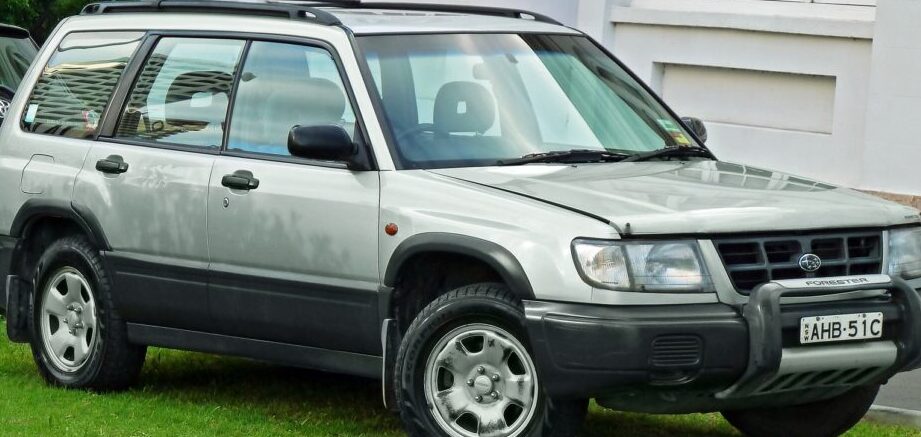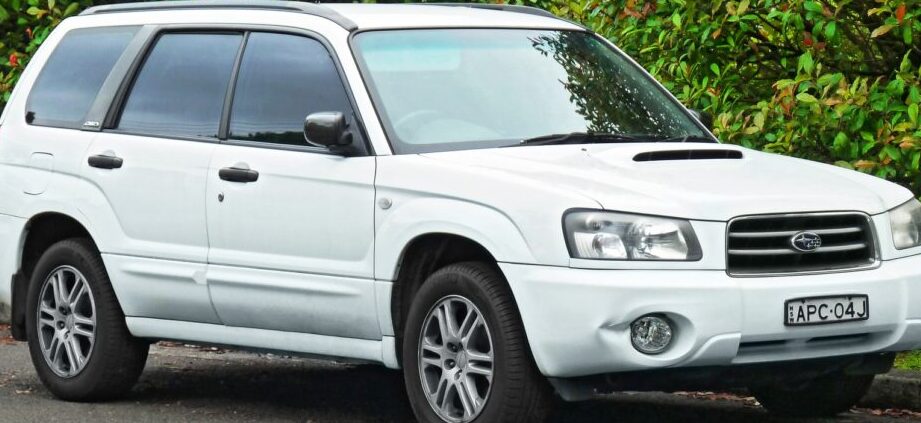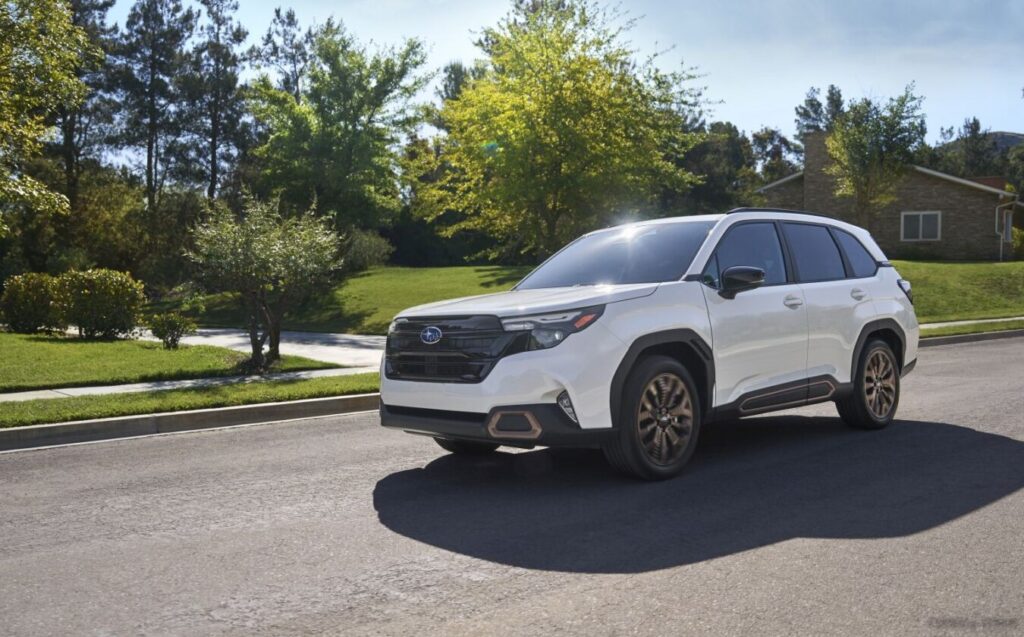
The Subaru Forester VI 2.5, equipped with a 180 horsepower engine and Lineartronic continuously variable transmission (CVT), represents the latest iteration of Subaru’s popular compact SUV. Introduced in 2024, this variant builds upon the sixth generation (introduced as the SM/VS model) of the Forester, known for its standard all-wheel drive and focus on practicality. This specific configuration aims to balance fuel efficiency with adequate performance for everyday driving, positioning itself as a mainstream offering within the Forester lineup. It continues Subaru’s commitment to the symmetrical all-wheel drive system and boxer engine design.
Technical Specifications
| Brand | Subaru |
| Model | Forester |
| Generation | Forester VI |
| Type (Engine) | 2.5 (180 Hp) AWD Lineartronic |
| Start of production | 2024 |
| Powertrain Architecture | Internal Combustion engine |
| Body type | SUV, Crossover |
| Seats | 5 |
| Doors | 5 |
| Fuel consumption (economy) – urban (EPA) | 9 l/100 km (26.1 US mpg) |
| Fuel consumption (economy) – extra urban (EPA) | 7.1 l/100 km (33.1 US mpg) |
| Fuel consumption (economy) – combined (EPA) | 8.1 l/100 km (29 US mpg) |
| Fuel Type | Petrol (Gasoline) |
| Weight-to-power ratio | 8.8 kg/Hp |
| Weight-to-torque ratio | 6.6 kg/Nm |
| Power | 180 Hp @ 5800 rpm |
| Power per litre | 72.1 Hp/l |
| Torque | 241 Nm @ 3700 rpm (177.75 lb.-ft. @ 3700 rpm) |
| Engine layout | Front, Longitudinal |
| Engine Model/Code | FB25 |
| Engine displacement | 2498 cm3 (152.44 cu. in.) |
| Number of cylinders | 4 |
| Engine configuration | Boxer |
| Cylinder Bore | 94 mm (3.7 in.) |
| Piston Stroke | 90 mm (3.54 in.) |
| Compression ratio | 12:1 |
| Number of valves per cylinder | 4 |
| Fuel injection system | Direct injection |
| Engine aspiration | Naturally aspirated engine |
| Valvetrain | DOHC, DAVCS |
| Engine systems | Start & Stop System |
| Kerb Weight | 1592-1662 kg (3509.76 – 3664.08 lbs.) |
| Trunk (boot) space – minimum | 779 l (27.51 cu. ft.) |
| Trunk (boot) space – maximum | 2107 l (74.41 cu. ft.) |
| Fuel tank capacity | 63 l (16.64 US gal | 13.86 UK gal) |
| Length | 4656 mm (183.31 in.) |
| Width | 1829 mm (72.01 in.) |
| Width including mirrors | 2062 mm (81.18 in.) |
| Height | 1730 mm (68.11 in.) |
| Wheelbase | 2670 mm (105.12 in.) |
| Front track | 1565-1570 mm (61.61 – 61.81 in.) |
| Rear (Back) track | 1570-1575 mm (61.81 – 62.01 in.) |
| Ride height (ground clearance) | 221 mm (8.7 in.) |
| Minimum turning circle (turning diameter) | 10.8 m (35.43 ft.) |
| Approach angle | 19° |
| Departure angle | 24.6° |
| Ramp-over (brakeover) angle | 19.6° |
| Drivetrain Architecture | All wheel drive (4×4) |
| Number of gears and type of gearbox | automatic transmission CVT Lineartronic |
| Front suspension | Independent, type McPherson with coil spring and anti-roll bar |
| Rear suspension | Double wishbone, Transverse stabilizer, Coil spring |
| Front brakes | Ventilated discs, 315 mm |
| Rear brakes | Ventilated discs, 300 mm |
| Assisting systems | ABS (Anti-lock braking system) |
| Steering type | Steering rack and pinion |
| Power steering | Electric Steering |
| Tires size | 225/60 R17; 225/55 R18; 235/50 R19 |
| Wheel rims size | 7J x 17; 7J x 18; 7.5J x 19 |
INTRODUCTION
The 2024 Subaru Forester VI 2.5 AWD Lineartronic is a five-passenger compact SUV that represents a significant update to Subaru’s best-selling model. Building on the foundation laid by the fifth-generation Forester (SK series), the VI generation (SM/VS) introduces enhanced safety features, updated styling, and refinements to the powertrain. This 2.5-liter variant is positioned as the standard engine option in many markets, offering a balance between performance and fuel economy. It’s designed to appeal to a broad range of buyers seeking a practical, reliable, and capable SUV for daily commuting and weekend adventures. The Forester has long been a popular choice for those prioritizing all-weather capability and a spacious interior.
Powertrain & Engine Architecture
At the heart of the Forester VI 2.5 is the FB25 2.5-liter naturally aspirated four-cylinder boxer engine. This engine is a hallmark of Subaru’s engineering, known for its low center of gravity and smooth operation. The FB25 utilizes direct fuel injection, contributing to improved fuel efficiency and responsiveness. The engine also incorporates Subaru’s Dynamic Active Valve Control System (DAVCS) on both the intake and exhaust valves, optimizing performance across the rev range. The Lineartronic CVT, replacing traditional geared automatic transmissions, is designed to provide seamless acceleration and improved fuel economy. This CVT features simulated shift points to mimic the feel of a conventional automatic, addressing a common complaint about earlier CVT implementations. The engine produces 180 horsepower at 5800 rpm and 177.75 lb-ft of torque at 3700 rpm.
Driving Characteristics
The Forester VI 2.5 with the Lineartronic CVT delivers a comfortable and predictable driving experience. While not particularly sporty, the engine provides adequate power for merging onto highways and passing maneuvers. The CVT effectively manages the engine’s powerband, offering smooth and linear acceleration. Compared to a manual transmission-equipped Forester, the CVT prioritizes fuel efficiency over outright performance. The simulated shift points help to mitigate the “rubber band” feel often associated with CVTs, but the engine can sometimes feel strained under hard acceleration. Subaru’s symmetrical all-wheel drive system provides excellent traction in various conditions, making the Forester a confident performer in rain, snow, or on gravel roads. The gear ratios are optimized for fuel economy, with a focus on keeping the engine in its most efficient operating range.
Equipment & Trim Levels
The standard equipment on the 2024 Subaru Forester VI 2.5 typically includes features such as automatic climate control, a touchscreen infotainment system with Apple CarPlay and Android Auto compatibility, Subaru’s EyeSight driver-assist technology (including adaptive cruise control, lane departure warning, and automatic emergency braking), and a suite of safety features. Interior upholstery is generally cloth, with options for leather upgrades on higher trim levels. Available options include a power sunroof, premium audio system, and heated front seats. Trim levels vary by market, but generally progress from a base model to more luxurious variants with additional features and cosmetic enhancements.
Chassis & Braking
The Forester VI utilizes a McPherson strut front suspension and a double-wishbone rear suspension, providing a comfortable ride and predictable handling. Stabilizer bars are fitted to both the front and rear axles to reduce body roll during cornering. The braking system consists of ventilated disc brakes on all four wheels, providing ample stopping power. The braking system is augmented by ABS (Anti-lock Braking System) and electronic brake-force distribution. The suspension tuning is geared towards comfort and practicality, prioritizing ride quality over sporty handling. The Forester’s relatively high ground clearance (8.7 inches) enhances its off-road capability.
Market Reception & Comparison
The Subaru Forester VI 2.5 has been generally well-received by automotive critics, praised for its spacious interior, standard all-wheel drive, and comprehensive safety features. Compared to other compact SUVs in its class, the Forester stands out for its standard AWD and focus on practicality. Fuel economy is competitive, averaging around 29 US mpg in combined driving. Some critics have noted that the engine can feel underpowered when fully loaded or climbing steep hills. Compared to higher-trim Forester models with more powerful engine options (if available in certain markets), the 2.5-liter variant offers a more affordable entry point into the Forester lineup.
Legacy
The FB25 engine has proven to be a reliable and durable powerplant in Subaru vehicles. While the Lineartronic CVT has undergone continuous improvements, long-term reliability remains a key consideration for potential buyers. The Forester’s reputation for reliability and resale value is strong, making it a popular choice in the used car market. The combination of all-wheel drive, a spacious interior, and a focus on safety has cemented the Forester’s position as a leading compact SUV, and the VI generation continues this legacy with refinements to its powertrain and features.