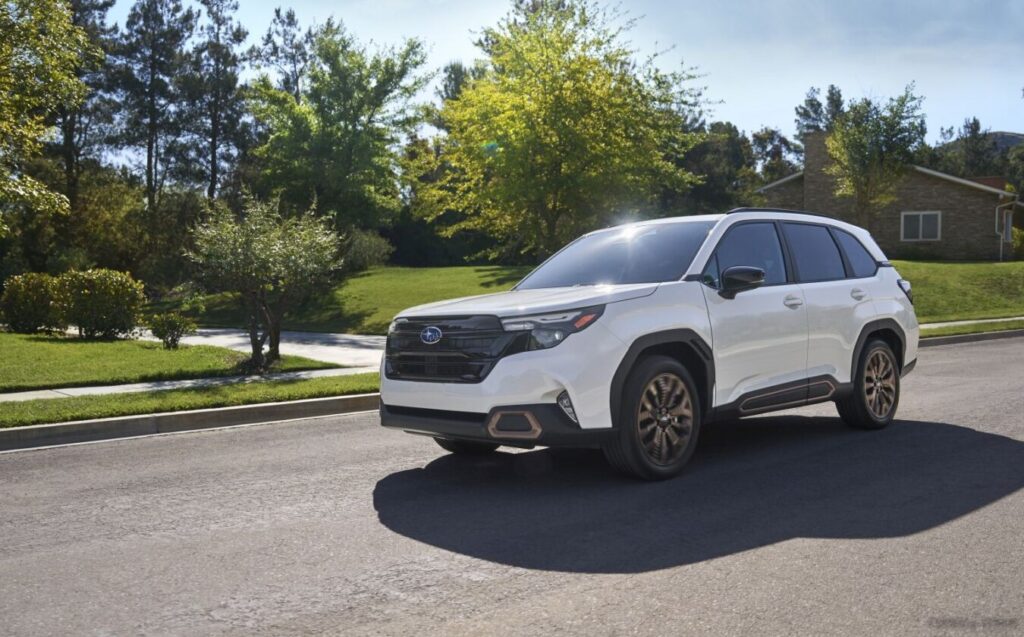
The Subaru Forester VI 2.5 Hybrid AWD Lineartronic, introduced in February 2025, represents the latest iteration of Subaru’s popular compact SUV. Positioned as a technologically advanced and fuel-efficient option within the sixth-generation Forester lineup (introduced as the SM/VS model), this variant combines a 2.5-liter naturally aspirated Boxer engine with a full hybrid electric vehicle (FHEV) system and Subaru’s signature Symmetrical All-Wheel Drive. It aims to appeal to buyers seeking a balance of practicality, capability, and reduced emissions. This model is primarily targeted towards the North American and European markets, where demand for fuel-efficient SUVs with all-weather capability is high.
Technical Specifications
| Brand | Subaru |
| Model | Forester |
| Generation | Forester VI |
| Type (Engine) | 2.5 (194 Hp) Hybrid AWD Lineartronic |
| Start of production | February, 2025 |
| Powertrain Architecture | FHEV (Full Hybrid Electric Vehicle) |
| Body type | SUV, Crossover |
| Seats | 5 |
| Doors | 5 |
| Fuel consumption (economy) – urban (EPA) | 6.7 l/100 km (35.1 US mpg, 42.2 UK mpg, 14.9 km/l) |
| Fuel consumption (economy) – extra urban (EPA) | 6.9 l/100 km (34.1 US mpg, 40.9 UK mpg, 14.5 km/l) |
| Fuel consumption (economy) – combined (EPA) | 6.7 l/100 km (35.1 US mpg, 42.2 UK mpg, 14.9 km/l) |
| Fuel Type | Petrol (Gasoline) |
| Weight-to-power ratio | 9.1 kg/Hp, 110.4 Hp/tonne |
| Weight-to-torque ratio | 8.4 kg/Nm, 119 Nm/tonne |
| Gross battery capacity | 1.1 kWh |
| Battery technology | Lithium-ion (Li-Ion) |
| Electric motor power | 118 Hp |
| Electric motor Torque | 270 Nm (199.14 lb.-ft.) |
| Electric motor location | Integrated into the transmission |
| Electric motor type | Synchronous |
| System power | 194 Hp |
| Power | 162 Hp |
| Power per litre | 64.9 Hp/l |
| Torque | 209 Nm (154.15 lb.-ft.) |
| Engine layout | Front, Longitudinal |
| Engine displacement | 2498 cm3 (152.44 cu. in.) |
| Number of cylinders | 4 |
| Engine configuration | Boxer |
| Cylinder Bore | 94 mm (3.7 in.) |
| Piston Stroke | 90 mm (3.54 in.) |
| Compression ratio | 12:1 |
| Number of valves per cylinder | 4 |
| Fuel injection system | Direct injection |
| Engine aspiration | Naturally aspirated engine |
| Valvetrain | DOHC |
| Kerb Weight | 1757-1790 kg (3873.52 – 3946.27 lbs.) |
| Trunk (boot) space – minimum | 779 l (27.51 cu. ft.) |
| Trunk (boot) space – maximum | 1957 l (69.11 cu. ft.) |
| Fuel tank capacity | 63 l (16.64 US gal | 13.86 UK gal) |
| Permitted trailer load with brakes (12%) | 680 kg (1499.14 lbs.) |
| Permitted towbar download | 68 kg (149.91 lbs.) |
| Length | 4655 mm (183.27 in.) |
| Width | 1830 mm (72.05 in.) |
| Width including mirrors | 2062 mm (81.18 in.) |
| Height | 1730 mm (68.11 in.) |
| Wheelbase | 2670 mm (105.12 in.) |
| Front track | 1565-1570 mm (61.61 – 61.81 in.) |
| Rear (Back) track | 1570-1575 mm (61.81 – 62.01 in.) |
| Ride height (ground clearance) | 220 mm (8.66 in.) |
| Minimum turning circle (turning diameter) | 10.7-10.8 m (35.1 – 35.43 ft.) |
| Front brakes | Ventilated discs, 320 mm |
| Rear brakes | Ventilated discs, 300 mm |
| Gearbox | automatic transmission Lineartronic |
Powertrain & Engine Architecture
At the heart of the Forester VI 2.5 Hybrid is the FB25 2.5-liter naturally aspirated Boxer engine. This engine, a hallmark of Subaru’s engineering, features horizontally opposed pistons, contributing to a low center of gravity and improved balance. The FB25 utilizes direct fuel injection and a dual overhead camshaft (DOHC) valvetrain with four valves per cylinder. The hybrid system incorporates a compact electric motor integrated directly into the Lineartronic continuously variable transmission (CVT). This configuration allows for electric-only driving at low speeds and assists the gasoline engine during acceleration, improving both fuel economy and performance. The 1.1 kWh lithium-ion battery pack is positioned under the floor, minimizing impact on passenger or cargo space. The Lineartronic CVT is programmed to simulate stepped gear changes for a more natural driving feel, addressing a common criticism of traditional CVTs.
Driving Characteristics
The 2.5-liter Hybrid powertrain delivers a combined output of 194 horsepower. While not the most powerful Forester variant (compared to the turbocharged models available in some markets), the hybrid system provides ample torque for everyday driving situations. The Lineartronic CVT offers smooth and seamless acceleration, although it may lack the responsiveness of a traditional automatic transmission. The electric motor’s instant torque helps to fill in gaps in the engine’s power delivery. In real-world conditions, the hybrid system excels in city driving, where frequent stop-and-go traffic allows for maximizing electric-only operation. The Symmetrical All-Wheel Drive system provides confident traction in various weather conditions, a key selling point for Subaru vehicles.
Equipment & Trim Levels
The 2.5 Hybrid AWD Lineartronic trim typically comes well-equipped with standard features such as Subaru’s EyeSight driver-assist technology (including adaptive cruise control, lane departure warning, and automatic emergency braking), a touchscreen infotainment system with Apple CarPlay and Android Auto compatibility, automatic climate control, and power-adjustable front seats. Interior upholstery is generally cloth, with available upgrades to leather. Optional extras often include a premium sound system, a power sunroof, and advanced safety features like blind-spot monitoring and rear cross-traffic alert.
Chassis & Braking
The Forester VI utilizes a McPherson strut front suspension and a double-wishbone rear suspension, optimized for ride comfort and handling. Stabilizer bars are fitted to both axles to reduce body roll during cornering. Braking duties are handled by ventilated disc brakes on all four wheels, providing ample stopping power. The electronic parking brake with auto hold function is standard. The chassis is designed to accommodate the added weight of the hybrid system without compromising handling or stability.
Market Reception & Comparison
The Subaru Forester VI 2.5 Hybrid has been generally well-received by automotive critics, praised for its fuel efficiency, comfortable ride, and standard safety features. Compared to the non-hybrid 2.5-liter Forester, the hybrid variant offers significantly improved fuel economy, particularly in urban driving. However, the hybrid model typically carries a higher price tag. Compared to other hybrid SUVs in its class, the Forester Hybrid stands out with its standard all-wheel drive and spacious interior. Some reviewers have noted that the Lineartronic CVT can feel less engaging than traditional automatic transmissions.
Legacy
The FB25 engine, in its various iterations, has proven to be a reliable and durable powerplant. The addition of the hybrid system in the Forester VI is expected to further enhance its long-term reliability by reducing the load on the internal combustion engine. On the used car market, the Forester VI 2.5 Hybrid is anticipated to hold its value well due to its fuel efficiency and Subaru’s reputation for dependability. The integration of the hybrid system represents Subaru’s commitment to electrification and sustainable mobility.