
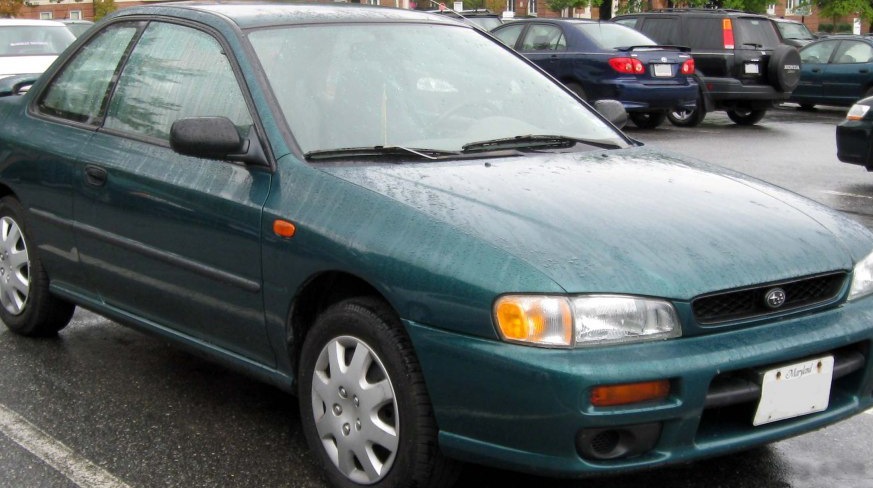
The Subaru Impreza I Coupe (GFC) 1.6, produced between 1996 and 2000, represented Subaru’s entry-level offering within the first generation Impreza lineup. Positioned as a more affordable and accessible variant, it catered to buyers seeking the Impreza’s renowned all-wheel drive capability in a compact, coupe body style, without the higher price tag of the more powerful models. This particular 1.6-liter, 90 horsepower version was primarily sold in European and Asian markets, offering a balance between fuel efficiency and Subaru’s signature driving dynamics. While not a performance leader, it provided a reliable and practical transportation option for a broad range of drivers.
Technical Specifications
| Brand | Subaru |
| Model | Impreza |
| Generation | Impreza I Coupe (GFC) |
| Type (Engine) | 1.6 (90 Hp) |
| Start of production | 1996 |
| End of production | 2000 |
| Powertrain Architecture | Internal Combustion engine |
| Body type | Coupe |
| Seats | 4 |
| Doors | 2 |
| Fuel consumption (urban) | 10.9 l/100 km (21.6 US mpg) |
| Fuel consumption (extra urban) | 6.8 l/100 km (34.6 US mpg) |
| Fuel Type | Petrol (Gasoline) |
| Acceleration 0 – 100 km/h | 12.3 sec |
| Acceleration 0 – 62 mph | 12.3 sec |
| Acceleration 0 – 60 mph | 11.7 sec |
| Maximum speed | 175 km/h (108.74 mph) |
| Weight-to-power ratio | 11.7 kg/Hp |
| Weight-to-torque ratio | 8.2 kg/Nm |
| Power | 90 Hp @ 5600 rpm |
| Torque | 128 Nm @ 4000 rpm (94.41 lb.-ft. @ 4000 rpm) |
| Engine layout | Front, Longitudinal |
| Engine Model/Code | EJ16 |
| Engine displacement | 1597 cm3 (97.45 cu. in.) |
| Number of cylinders | 4 |
| Engine configuration | Boxer |
| Cylinder Bore | 87.9 mm (3.46 in.) |
| Piston Stroke | 65.8 mm (2.59 in.) |
| Compression ratio | 9.4:1 |
| Number of valves per cylinder | 4 |
| Fuel injection system | Multi-port manifold injection |
| Engine aspiration | Naturally aspirated engine |
| Valvetrain | OHC |
| Engine oil capacity | 4 l (4.23 US qt | 3.52 UK qt) |
| Kerb Weight | 1050 kg (2314.85 lbs.) |
| Max. weight | 1680 kg (3703.77 lbs.) |
| Max load | 630 kg (1388.91 lbs.) |
| Trunk (boot) space | 365 l (12.89 cu. ft.) |
| Fuel tank capacity | 50 l (13.21 US gal | 11 UK gal) |
| Length | 4374 mm (172.2 in.) |
| Width | 1690 mm (66.54 in.) |
| Height | 1410 mm (55.51 in.) |
| Wheelbase | 2520 mm (99.21 in.) |
| Front track | 1460 mm (57.48 in.) |
| Rear track | 1455 mm (57.28 in.) |
| Drivetrain Architecture | Front wheel drive |
| Number of gears | 5 gears, manual transmission |
Powertrain & Engine Architecture
The heart of the Impreza 1.6 Coupe was the EJ16 engine, a 1.6-liter, naturally aspirated, four-cylinder boxer engine. Subaru’s boxer configuration, with horizontally opposed pistons, provided a low center of gravity, contributing to the car’s balanced handling. The EJ16 featured a single overhead camshaft (OHC) design and multi-port fuel injection. This engine produced 90 horsepower at 5600 rpm and 128 Nm (94.41 lb-ft) of torque at 4000 rpm. The engine’s relatively modest output was typical for entry-level cars of the era, prioritizing fuel economy over outright performance. The transmission was a standard five-speed manual, offering a direct connection between the engine and the front wheels. While an automatic transmission was available in some markets, it was less common with this engine configuration.
Driving Characteristics
The 1.6-liter Impreza Coupe offered a predictable and manageable driving experience. Acceleration was adequate for everyday driving, with a 0-60 mph time of around 11.7 seconds. However, it lacked the punch of the more powerful 1.8 or 2.0-liter Impreza variants. The five-speed manual transmission provided reasonable control, but the engine needed to be revved to extract its full potential. The front-wheel drive layout, while contributing to fuel efficiency, didn’t offer the same level of traction and stability as Subaru’s more renowned all-wheel drive systems found in higher-spec Impreza models. The suspension was tuned for comfort, providing a relatively smooth ride, but it wasn’t particularly sporty.
Equipment & Trim Levels
The 1.6-liter Impreza Coupe was typically equipped with basic amenities. Standard features generally included power steering, central locking, and electric windows. Interior upholstery was typically cloth, and the dashboard featured a functional, if somewhat spartan, design. Optional extras could include air conditioning, a radio/cassette player, and alloy wheels. The trim level was generally considered the base model, aimed at budget-conscious buyers. It served as a stepping stone to the more well-equipped and powerful Impreza variants.
Chassis & Braking
The Impreza Coupe featured a MacPherson strut front suspension and a double-wishbone rear suspension. A transverse stabilizer bar was fitted to both the front and rear axles to reduce body roll during cornering. The braking system consisted of ventilated discs on the front wheels and drum brakes on the rear. Anti-lock braking system (ABS) was often included as standard equipment, enhancing safety. The chassis was designed to provide a balance between rigidity and weight, contributing to the car’s handling characteristics. The tires were typically 185/70 R14, offering a reasonable compromise between grip and ride comfort.
Market Reception & Comparison
The 1.6-liter Impreza Coupe was generally well-received as an affordable and practical entry point into the Impreza range. Critics acknowledged its fuel efficiency and ease of driving, but noted its lack of outright performance compared to the higher-spec models. Compared to the 1.8-liter and 2.0-liter Impreza variants, the 1.6 offered lower running costs but sacrificed acceleration and overall driving excitement. The 1.8-liter models, while more expensive, provided a noticeable performance boost, while the 2.0-liter WRX models were aimed at enthusiasts seeking a high-performance experience. The 1.6-liter version was often seen as a sensible choice for first-time buyers or those prioritizing fuel economy and reliability.
Legacy
The Subaru Impreza I Coupe 1.6, while not the most iconic version of the Impreza, remains a relatively reliable and affordable used car option today. The EJ16 engine is known for its durability, and with proper maintenance, it can provide many years of service. However, potential buyers should be aware of common issues associated with older Subarus, such as oil leaks and corrosion. The 1.6-liter Impreza Coupe represents a significant part of Subaru’s history, demonstrating the brand’s commitment to providing accessible and reliable transportation. Its simple design and robust construction have ensured its continued presence on roads around the world, offering a nostalgic glimpse into the early days of the Impreza lineage.
