
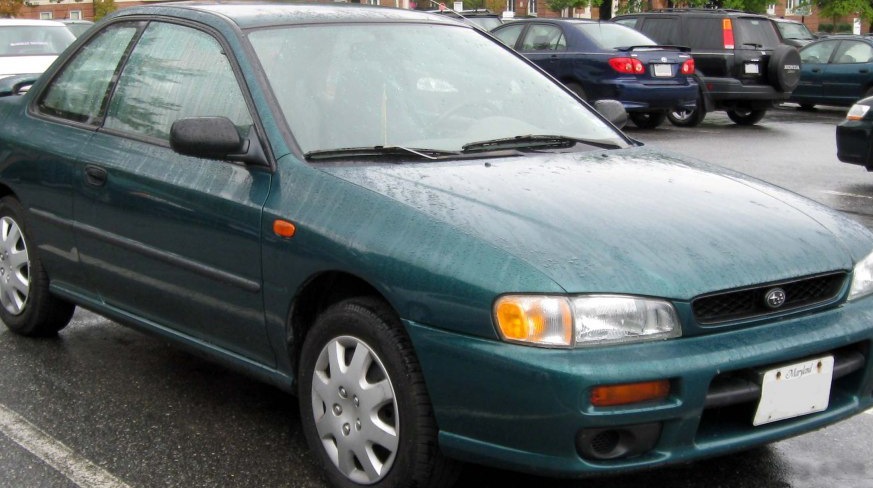
The Subaru Impreza I Coupe (GFC) 2.0, produced between 1995 and 2000, represented Subaru’s entry into the increasingly popular compact coupe market. Positioned as a more sporting alternative to the Impreza sedan and wagon, the GFC chassis code designates this specific coupe body style. It was a key component of the first-generation Impreza (1992-2000), sharing its platform with other models but offering a distinct two-door profile and a focus on driver engagement. The 2.0-liter engine, producing 115 horsepower, coupled with Subaru’s signature symmetrical all-wheel drive, aimed to deliver a blend of performance and all-weather capability. This variant served as a more affordable and accessible entry point into the Impreza range, appealing to buyers seeking a practical yet fun-to-drive vehicle.
Technical Specifications
| Brand | Subaru |
| Model | Impreza |
| Generation | Impreza I Coupe (GFC) |
| Type | 2.0 (115 Hp) 4WD |
| Start of production | 1995 |
| End of production | 2000 |
| Powertrain Architecture | Internal Combustion engine |
| Body type | Coupe |
| Seats | 5 |
| Doors | 2 |
| Fuel Type | Petrol (Gasoline) |
| Power | 115 Hp |
| Power per litre | 57.7 Hp/l |
| Torque | 170 Nm @ 4400 rpm (125.39 lb.-ft. @ 4400 rpm) |
| Engine layout | Front, Longitudinal |
| Engine Model/Code | EJ20G |
| Engine displacement | 1994 cm3 (121.68 cu. in.) |
| Number of cylinders | 4 |
| Engine configuration | Boxer |
| Cylinder Bore | 92 mm (3.62 in.) |
| Piston Stroke | 75 mm (2.95 in.) |
| Compression ratio | 9.5:1 |
| Number of valves per cylinder | 4 |
| Fuel injection system | Multi-port manifold injection |
| Engine aspiration | Naturally aspirated engine |
| Valvetrain | OHC |
| Engine oil capacity | 4 l (4.23 US qt | 3.52 UK qt) |
| Trunk (boot) space – minimum | 365 l (12.89 cu. ft.) |
| Fuel tank capacity | 50 l (13.21 US gal | 11 UK gal) |
| Length | 4350 mm (171.26 in.) |
| Width | 1690 mm (66.54 in.) |
| Height | 1410 mm (55.51 in.) |
| Wheelbase | 2520 mm (99.21 in.) |
| Front track | 1470 mm (57.87 in.) |
| Rear (Back) track | 1450 mm (57.09 in.) |
| Drive wheel | All wheel drive (4×4) |
| Number of gears and type of gearbox | 5 gears, manual transmission |
| Front suspension | Wishbone |
| Rear suspension | Several levers and rods |
| Front brakes | Ventilated discs |
| Rear brakes | Drum |
| Assisting systems | ABS (Anti-lock braking system) |
| Steering type | Steering rack and pinion |
| Power steering | Hydraulic Steering |
Powertrain & Engine Architecture
The heart of the Impreza 2.0 Coupe was the EJ20G engine, a 1994cc (121.68 cu. in.) naturally aspirated, horizontally-opposed (boxer) four-cylinder. This engine design, a Subaru hallmark, offered inherent balance and a lower center of gravity, contributing to improved handling. The EJ20G utilized a single overhead camshaft (OHC) design operating four valves per cylinder. Fuel delivery was managed by a multi-port fuel injection system, providing precise fuel metering for optimal combustion. The 9.5:1 compression ratio was a compromise between performance and fuel efficiency. The engine produced 115 horsepower at a yet unspecified RPM and 170 Nm (125.39 lb.-ft.) of torque at 4400 rpm. The engine’s longitudinal mounting allowed for a more efficient drivetrain layout, maximizing space within the engine bay and contributing to the car’s balanced weight distribution. The standard transmission was a five-speed manual, providing drivers with direct control over the engine’s power.
Driving Characteristics
The 115 hp output, while not overwhelming, provided adequate performance for everyday driving. The Impreza 2.0 Coupe wasn’t designed for outright speed, but rather for a balanced driving experience. Acceleration was respectable, and the all-wheel-drive system provided excellent traction in various conditions. The five-speed manual transmission offered a reasonably engaging driving experience, although the gear ratios were tuned for fuel economy and usability rather than aggressive performance. Compared to the more powerful turbocharged Impreza WRX models, the 2.0-liter version felt noticeably less responsive, particularly at higher speeds. However, it offered a smoother, more linear power delivery, making it easier to drive in urban environments. The all-wheel-drive system, a key Subaru differentiator, instilled confidence in slippery conditions, providing a level of stability that front-wheel-drive competitors couldn’t match.
Equipment & Trim Levels
The Impreza 2.0 Coupe typically came with a fairly basic level of equipment, reflecting its position as an entry-level model. Standard features generally included power steering, ABS brakes, and a basic audio system. Interior upholstery was typically cloth, and the dashboard featured a functional, if somewhat spartan, design. Optional extras could include air conditioning, power windows, and upgraded audio systems. Trim levels varied depending on the market, but generally offered incremental upgrades in terms of interior comfort and convenience features. The focus was on providing a practical and reliable vehicle at an affordable price point.
Chassis & Braking
The Impreza Coupe utilized a MacPherson strut front suspension and a multi-link rear suspension, providing a comfortable ride and predictable handling. The suspension was tuned for a balance between comfort and control, offering a reasonably compliant ride over uneven surfaces. Braking duties were handled by ventilated discs at the front and drum brakes at the rear. While adequate for normal driving conditions, the rear drum brakes were a cost-saving measure and didn’t offer the same stopping power as disc brakes. The hydraulic power steering provided light and responsive steering feel, making the car easy to maneuver in tight spaces.
Market Reception & Comparison
The Impreza 2.0 Coupe was generally well-received by automotive critics as a practical and reliable vehicle. However, its performance was often criticized as being somewhat underwhelming, particularly when compared to the more powerful turbocharged models. Fuel economy was considered to be average for its class. Compared to other coupes in its segment, such as the Honda Civic Coupe or Toyota Celica, the Impreza offered the distinct advantage of all-wheel drive, making it a compelling choice for buyers in regions with inclement weather. The 2.0-liter engine also proved to be relatively reliable, with fewer reported issues compared to the more complex turbocharged engines.
Legacy
The Subaru Impreza I Coupe 2.0 (115 Hp) 4WD, while not the most iconic version of the Impreza, remains a popular choice among enthusiasts and collectors. The EJ20G engine is known for its durability and relatively simple maintenance requirements. Today, well-maintained examples are becoming increasingly rare, and prices for clean, original cars are steadily rising. The Impreza Coupe’s combination of all-wheel drive, practicality, and affordability has cemented its place as a cult classic, appealing to those seeking a unique and engaging driving experience. Its enduring appeal lies in its simplicity, reliability, and the inherent charm of Subaru’s boxer engine and symmetrical all-wheel-drive system.
