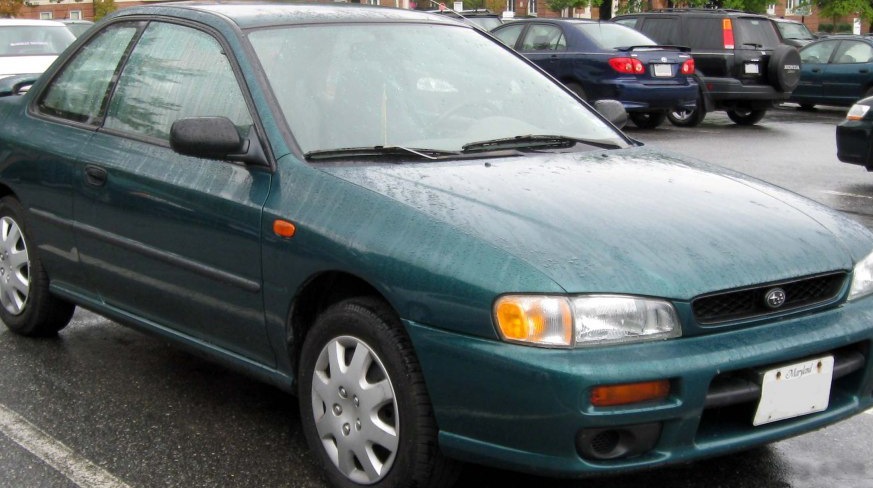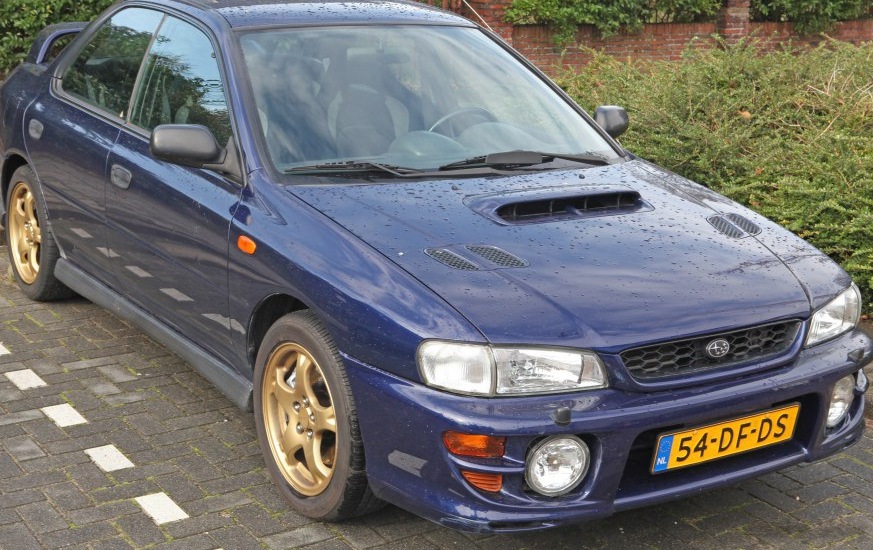
The Subaru Impreza I (GC) 1.6i, produced from 1992 to 2000, represented the entry point into the first generation of Subaru’s popular compact car. Positioned as an affordable and practical option, the 1.6i utilized Subaru’s signature symmetrical all-wheel drive system – though this specific variant was front wheel drive – and horizontally-opposed “Boxer” engine. It served as a crucial model for establishing the Impreza’s presence in the global market, particularly in Europe and Australia, where compact, reliable transportation was highly valued. This variant was often chosen by buyers prioritizing fuel efficiency and lower running costs over outright performance, making it a common sight as a family car or commuter vehicle.
Technical Specifications
| Brand | Subaru |
| Model | Impreza |
| Generation | Impreza I (GC) |
| Type (Engine) | 1.6i (90 Hp) |
| Start of production | 1992 |
| End of production | 2000 |
| Powertrain Architecture | Internal Combustion engine |
| Body type | Sedan |
| Seats | 5 |
| Doors | 4 |
| Fuel consumption (combined) | 8.2 l/100 km |
| Fuel consumption (US mpg) | 28.7 US mpg |
| Fuel consumption (UK mpg) | 34.4 UK mpg |
| Fuel consumption (km/l) | 12.2 km/l |
| Fuel Type | Petrol (Gasoline) |
| Acceleration 0 – 100 km/h | 13.1 sec |
| Acceleration 0 – 62 mph | 13.1 sec |
| Acceleration 0 – 60 mph | 12.4 sec |
| Maximum speed | 172 km/h (106.88 mph) |
| Weight-to-power ratio | 12.4 kg/Hp |
| Weight-to-torque ratio | 8.7 kg/Nm |
| Power | 90 Hp @ 5600 rpm |
| Power per litre | 56.4 Hp/l |
| Torque | 128 Nm @ 4000 rpm (94.41 lb.-ft. @ 4000 rpm) |
| Engine layout | Front, Longitudinal |
| Engine Model/Code | EJ16 |
| Engine displacement | 1597 cm3 (97.45 cu. in.) |
| Number of cylinders | 4 |
| Engine configuration | Boxer |
| Cylinder Bore | 87.9 mm (3.46 in.) |
| Piston Stroke | 65.8 mm (2.59 in.) |
| Compression ratio | 9.4:1 |
| Number of valves per cylinder | 4 |
| Fuel injection system | Multi-port manifold injection |
| Engine aspiration | Naturally aspirated engine |
| Valvetrain | OHC |
| Engine oil capacity | 4 l (4.23 US qt | 3.52 UK qt) |
| Kerb Weight | 1115 kg (2458.15 lbs.) |
| Max. weight | 1620 kg (3571.49 lbs.) |
| Max load | 505 kg (1113.33 lbs.) |
| Trunk (boot) space – minimum | 353 l (12.47 cu. ft.) |
| Fuel tank capacity | 50 l (13.21 US gal | 11 UK gal) |
| Length | 4350 mm (171.26 in.) |
| Width | 1690 mm (66.54 in.) |
| Height | 1415 mm (55.71 in.) |
| Wheelbase | 2520 mm (99.21 in.) |
| Front track | 1460 mm (57.48 in.) |
| Rear (Back) track | 1455 mm (57.28 in.) |
| Drivetrain Architecture | The Internal combustion engine (ICE) drives the front wheels of the vehicle. |
| Drive wheel | Front wheel drive |
| Number of gears and type of gearbox | 5 gears, manual transmission |
| Front suspension | Wishbone |
| Rear suspension | Several levers and rods |
| Front brakes | Ventilated discs |
| Rear brakes | Drum |
| Steering type | Steering rack and pinion |
| Power steering | Hydraulic Steering |
| Tires size | 175/70 R14 |
| Wheel rims size | 14 |
INTRODUCTION
The Subaru Impreza I (GC) 1.6i, launched in 1992, was a key component of Subaru’s strategy to broaden its appeal beyond niche markets. Built on the GC platform, which also underpinned the Subaru Legacy, the Impreza aimed to provide a modern, reliable, and affordable compact car. The 1.6i variant, with its 1.6-liter Boxer engine producing 90 horsepower, was specifically targeted at buyers seeking economical transportation. It was available primarily as a four-door sedan, though a five-door hatchback version was also offered in some markets. The Impreza quickly gained a reputation for its robust build quality and surprisingly capable handling, even in this base trim level.
Powertrain & Engine Architecture
The heart of the 1.6i is the EJ16 engine, a 1.6-liter (1597 cc) naturally aspirated, four-cylinder Boxer engine. Subaru’s Boxer configuration, with horizontally opposed pistons, provides inherent balance and a low center of gravity, contributing to the Impreza’s stable handling. The EJ16 utilizes a single overhead camshaft (OHC) design and multi-port fuel injection. While not a high-performance engine, the EJ16 was known for its durability and relatively smooth operation. The 90 horsepower output was achieved at 5600 rpm, with a torque figure of 128 Nm (94.41 lb-ft) available at 4000 rpm. This engine was paired with a five-speed manual transmission in most markets, offering a reasonable level of control for the driver. The transmission was designed to maximize fuel efficiency and provide adequate acceleration for everyday driving.
Driving Characteristics
The Impreza 1.6i, with its 90 hp engine and manual transmission, offered a practical but not particularly exhilarating driving experience. Acceleration from 0-60 mph took around 12.4 seconds, and the top speed was approximately 106.88 mph. The engine felt somewhat strained at higher speeds, and overtaking required careful planning. However, the Impreza’s well-tuned suspension and balanced chassis provided a comfortable and predictable ride. The steering was precise, and the car felt stable even on uneven surfaces. Compared to higher-spec Impreza models with larger engines (like the 1.8 or 2.0-liter variants), the 1.6i lacked the punch for spirited driving. However, it excelled in urban environments and on longer journeys where fuel economy was a priority.
Equipment & Trim Levels
The 1.6i typically represented the base trim level of the Impreza range. Standard equipment generally included power steering, central locking, and basic instrumentation. Interior upholstery was typically cloth, and the dashboard featured a functional but relatively simple design. Options available for the 1.6i often included air conditioning, power windows, and an upgraded audio system. The focus was on providing essential features at an affordable price point. Higher trim levels, such as the LX or GL, added features like alloy wheels, upgraded interior trim, and more sophisticated audio systems.
Chassis & Braking
The Impreza 1.6i utilized a MacPherson strut front suspension and a multi-link rear suspension, providing a good balance between ride comfort and handling. The front brakes were ventilated discs, offering adequate stopping power, while the rear brakes were drums. This configuration was typical for cars in this weight class during the 1990s. The car’s relatively lightweight construction (around 1115 kg or 2458 lbs) helped to compensate for the modest engine output. Stabilizer bars were fitted to both the front and rear axles to reduce body roll during cornering.
Market Reception & Comparison
The Impreza 1.6i was generally well-received by automotive critics as a practical and reliable family car. It was praised for its build quality, comfortable ride, and fuel efficiency. However, some reviewers noted that the engine lacked power, particularly when fully loaded or driving uphill. Compared to rivals like the Ford Escort or Volkswagen Golf, the Impreza offered a unique combination of all-wheel drive capability (in some markets) and a durable Boxer engine. The 1.6i’s fuel economy was competitive with other cars in its class, averaging around 28.7 US mpg. The higher-spec Impreza models, with their more powerful engines, were often seen as more desirable by enthusiasts, but the 1.6i remained a popular choice for budget-conscious buyers.
Legacy
The Subaru Impreza I (GC) 1.6i has proven to be a remarkably durable car, with many examples still on the road today. The EJ16 engine, while not known for its high performance, is generally considered to be reliable and relatively easy to maintain. However, like all older cars, the 1.6i is susceptible to age-related issues such as rust and wear and tear on suspension components. In the used car market, the 1.6i is often valued for its affordability and simplicity. It represents a good entry point for those looking to experience Subaru ownership without breaking the bank. While it may not offer the excitement of the more powerful Impreza variants, the 1.6i remains a testament to Subaru’s commitment to building practical and dependable vehicles.