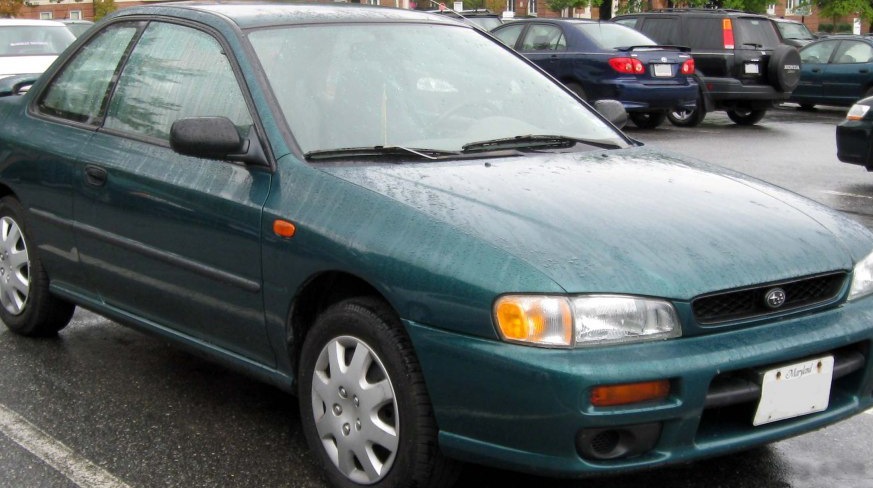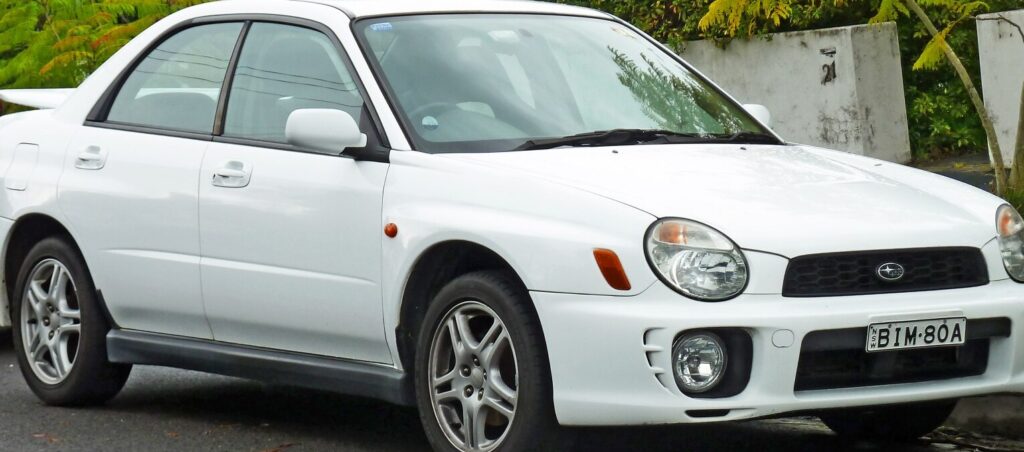
The Subaru Impreza II 2.0i 16V, produced between 2000 and 2002, represented a significant evolution of Subaru’s popular compact car. This variant, equipped with a 2.0-liter naturally aspirated boxer engine producing 155 horsepower and paired with a four-speed automatic transmission, occupied a middle ground within the Impreza II lineup. It aimed to provide a balance of performance, practicality, and ease of use for buyers seeking all-wheel-drive capability in a comfortable package. The Impreza II, internally designated as the GE platform (with variations like GE2/GE3/GE6/GE7), was a key model for Subaru, particularly in markets where all-wheel drive was highly valued.
Technical Specifications
| Brand | Subaru |
| Model | Impreza |
| Generation | Impreza II |
| Type (Engine) | 2.0i 16V (155 Hp) 4WD Automatic |
| Start of production | 2000 |
| End of production | 2002 |
| Powertrain Architecture | Internal Combustion engine |
| Body type | Sedan |
| Seats | 5 |
| Doors | 4 |
| Fuel consumption (urban) | 13.5 l/100 km (17.4 US mpg, 20.9 UK mpg, 7.4 km/l) |
| Fuel consumption (extra urban) | 7.5 l/100 km (31.4 US mpg, 37.7 UK mpg, 13.3 km/l) |
| Fuel consumption (combined) | 9.7 l/100 km (24.2 US mpg, 29.1 UK mpg, 10.3 km/l) |
| Fuel Type | Petrol (Gasoline) |
| Acceleration 0 – 100 km/h | 12.7 sec |
| Acceleration 0 – 62 mph | 12.7 sec |
| Acceleration 0 – 60 mph | 12.1 sec |
| Maximum speed | 176 km/h (109.36 mph) |
| Weight-to-power ratio | 8.9 kg/Hp, 112.7 Hp/tonne |
| Weight-to-torque ratio | 7 kg/Nm, 142.5 Nm/tonne |
| Power | 155 Hp @ 6400 rpm |
| Torque | 196 Nm @ 3200 rpm (144.56 lb.-ft. @ 3200 rpm) |
| Engine layout | Front, Longitudinal |
| Engine Model/Code | EJ20 |
| Engine displacement | 1994 cm3 (121.68 cu. in.) |
| Number of cylinders | 4 |
| Engine configuration | Boxer |
| Cylinder Bore | 92 mm (3.62 in.) |
| Piston Stroke | 75 mm (2.95 in.) |
| Compression ratio | 10.8:1 |
| Number of valves per cylinder | 4 |
| Fuel injection system | Multi-port manifold injection |
| Engine aspiration | Naturally aspirated engine |
| Valvetrain | OHC |
| Engine oil capacity | 4 l (4.23 US qt | 3.52 UK qt) |
| Coolant capacity | 6 l (6.34 US qt | 5.28 UK qt) |
| Kerb Weight | 1375 kg (3031.36 lbs.) |
| Max. weight | 1800 kg (3968.32 lbs.) |
| Max load | 425 kg (936.96 lbs.) |
| Trunk (boot) space – minimum | 401 l (14.16 cu. ft.) |
| Fuel tank capacity | 50 l (13.21 US gal | 11 UK gal) |
| Length | 4405 mm (173.43 in.) |
| Width | 1730 mm (68.11 in.) |
| Height | 1440 mm (56.69 in.) |
| Wheelbase | 2525 mm (99.41 in.) |
| Front track | 1485 mm (58.46 in.) |
| Rear (Back) track | 1475 mm (58.07 in.) |
| Drive wheel | All wheel drive (4×4) |
| Number of gears and type of gearbox | 4 gears, automatic transmission |
| Front suspension | Wishbone |
| Rear suspension | Spring Strut |
| Front brakes | Ventilated discs |
| Rear brakes | Disc |
| Assisting systems | ABS (Anti-lock braking system) |
| Steering type | Steering rack and pinion |
| Power steering | Hydraulic Steering |
| Tires size | 195/60 R15 H |
| Wheel rims size | 15 |
INTRODUCTION
The Subaru Impreza II 2.0i 16V Automatic, produced from 2000 to 2002, was a key component of Subaru’s second-generation Impreza lineup. Building upon the success of the original Impreza, the II generation (chassis code GE) offered improved refinement, safety, and a more contemporary design. This particular variant, with its 155-horsepower 2.0-liter engine and four-speed automatic transmission, was positioned as a practical and accessible option for buyers prioritizing comfort and all-weather capability over outright performance. It was a common sight on roads in Europe, Australia, and North America, where Subaru’s symmetrical all-wheel-drive system was highly regarded.
Powertrain & Engine Architecture
At the heart of the Impreza II 2.0i 16V Automatic lies the EJ20 engine, a 1994cc naturally aspirated 16-valve boxer four-cylinder. Subaru’s boxer engine design, with its horizontally opposed pistons, provides a low center of gravity, contributing to the car’s balanced handling. The EJ20 featured multi-point fuel injection and a single overhead camshaft (SOHC) valvetrain. This engine was known for its relative simplicity and durability. The four-speed automatic transmission, while not offering the sportiness of a manual, provided smooth and convenient gear changes. It was designed to work in conjunction with Subaru’s all-wheel-drive system, distributing power to all four wheels for enhanced traction. The transmission’s gear ratios were optimized for fuel efficiency and comfortable cruising, rather than aggressive acceleration.
Driving Characteristics
The Impreza II 2.0i 16V Automatic delivered a comfortable and predictable driving experience. Acceleration from 0-60 mph took around 12.1 seconds, and top speed was approximately 109 mph. While not particularly quick, the engine provided adequate power for everyday driving situations. The automatic transmission, while smooth, could feel somewhat sluggish during quick overtaking maneuvers. The all-wheel-drive system provided excellent grip in various weather conditions, making it a confident handler on both dry and slippery surfaces. Compared to the more powerful turbocharged Impreza WRX models, the 2.0i Automatic prioritized fuel economy and ease of use over outright performance. The manual transmission versions of the 2.0i offered a more engaging driving experience, while the WRX provided significantly more power and a sportier feel.
Equipment & Trim Levels
The Impreza II 2.0i 16V Automatic typically came equipped with a reasonable level of standard features. These included power windows, power locks, air conditioning, and an AM/FM radio. Higher trim levels offered options such as alloy wheels, a sunroof, and upgraded audio systems. Interior upholstery was typically cloth, with a functional and durable design. The dashboard layout was straightforward and easy to use. Safety features included dual front airbags and ABS brakes. The specific trim level and available options varied depending on the market.
Chassis & Braking
The Impreza II featured a MacPherson strut front suspension and a double-wishbone rear suspension, providing a comfortable ride and predictable handling. The chassis was designed to work in harmony with the all-wheel-drive system, maximizing traction and stability. Braking duties were handled by ventilated discs at the front and solid discs at the rear. ABS was standard, providing enhanced braking performance in emergency situations. The suspension was tuned for a balance of comfort and handling, making it suitable for a wide range of driving conditions.
Market Reception & Comparison
The Impreza II 2.0i 16V Automatic was generally well-received by automotive critics as a practical and reliable family car. It was praised for its all-wheel-drive capability, comfortable ride, and reasonable fuel economy. However, some critics noted that the automatic transmission could feel sluggish and that the engine lacked the excitement of the turbocharged WRX models. Compared to other compact cars of the time, the Impreza offered a unique combination of all-wheel-drive traction and Subaru’s renowned reliability. Fuel economy was respectable for its class, averaging around 24.2 US mpg in combined driving.
Legacy
The Subaru Impreza II 2.0i 16V Automatic has proven to be a durable and reliable vehicle. Many examples are still on the road today, testament to Subaru’s engineering quality. The EJ20 engine, while not without its quirks, is generally considered to be a robust and long-lasting powerplant. The four-speed automatic transmission is also relatively reliable, although regular maintenance is essential. In the used car market, these Imprezas are often sought after by buyers looking for an affordable and capable all-wheel-drive vehicle. While not a performance icon like the WRX, the 2.0i Automatic remains a popular choice for those seeking a practical and dependable compact car.