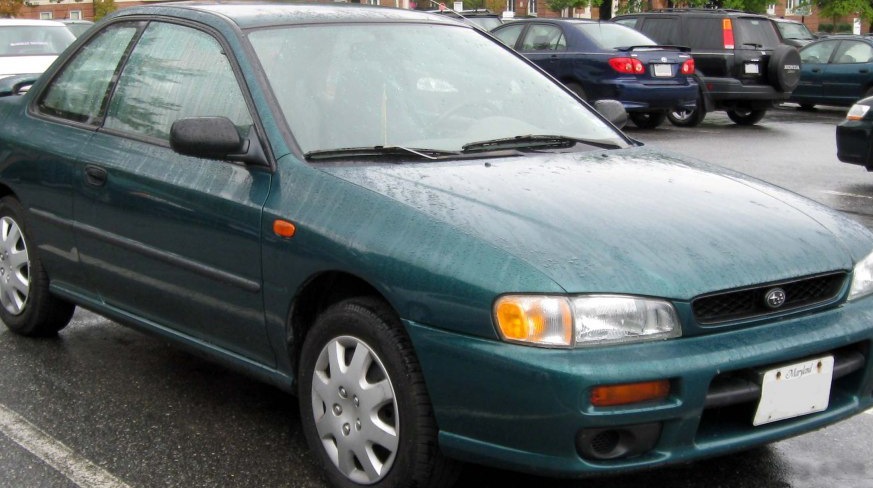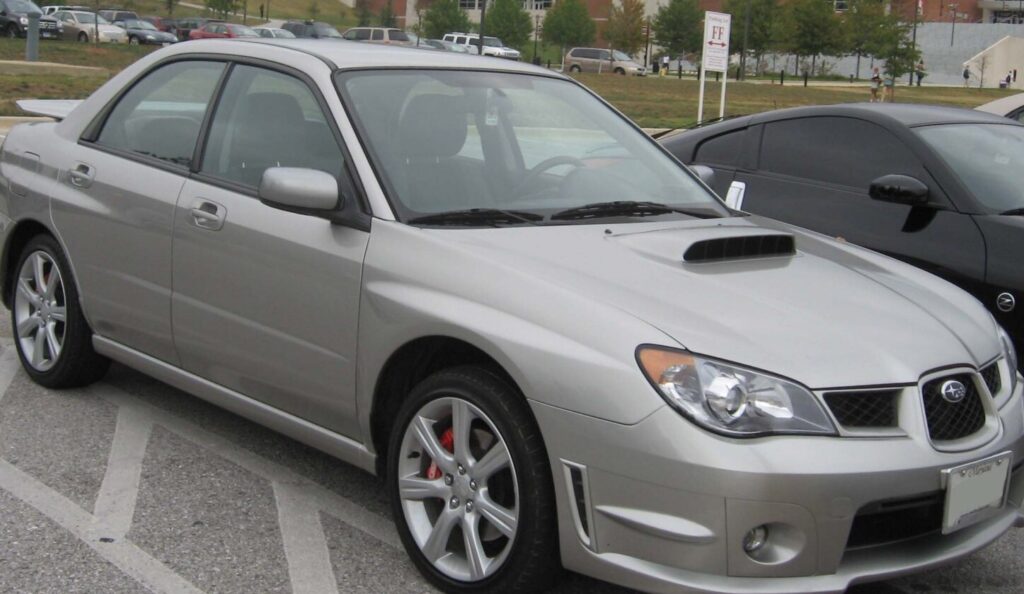
The Subaru Impreza II, specifically the WRX 2.5 model produced from 2005 to 2007, represents a significant evolution in the Impreza lineage. This facelifted version of the GD chassis (internally designated GG/GY for the wagon and sedan respectively) brought increased performance and a more refined driving experience compared to earlier iterations. Positioned as the performance variant within the Impreza range, the WRX 2.5 aimed to deliver a compelling blend of all-weather capability, sporty handling, and accessible power. It served as a stepping stone between the naturally aspirated Impreza models and the more focused, higher-performance STI variant.
Technical Specifications
| Brand | Subaru |
| Model | Impreza |
| Generation | Impreza II (facelift 2005) |
| Type (Engine) | WRX 2.5 (230 Hp) AWD |
| Start of production | 2005 |
| End of production | 2007 |
| Powertrain Architecture | Internal Combustion engine |
| Body type | Sedan |
| Seats | 5 |
| Doors | 4 |
| Fuel consumption (economy) – urban (NEDC) | 14.4 l/100 km (16.3 US mpg, 19.6 UK mpg, 6.9 km/l) |
| Fuel consumption (economy) – extra urban (NEDC) | 7.9 l/100 km (29.8 US mpg, 35.8 UK mpg, 12.7 km/l) |
| Fuel consumption (economy) – combined (NEDC) | 10.3 l/100 km (22.8 US mpg, 27.4 UK mpg, 9.7 km/l) |
| CO2 emissions (NEDC) | 244 g/km |
| Fuel Type | Petrol (Gasoline) |
| Acceleration 0 – 100 km/h | 5.9 sec |
| Acceleration 0 – 62 mph | 5.9 sec |
| Acceleration 0 – 60 mph | 5.6 sec |
| Maximum speed | 230 km/h (142.92 mph) |
| Emission standard | Euro 4 |
| Weight-to-power ratio | 6 kg/Hp, 167.9 Hp/tonne |
| Weight-to-torque ratio | 4.3 kg/Nm, 233.6 Nm/tonne |
| Power | 230 Hp @ 5600 rpm |
| Torque | 320 Nm @ 3600 rpm (236.02 lb.-ft. @ 3600 rpm) |
| Engine layout | Front, Longitudinal |
| Engine Model/Code | EJ255 |
| Engine displacement | 2457 cm3 (149.94 cu. in.) |
| Number of cylinders | 4 |
| Engine configuration | Boxer |
| Cylinder Bore | 99.5 mm (3.92 in.) |
| Piston Stroke | 79 mm (3.11 in.) |
| Compression ratio | 8.4:1 |
| Number of valves per cylinder | 4 |
| Fuel injection system | Multi-port manifold injection |
| Engine aspiration | Turbocharger, Intercooler |
| Valvetrain | DOHC |
| Engine oil capacity | 4.3 l (4.54 US qt | 3.78 UK qt) |
| Coolant | 7.8 l (8.24 US qt | 6.86 UK qt) |
| Kerb Weight | 1370 kg (3020.33 lbs.) |
| Max. weight | 1850 kg (4078.55 lbs.) |
| Max load | 480 kg (1058.22 lbs.) |
| Trunk (boot) space – minimum | 401 l (14.16 cu. ft.) |
| Fuel tank capacity | 60 l (15.85 US gal | 13.2 UK gal) |
| Max. roof load | 80 kg (176.37 lbs.) |
| Permitted trailer load with brakes (12%) | 1200 kg (2645.55 lbs.) |
| Permitted trailer load without brakes | 500 kg (1102.31 lbs.) |
| Length | 4465 mm (175.79 in.) |
| Width | 1740 mm (68.5 in.) |
| Height | 1440 mm (56.69 in.) |
| Wheelbase | 2525 mm (99.41 in.) |
| Front track | 1485 mm (58.46 in.) |
| Rear (Back) track | 1480 mm (58.27 in.) |
| Ride height (ground clearance) | 155 mm (6.1 in.) |
| Minimum turning circle (turning diameter) | 11.8 m (38.71 ft.) |
| Drivetrain Architecture | The Internal combustion engine (ICE) drives permanently the four wheels of the vehicle. |
| Drive wheel | All wheel drive (4×4) |
| Number of gears and type of gearbox | 5 gears, manual transmission |
| Front suspension | Spring Strut, Transverse stabilizer |
| Rear suspension | Spring Strut, Transverse stabilizer |
| Front brakes | Ventilated discs |
| Rear brakes | Ventilated discs |
| Assisting systems | ABS (Anti-lock braking system) |
| Steering type | Steering rack and pinion |
| Power steering | Hydraulic Steering |
| Tires size | 215/45 R17 |
| Wheel rims size | 7J x 17 |
Powertrain & Engine Architecture
The heart of the 2005-2007 Impreza WRX 2.5 is the EJ255 2.5-liter horizontally-opposed (Boxer) four-cylinder engine. This engine represented a significant upgrade over the 2.0-liter EJ205 found in earlier WRX models. The larger displacement, combined with a Mitsubishi TD04L turbocharger and an intercooler, allowed for a substantial increase in power and torque. The EJ255 utilizes multi-point fuel injection and a dual overhead camshaft (DOHC) valvetrain. The engine’s Boxer configuration contributes to a lower center of gravity, enhancing handling characteristics. The transmission is a robust 5-speed manual, chosen for its durability and direct feel. While an automatic transmission was offered in some markets, the manual was favored by enthusiasts for its superior control and engagement.
Driving Characteristics
The WRX 2.5 offered a noticeable step up in performance compared to the base Impreza models. The 230 horsepower and 320 Nm (236 lb-ft) of torque provided brisk acceleration, with 0-60 mph times consistently in the mid-5 second range. The all-wheel-drive system, a Subaru hallmark, delivered excellent traction in a variety of conditions. The 5-speed manual transmission featured relatively short gear ratios, prioritizing acceleration over fuel economy. Compared to the STI, the WRX 2.5 felt less raw and more approachable, making it a more comfortable daily driver. However, it lacked the STI’s more sophisticated suspension and limited-slip differentials, resulting in slightly less precise handling on the limit.
Equipment & Trim Levels
The WRX 2.5 typically came standard with features such as alloy wheels, sport seats, a leather-wrapped steering wheel, and air conditioning. Optional extras included a sunroof, premium audio system, and upgraded interior trim. The interior design was functional and driver-focused, with clear instrumentation and supportive seats. While not luxurious, the WRX 2.5 offered a comfortable and well-equipped cabin for its price point.
Chassis & Braking
The Impreza WRX 2.5 utilized a MacPherson strut suspension setup at both the front and rear, with stabilizer bars to reduce body roll. The braking system consisted of ventilated disc brakes on all four wheels, providing ample stopping power. The chassis was reinforced compared to the standard Impreza to handle the increased power and stresses of performance driving. The all-wheel-drive system employed a viscous limited-slip center differential, distributing power between the front and rear axles as needed.
Market Reception & Comparison
The 2005-2007 Impreza WRX 2.5 was generally well-received by automotive critics. It was praised for its performance, handling, and all-weather capability. However, some reviewers noted its relatively high fuel consumption and somewhat basic interior. Compared to the STI, the WRX 2.5 offered a more affordable entry point into the world of Subaru performance. It also proved to be more reliable than some earlier WRX models, thanks to the more robust EJ255 engine. Against competitors like the Mitsubishi Lancer Evolution, the Impreza WRX 2.5 offered a unique blend of performance and practicality.
Legacy
The EJ255 engine, while generally reliable, is known to be susceptible to head gasket failures if not properly maintained. Regular oil changes and careful monitoring of coolant levels are crucial for long-term durability. Today, the 2005-2007 Impreza WRX 2.5 remains a popular choice among enthusiasts, offering a compelling combination of performance, affordability, and all-weather capability. Well-maintained examples command a reasonable price on the used car market, and the car’s robust mechanicals make it a relatively easy platform to modify and upgrade.