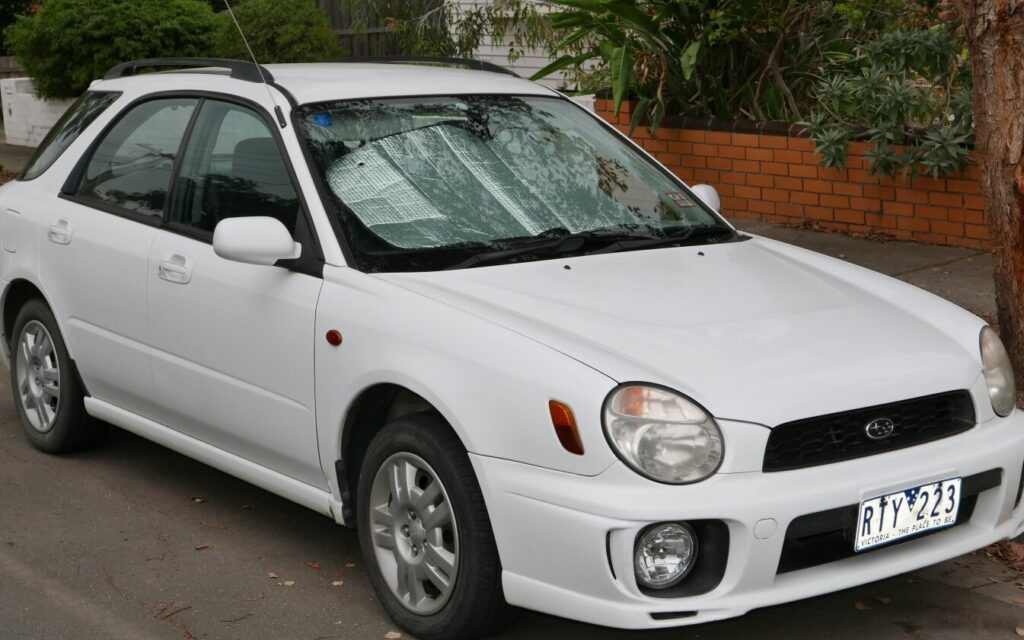
The Subaru Impreza II Station Wagon 1.6i 16V, produced between 2000 and 2002, represented a practical and accessible entry point into the Impreza range, particularly in European and Asian markets. Positioned as a family-oriented vehicle, it offered the renowned Subaru symmetrical all-wheel drive system in a versatile wagon body style. This variant, powered by the EJ16 engine and equipped with a five-speed manual transmission, aimed to balance affordability with Subaru’s reputation for reliability and all-weather capability. It was part of the second generation of the Impreza (GF series), built on the GC/GF platform, which saw significant revisions over the original model.
Technical Specifications
| Brand | Subaru |
| Model | Impreza |
| Generation | Impreza II Station Wagon |
| Type (Engine) | 1.6i 16V (95 Hp) 4WD |
| Start of production | 2000 year |
| End of production | 2002 year |
| Powertrain Architecture | Internal Combustion engine |
| Body type | Station wagon (estate) |
| Seats | 5 |
| Doors | 5 |
| Fuel consumption (urban) | 12.1 l/100 km (19.4 US mpg, 23.3 UK mpg, 8.3 km/l) |
| Fuel consumption (extra urban) | 7.1 l/100 km (33.1 US mpg, 39.8 UK mpg, 14.1 km/l) |
| Fuel consumption (combined) | 8.9 l/100 km (26.4 US mpg, 31.7 UK mpg, 11.2 km/l) |
| Fuel Type | Petrol (Gasoline) |
| Acceleration 0 – 100 km/h | 12.8 sec |
| Acceleration 0 – 62 mph | 12.8 sec |
| Acceleration 0 – 60 mph | 12.2 sec |
| Maximum speed | 169 km/h (105.01 mph) |
| Weight-to-power ratio | 14.5 kg/Hp, 68.8 Hp/tonne |
| Weight-to-torque ratio | 9.7 kg/Nm, 103.6 Nm/tonne |
| Power | 95 Hp @ 5600 rpm |
| Power per litre | 59.5 Hp/l |
| Torque | 143 Nm @ 3600 rpm (105.47 lb.-ft. @ 3600 rpm) |
| Engine layout | Front, Longitudinal |
| Engine Model/Code | EJ16 |
| Engine displacement | 1597 cm3 (97.45 cu. in.) |
| Number of cylinders | 4 |
| Engine configuration | Boxer |
| Cylinder Bore | 87.9 mm (3.46 in.) |
| Piston Stroke | 65.8 mm (2.59 in.) |
| Compression ratio | 10:1 |
| Number of valves per cylinder | 4 |
| Fuel injection system | Multi-port manifold injection |
| Engine aspiration | Naturally aspirated engine |
| Valvetrain | OHC |
| Engine oil capacity | 4.5 l (4.76 US qt | 3.96 UK qt) |
| Coolant capacity | 7.4 l (7.82 US qt | 6.51 UK qt) |
| Kerb Weight | 1380 kg (3042.38 lbs.) |
| Max. weight | 1730 kg (3814 lbs.) |
| Max load | 350 kg (771.62 lbs.) |
| Trunk (boot) space – minimum | 356 l (12.57 cu. ft.) |
| Trunk (boot) space – maximum | 1266 l (44.71 cu. ft.) |
| Fuel tank capacity | 50 l (13.21 US gal | 11 UK gal) |
| Length | 4405 mm (173.43 in.) |
| Width | 1695 mm (66.73 in.) |
| Height | 1485 mm (58.46 in.) |
| Wheelbase | 2520 mm (99.21 in.) |
| Front track | 1465 mm (57.68 in.) |
| Rear track | 1455 mm (57.28 in.) |
| Drive wheel | All wheel drive (4×4) |
| Number of gears and type of gearbox | 5 gears, manual transmission |
| Front suspension | Wishbone |
| Rear suspension | Spring Strut |
| Front brakes | Ventilated discs |
| Rear brakes | Disc |
| Assisting systems | ABS (Anti-lock braking system) |
| Steering type | Steering rack and pinion |
| Power steering | Hydraulic Steering |
| Tires size | 185/70 R14 H |
| Wheel rims size | 14 |
Powertrain & Engine Architecture
The heart of the 1.6i 16V was the EJ16 engine, a 1.6-liter (1597 cc) naturally aspirated, horizontally-opposed (boxer) four-cylinder. This engine design, a Subaru hallmark, offered inherent balance and a lower center of gravity, contributing to the car’s handling characteristics. The ‘16V’ designation indicated the use of four valves per cylinder, enhancing breathing and overall efficiency. Fuel delivery was managed by a multi-point fuel injection system. The EJ16 produced 95 horsepower at 5600 rpm and 143 Nm (105 lb-ft) of torque at 3600 rpm. The five-speed manual transmission was a standard feature, providing drivers with good control over the engine’s power band. The transmission was chosen for its durability and relatively simple maintenance requirements.
Driving Characteristics
The 1.6i 16V, with its 95 hp output, wasn’t designed for outright speed. Acceleration from 0 to 60 mph took around 12.2 seconds, and top speed was approximately 105 mph. However, the engine’s torque delivery, combined with Subaru’s symmetrical all-wheel drive, provided confident traction in various conditions. The all-wheel drive system distributed power to all four wheels, enhancing grip on slippery surfaces like snow or gravel. Compared to the more powerful 2.0-liter Impreza variants, the 1.6i felt less responsive, particularly during overtaking maneuvers. The gear ratios in the five-speed manual were well-spaced, allowing the driver to keep the engine within its optimal power range. The driving experience was generally comfortable and predictable, making it well-suited for everyday commuting and family transportation.
Equipment & Trim Levels
The 1.6i 16V typically came with a modest level of standard equipment. Interior features generally included cloth upholstery, a basic audio system, and manual air conditioning. Power windows and central locking were often included, but features like alloy wheels, a sunroof, or upgraded audio systems were usually optional extras. Trim levels varied slightly depending on the market, but the focus remained on providing a functional and affordable vehicle. Safety features included ABS (Anti-lock Braking System) as standard, a notable inclusion for the time.
Chassis & Braking
The Impreza II Station Wagon utilized a MacPherson strut front suspension and a spring strut rear suspension. This setup provided a good balance between ride comfort and handling. The car’s relatively lightweight construction, at around 1380 kg (3042 lbs), contributed to its agility. Braking duties were handled by ventilated discs at the front and solid discs at the rear. The ABS system helped to maintain steering control during hard braking situations. Stabilizer bars were fitted to both the front and rear axles to reduce body roll during cornering.
Market Reception & Comparison
The 1.6i 16V Impreza Station Wagon was generally well-received as a practical and reliable family car. Critics praised its all-wheel drive system and spacious interior. However, some reviewers noted that the engine lacked the power and refinement of the larger-displacement Impreza models. Compared to the 2.0-liter variants, the 1.6i offered better fuel economy, but at the expense of performance. The 1.6i was also more affordable to purchase and maintain, making it an attractive option for budget-conscious buyers. Its fuel consumption figures of around 26.4 US mpg combined were respectable for the time.
Legacy
The EJ16 engine, while not as celebrated as Subaru’s turbocharged engines, proved to be a durable and reliable powerplant. The Impreza II Station Wagon 1.6i 16V remains a relatively common sight on used car markets today, often appreciated for its practicality and affordability. While not a performance icon, this variant played an important role in establishing Subaru’s reputation for building capable and dependable vehicles. Maintenance is generally straightforward, and parts availability remains good, making it a viable option for those seeking a classic Subaru wagon.