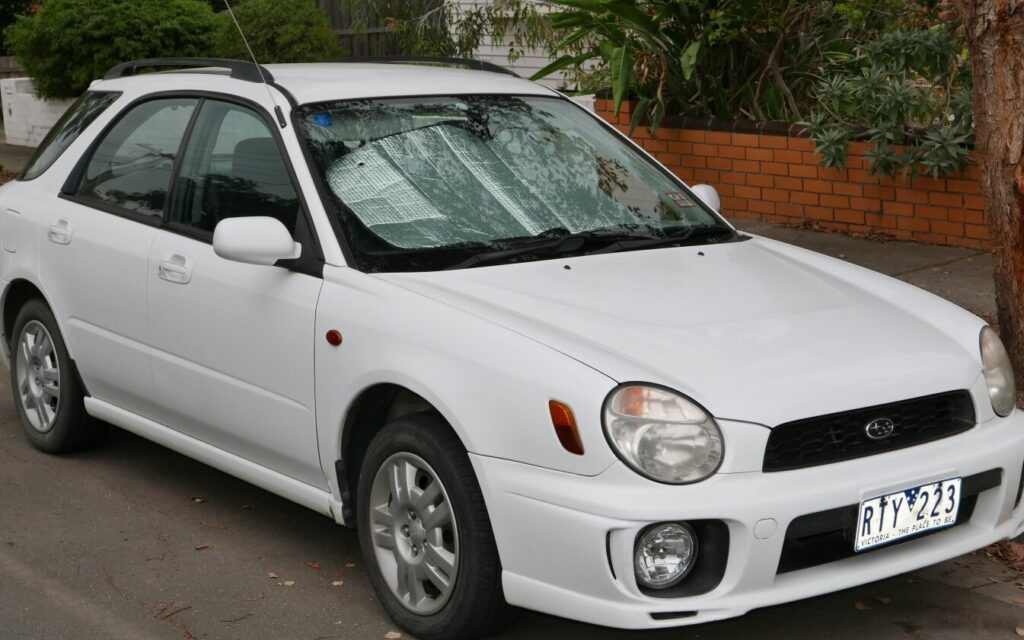
The Subaru Impreza II Station Wagon 2.0i 16V, producing 125 horsepower, was a practical and capable offering from the Japanese automaker during its 2000-2002 production run. Positioned as a versatile family vehicle, it represented a key part of Subaru’s commitment to all-wheel drive and reliability. This variant sat within the broader Impreza II range, offering a balance between affordability and functionality, appealing to buyers who needed space and all-weather capability without the performance focus of the WRX models. It was primarily sold in European and Asian markets, where the station wagon body style remained popular.
Technical Specifications
| Brand | Subaru |
| Model | Impreza |
| Generation | Impreza II Station Wagon |
| Type (Engine) | 2.0i 16V (125 Hp) 4WD |
| Start of production | 2000 year |
| End of production | 2002 year |
| Powertrain Architecture | Internal Combustion engine |
| Body type | Station wagon (estate) |
| Seats | 5 |
| Doors | 5 |
| Fuel consumption (economy) – urban | 13.5 l/100 km (17.4 US mpg, 20.9 UK mpg, 7.4 km/l) |
| Fuel consumption (economy) – extra urban | 7.4 l/100 km (31.8 US mpg, 38.2 UK mpg, 13.5 km/l) |
| Fuel consumption (economy) – combined | 9.6 l/100 km (24.5 US mpg, 29.4 UK mpg, 10.4 km/l) |
| Fuel Type | Petrol (Gasoline) |
| Acceleration 0 – 100 km/h | 10.2 sec |
| Acceleration 0 – 62 mph | 10.2 sec |
| Acceleration 0 – 60 mph | 9.7 sec |
| Maximum speed | 185 km/h (114.95 mph) |
| Weight-to-power ratio | 11.5 kg/Hp, 86.8 Hp/tonne |
| Weight-to-torque ratio | 7.8 kg/Nm, 127.8 Nm/tonne |
| Power | 125 Hp @ 5600 rpm |
| Power per litre | 62.7 Hp/l |
| Torque | 184 Nm @ 3600 rpm (135.71 lb.-ft. @ 3600 rpm) |
| Engine layout | Front, Longitudinal |
| Engine Model/Code | EJ201 |
| Engine displacement | 1994 cm3 (121.68 cu. in.) |
| Number of cylinders | 4 |
| Engine configuration | Boxer |
| Cylinder Bore | 92 mm (3.62 in.) |
| Piston Stroke | 75 mm (2.95 in.) |
| Compression ratio | 10:1 |
| Number of valves per cylinder | 4 |
| Fuel injection system | Multi-port manifold injection |
| Engine aspiration | Naturally aspirated engine |
| Valvetrain | OHC |
| Engine oil capacity | 4.5 l (4.76 US qt | 3.96 UK qt) |
| Coolant | 7 l (7.4 US qt | 6.16 UK qt) |
| Kerb Weight | 1440 kg (3174.66 lbs.) |
| Max. weight | 1800 kg (3968.32 lbs.) |
| Max load | 360 kg (793.66 lbs.) |
| Trunk (boot) space – minimum | 353 l (12.47 cu. ft.) |
| Trunk (boot) space – maximum | 1266 l (44.71 cu. ft.) |
| Fuel tank capacity | 50 l (13.21 US gal | 11 UK gal) |
| Length | 4405 mm (173.43 in.) |
| Width | 1695 mm (66.73 in.) |
| Height | 1485 mm (58.46 in.) |
| Wheelbase | 2525 mm (99.41 in.) |
| Front track | 1465 mm (57.68 in.) |
| Rear (Back) track | 1455 mm (57.28 in.) |
| Drive wheel | All wheel drive (4×4) |
| Number of gears and type of gearbox | 5 gears, manual transmission |
| Front suspension | Wishbone |
| Rear suspension | Spring Strut |
| Front brakes | Ventilated discs |
| Rear brakes | Disc |
| Assisting systems | ABS (Anti-lock braking system) |
| Steering type | Steering rack and pinion |
| Power steering | Hydraulic Steering |
| Tires size | 195/60 R15 H |
| Wheel rims size | 15 |
Powertrain & Engine Architecture
At the heart of the Impreza II 2.0i 16V Station Wagon lay the EJ201 engine, a 1.994-liter (121.68 cubic inch) naturally aspirated, horizontally-opposed (boxer) four-cylinder. This engine was a hallmark of Subaru, known for its smooth operation and inherent balance. The ‘16V’ designation refers to the four valves per cylinder, enhancing breathing and contributing to the engine’s 125 horsepower output at 5600 rpm and 184 Nm (135.71 lb-ft) of torque at 3600 rpm. Fuel delivery was managed by a multi-port fuel injection system, a common setup for the time, providing precise fuel metering for optimal combustion. The engine featured an overhead camshaft (OHC) valvetrain. The engine’s longitudinal mounting, coupled with Subaru’s symmetrical all-wheel drive system, contributed to the car’s balanced handling characteristics. The 5-speed manual transmission was the standard offering, providing drivers with direct control over the engine’s power.
Driving Characteristics
The 125 hp 2.0i engine, paired with the 5-speed manual transmission, delivered adequate, though not exhilarating, performance. Acceleration from 0 to 60 mph took around 9.7 seconds, and top speed was approximately 115 mph. The engine’s torque curve was relatively flat, providing usable power across a broad range of engine speeds. However, it lacked the punch of the turbocharged WRX variants. The all-wheel drive system provided excellent traction in various conditions, making it a confident handler on both dry and wet surfaces. The gear ratios were tuned for everyday usability rather than outright performance, prioritizing fuel economy and smooth cruising. Compared to the more powerful Impreza models, this variant offered a more relaxed and refined driving experience.
Equipment & Trim Levels
The Impreza II Station Wagon 2.0i 16V typically came with a reasonable level of standard equipment. This included power windows, central locking, and an AM/FM radio. Air conditioning was often included, but sometimes offered as an optional extra. Interior upholstery was typically cloth, with a functional and durable design. Optional extras could include alloy wheels, a sunroof, and upgraded audio systems. The dashboard layout was straightforward and driver-focused, with easy-to-read gauges and logically placed controls. Trim levels varied slightly depending on the market, but generally focused on providing a comfortable and practical interior.
Chassis & Braking
The Impreza II Station Wagon utilized a MacPherson strut front suspension and a spring strut rear suspension. This setup provided a good balance between ride comfort and handling. The car’s weight of approximately 1440 kg (3175 lbs) was relatively moderate for a station wagon of its size. Braking duties were handled by ventilated discs at the front and solid discs at the rear. An anti-lock braking system (ABS) was standard, enhancing safety by preventing wheel lockup during hard braking. The steering was rack and pinion, providing precise and responsive steering feel. The 195/60 R15 tires offered a good compromise between grip and ride comfort.
Market Reception & Comparison
The Impreza II Station Wagon 2.0i 16V was generally well-received by automotive critics as a practical and reliable family vehicle. It was praised for its all-wheel drive system, spacious interior, and comfortable ride. However, some critics noted that the engine lacked the performance of its turbocharged counterparts. Fuel economy was considered average for its class, with combined fuel consumption around 24.5 US mpg. Compared to other station wagons in its segment, the Impreza offered a unique combination of all-wheel drive capability and Subaru’s reputation for durability. The 1.8L models were often seen as a more affordable entry point into the Impreza range, while the WRX models catered to performance enthusiasts.
Legacy
The EJ201 engine, in its various iterations, proved to be a remarkably durable and reliable powerplant. The Impreza II Station Wagon 2.0i 16V, while not as iconic as the WRX models, remains a popular choice among used car buyers seeking a practical and dependable vehicle. Parts availability is generally good, and the car’s relatively simple mechanical design makes it relatively easy to maintain. Today, these Imprezas are appreciated for their practicality, all-weather capability, and the enduring appeal of the Subaru brand. While not a collector’s item, well-maintained examples continue to provide reliable transportation for their owners.