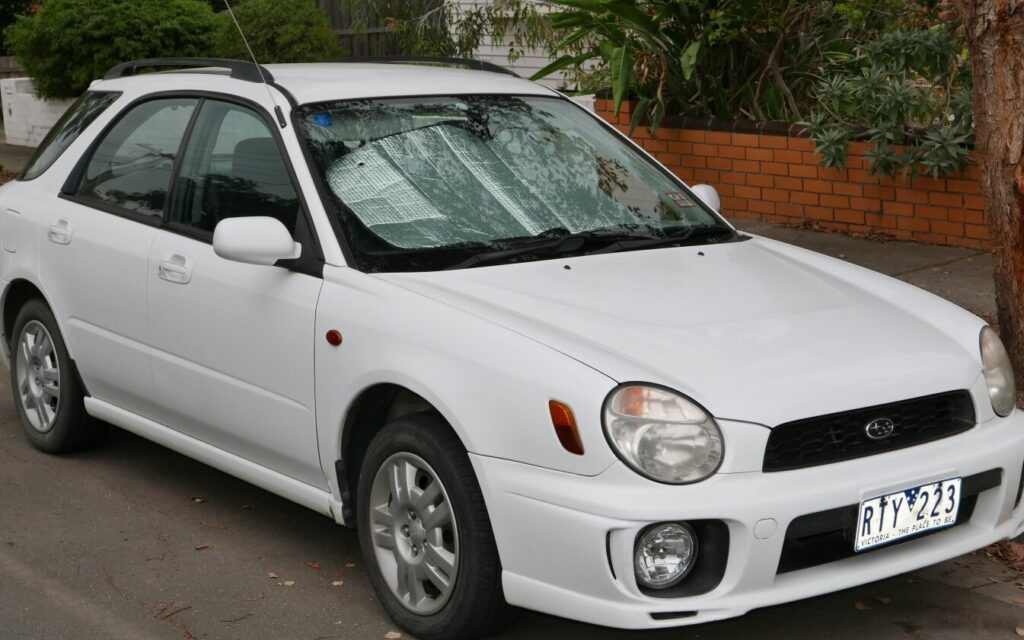
The Subaru Impreza II Station Wagon 2.5 AWD, produced between 2000 and 2002, represented Subaru’s entry into the compact wagon market with a focus on all-weather capability and practicality. This variant, powered by the 2.5-liter naturally aspirated boxer engine producing 165 horsepower, occupied a middle ground within the Impreza II range, offering a balance between performance and fuel efficiency. It was positioned above the base 1.6-liter models and below the more performance-oriented turbocharged WRX variants. The Impreza II series, built on the GD chassis platform, aimed to modernize the Impreza line with improved styling, safety features, and a more refined driving experience compared to its predecessor.
Technical Specifications
| Brand | Subaru |
| Model | Impreza |
| Generation | Impreza II Station Wagon |
| Type (Engine) | 2.5 (165 Hp) AWD |
| Start of production | 2000 |
| End of production | 2002 |
| Powertrain Architecture | Internal Combustion engine |
| Body type | Station wagon (estate) |
| Seats | 5 |
| Doors | 5 |
| Fuel consumption (economy) – urban (EPA) | 11.2 l/100 km (21 US mpg) |
| Fuel consumption (economy) – extra urban (EPA) | 8.4 l/100 km (28 US mpg) |
| Fuel Type | Petrol (Gasoline) |
| Weight-to-power ratio | 8.4 kg/Hp |
| Weight-to-torque ratio | 6.1 kg/Nm |
| Power | 165 Hp @ 5600 rpm |
| Power per litre | 67.2 Hp/l |
| Torque | 225 Nm @ 4000 rpm (165.95 lb.-ft. @ 4000 rpm) |
| Engine layout | Front, Longitudinal |
| Engine Model/Code | EJ251 |
| Engine displacement | 2457 cm3 (149.94 cu. in.) |
| Number of cylinders | 4 |
| Engine configuration | Boxer |
| Cylinder Bore | 99.5 mm (3.92 in.) |
| Piston Stroke | 79 mm (3.11 in.) |
| Compression ratio | 10:1 |
| Number of valves per cylinder | 4 |
| Fuel injection system | Multi-port manifold injection |
| Engine aspiration | Naturally aspirated engine |
| Valvetrain | SOHC |
| Engine oil capacity | 4 l (4.23 US qt | 3.52 UK qt) |
| Coolant | 7 l (7.4 US qt | 6.16 UK qt) |
| Kerb Weight | 1381 kg (3044.58 lbs.) |
| Trunk (boot) space – minimum | 790 l (27.9 cu. ft.) |
| Trunk (boot) space – maximum | 1744 l (61.59 cu. ft.) |
| Fuel tank capacity | 60 l (15.85 US gal | 13.2 UK gal) |
| Permitted trailer load with brakes (12%) | 907 kg (1999.59 lbs.) |
| Length | 4405 mm (173.43 in.) |
| Width | 1695 mm (66.73 in.) |
| Height | 1465 mm (57.68 in.) |
| Wheelbase | 2525 mm (99.41 in.) |
| Front track | 1465 mm (57.68 in.) |
| Rear (Back) track | 1455 mm (57.28 in.) |
| Ride height (ground clearance) | 150 mm (5.91 in.) |
| Minimum turning circle (turning diameter) | 10.2 m (33.46 ft.) |
| Drivetrain Architecture | All wheel drive (4×4) |
| Number of gears and type of gearbox | 5 gears, manual transmission |
| Front suspension | Independent, type McPherson with coil spring and anti-roll bar |
| Rear suspension | Independent coil spring, Transverse stabilizer |
| Front brakes | Ventilated discs, 272 mm |
| Rear brakes | Drum, 229 mm |
| Assisting systems | ABS (Anti-lock braking system) |
| Steering type | Steering rack and pinion |
| Power steering | Hydraulic Steering |
| Tires size | 195/60 R15 |
| Wheel rims size | 6J x 15 |
Powertrain & Engine Architecture
The heart of the Impreza II 2.5 AWD is the EJ251 engine, a 2.5-liter naturally aspirated boxer-four. Subaru’s horizontally opposed “boxer” configuration provides a low center of gravity, contributing to the car’s balanced handling. The EJ251 utilizes a single overhead camshaft (SOHC) design, operating with four valves per cylinder. Fuel delivery is managed by a multi-port fuel injection system. This engine produced 165 horsepower at 5600 rpm and 225 Nm (165.95 lb-ft) of torque at 4000 rpm. The engine’s longitudinal mounting and the standard all-wheel-drive system necessitated a more complex drivetrain layout than front-wheel-drive competitors. The standard transmission for this variant was a 5-speed manual, providing direct control over the engine’s power. While an automatic transmission was offered in other Impreza trims, it wasn’t commonly paired with the 2.5L engine in the US market.
Driving Characteristics
The 2.5-liter engine, coupled with the manual transmission, offered a reasonably engaging driving experience. Acceleration was adequate for everyday driving, but it wasn’t particularly quick compared to the turbocharged WRX models. The all-wheel-drive system provided excellent traction in various weather conditions, making it a capable and confidence-inspiring vehicle. The manual gearbox had well-defined shift points, and the clutch feel was light. The 5-speed manual transmission’s gear ratios were tuned for a balance of fuel economy and usability, rather than outright performance. Compared to the WRX, the 2.5L felt less responsive, with a more linear power delivery. However, it offered a smoother and more refined driving experience, particularly at lower speeds.
Equipment & Trim Levels
The Impreza II 2.5 AWD typically came with a respectable level of standard equipment. This included power windows, power locks, and air conditioning. Interior upholstery was typically cloth, with a functional and durable design. The dashboard layout was straightforward and easy to use. Optional extras included a sunroof, upgraded audio systems, and alloy wheels. The trim level was generally considered a step up from the base models, offering a more comfortable and well-equipped interior. However, it lacked the sporty touches found in the WRX variants, such as sport seats and a leather-wrapped steering wheel.
Chassis & Braking
The Impreza II utilized a McPherson strut front suspension and an independent coil spring rear suspension. This setup provided a comfortable ride while maintaining good handling characteristics. The front suspension incorporated an anti-roll bar to reduce body roll during cornering. Braking duties were handled by ventilated discs at the front and drum brakes at the rear. The inclusion of ABS (Anti-lock Braking System) was standard, enhancing safety and control during emergency braking situations. The chassis was designed to accommodate the all-wheel-drive system, resulting in a slightly higher ride height compared to some front-wheel-drive competitors.
Market Reception & Comparison
The Impreza II 2.5 AWD was generally well-received by automotive critics as a practical and capable all-weather vehicle. It was praised for its standard all-wheel drive, comfortable ride, and spacious interior. However, some critics noted that the 2.5-liter engine lacked the excitement of the turbocharged WRX models. Fuel economy was considered average for its class. Compared to other compact wagons, the Impreza II offered a unique combination of all-wheel-drive capability and practicality. It competed with vehicles like the Toyota Corolla Wagon and the Honda Civic Wagon, but the Subaru’s standard AWD gave it a distinct advantage in regions with inclement weather.
Legacy
The EJ251 engine, while not as renowned as the turbocharged EJ20 engines found in the WRX, proved to be a reliable and durable powerplant. The Impreza II 2.5 AWD has maintained a reasonable reputation for reliability in the used car market. Common maintenance items include regular oil changes and timing belt replacements. The all-wheel-drive system remains a key selling point for these vehicles, particularly in areas with snow or challenging road conditions. Today, the Impreza II 2.5 AWD represents a practical and affordable option for buyers seeking a reliable and capable compact wagon with all-weather capability. Its simplicity and robust construction make it a relatively easy vehicle to maintain and repair.