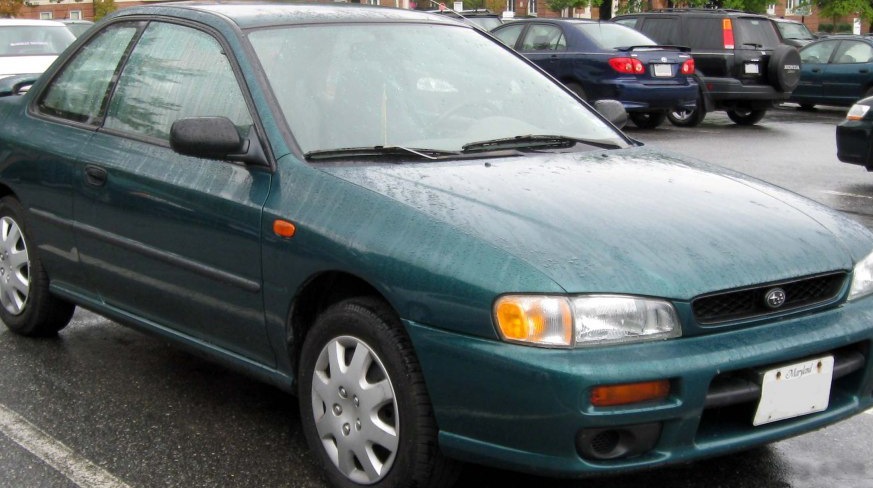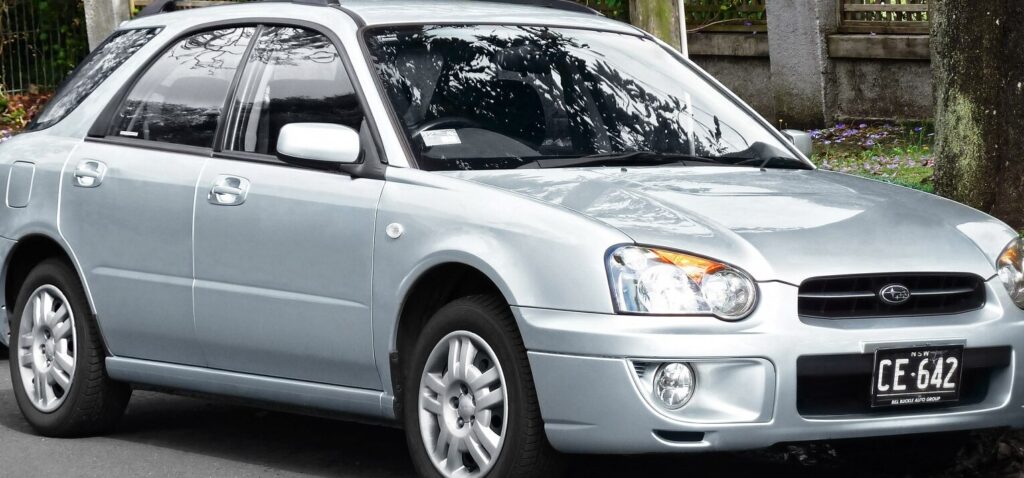
The Subaru Impreza II Station Wagon, specifically the facelifted version produced from 2002 to 2005, offered a practical and capable all-wheel-drive option in the compact estate segment. The 1.6-liter (95 horsepower) variant with an automatic transmission represented the entry point into the Impreza wagon range, aimed at buyers prioritizing fuel efficiency and ease of use over outright performance. This model sat below the more powerful 2.0-liter naturally aspirated and turbocharged options, and also the diesel variants available in some European markets. It was a common sight in Europe, where the practicality of a wagon and the security of all-wheel drive were highly valued.
Technical Specifications
| Brand | Subaru |
| Model | Impreza |
| Generation | Impreza II Station Wagon (facelift 2002) |
| Type (Engine) | 1.6 (95 Hp) AWD |
| Start of production | 2002 |
| End of production | 2005 |
| Powertrain Architecture | Internal Combustion engine |
| Body type | Station wagon (estate) |
| Seats | 5 |
| Doors | 5 |
| Fuel consumption (economy) – urban (NEDC) | 10.9 l/100 km (21.6 US mpg, 25.9 UK mpg, 9.2 km/l) |
| Fuel consumption (economy) – extra urban (NEDC) | 6.6 l/100 km (35.6 US mpg, 42.8 UK mpg, 15.2 km/l) |
| Fuel consumption (economy) – combined (NEDC) | 8.2 l/100 km (28.7 US mpg, 34.4 UK mpg, 12.2 km/l) |
| CO2 emissions (NEDC) | 195 g/km |
| Fuel Type | Petrol (Gasoline) |
| Acceleration 0 – 100 km/h | 12.8 sec |
| Acceleration 0 – 62 mph | 12.8 sec |
| Acceleration 0 – 60 mph | 12.2 sec |
| Maximum speed | 171 km/h (106.25 mph) |
| Emission standard | Euro 3 |
| Weight-to-power ratio | 13.8 kg/Hp, 72.5 Hp/tonne |
| Weight-to-torque ratio | 9.2 kg/Nm, 109.2 Nm/tonne |
| Power | 95 Hp @ 5200 rpm |
| Power per litre | 59.5 Hp/l |
| Torque | 143 Nm @ 3600 rpm (105.47 lb.-ft. @ 3600 rpm) |
| Engine layout | Front, Longitudinal |
| Engine Model/Code | EJ16 |
| Engine displacement | 1597 cm3 (97.45 cu. in.) |
| Number of cylinders | 4 |
| Engine configuration | Boxer |
| Cylinder Bore | 87.9 mm (3.46 in.) |
| Piston Stroke | 65.8 mm (2.59 in.) |
| Compression ratio | 10:1 |
| Number of valves per cylinder | 4 |
| Fuel injection system | Multi-port manifold injection |
| Engine aspiration | Naturally aspirated engine |
| Valvetrain | SOHC |
| Engine oil capacity | 4.5 l (4.76 US qt | 3.96 UK qt) |
| Coolant | 7.4 l (7.82 US qt | 6.51 UK qt) |
| Kerb Weight | 1310 kg (2888.06 lbs.) |
| Max. weight | 1730 kg (3814 lbs.) |
| Max load | 420 kg (925.94 lbs.) |
| Trunk (boot) space – minimum | 356 l (12.57 cu. ft.) |
| Trunk (boot) space – maximum | 1266 l (44.71 cu. ft.) |
| Fuel tank capacity | 50 l (13.21 US gal | 11 UK gal) |
| Max. roof load | 80 kg (176.37 lbs.) |
| Permitted trailer load with brakes (12%) | 1500 kg (3306.93 lbs.) |
| Permitted trailer load without brakes | 500 kg (1102.31 lbs.) |
| Length | 4415 mm (173.82 in.) |
| Width | 1695 mm (66.73 in.) |
| Height | 1465 mm (57.68 in.) |
| Wheelbase | 2525 mm (99.41 in.) |
| Front track | 1465 mm (57.68 in.) |
| Rear (Back) track | 1455 mm (57.28 in.) |
| Ride height (ground clearance) | 150 mm (5.91 in.) |
| Drivetrain Architecture | The Internal combustion engine (ICE) drives permanently the four wheels of the vehicle. |
| Drive wheel | All wheel drive (4×4) |
| Number of gears and type of gearbox | 5 gears, manual transmission |
| Front suspension | Spring Strut, Transverse stabilizer |
| Rear suspension | Spring Strut, Transverse stabilizer |
| Front brakes | Ventilated discs |
| Rear brakes | Disc |
| Assisting systems | ABS (Anti-lock braking system) |
| Steering type | Steering rack and pinion |
| Power steering | Hydraulic Steering |
| Tires size | 185/70 R14 |
| Wheel rims size | 5.5J x 14 |
INTRODUCTION
The Subaru Impreza II Station Wagon, facelifted in 2002, represented a significant update to the second-generation Impreza line. Building upon the success of the original Impreza, the II generation (produced from 1996-2007) aimed to refine the formula with improved comfort, safety, and styling. The facelift brought subtle cosmetic changes, including revised headlights and bumpers. The 1.6-liter AWD variant was primarily marketed in Europe as an affordable and practical family vehicle, leveraging Subaru’s renowned symmetrical all-wheel-drive system. It was positioned as the entry-level model, offering a balance of functionality and reasonable running costs.
Powertrain & Engine Architecture
The heart of this Impreza variant is the EJ16 engine, a 1.6-liter (1597cc) naturally aspirated, horizontally-opposed four-cylinder “boxer” engine. Subaru’s boxer configuration, where pistons move horizontally rather than vertically, contributes to a lower center of gravity, enhancing stability and handling. The EJ16 features a single overhead camshaft (SOHC) valvetrain and multi-point fuel injection. While not a powerhouse, the EJ16 was known for its relative smoothness and durability. The engine produced 95 horsepower at 5200 rpm and 143 Nm (105.47 lb-ft) of torque at 3600 rpm. The automatic transmission was typically a four-speed unit, chosen for its convenience rather than performance. This transmission was designed to provide smooth shifts and ease of driving in urban environments.
Driving Characteristics
The 1.6-liter automatic Impreza wagon offered a comfortable, if not particularly exciting, driving experience. Acceleration was modest, taking around 12.8 seconds to reach 62 mph (100 km/h). The automatic transmission, while convenient, did detract from the engine’s responsiveness. Gear ratios were optimized for fuel economy and everyday usability, rather than spirited driving. Compared to the 2.0-liter versions, the 1.6 felt noticeably slower, especially when fully loaded. However, the all-wheel-drive system provided excellent traction in various weather conditions, making it a secure and confident vehicle to drive year-round. The boxer engine’s low center of gravity contributed to stable handling, although body roll was present during cornering.
Equipment & Trim Levels
The 1.6-liter Impreza wagon typically came with a reasonable level of standard equipment. This included power steering, central locking, electric front windows, and an anti-lock braking system (ABS). Interior upholstery was usually cloth, and the dashboard featured a functional, if somewhat basic, design. Optional extras included air conditioning, alloy wheels, and a CD player. Higher trim levels, available with the larger engines, offered features like leather upholstery, sunroofs, and upgraded audio systems. The 1.6 model was generally aimed at buyers who prioritized value and practicality over luxury features.
Chassis & Braking
The Impreza II Station Wagon utilized a MacPherson strut suspension setup at both the front and rear, incorporating a transverse stabilizer bar to reduce body roll. The chassis was designed to provide a comfortable ride while maintaining good handling characteristics. Braking duties were handled by ventilated discs at the front and solid discs at the rear. The ABS system helped to maintain steering control during emergency braking situations. The weight distribution, aided by the boxer engine, contributed to balanced handling. The suspension was tuned for comfort, prioritizing ride quality over sporty handling.
Market Reception & Comparison
The 1.6-liter Impreza wagon received generally positive reviews for its practicality, safety, and all-wheel-drive capability. Critics noted its modest performance, particularly with the automatic transmission, but acknowledged its appeal to buyers seeking a reliable and affordable family vehicle. Compared to the 2.0-liter models, the 1.6 offered better fuel economy but significantly less power. The 2.0-liter models were favored by drivers who wanted more responsive performance. The diesel variants, available in some markets, provided even better fuel economy but lacked the refinement of the petrol engines. The 1.6’s main strength was its affordability and ease of use.
Legacy
The EJ16 engine, while not as celebrated as Subaru’s turbocharged engines, proved to be a durable and reliable powerplant. The Impreza II Station Wagon 1.6 AWD remains a relatively common sight on European roads today, testament to its build quality and longevity. Used examples are generally affordable, making them an attractive option for budget-conscious buyers. However, potential buyers should be aware of the typical maintenance requirements for older Subarus, including regular oil changes and inspection of the all-wheel-drive system. The combination of all-wheel drive, practicality, and affordability has ensured that the Impreza II Station Wagon 1.6 AWD retains a loyal following among those who appreciate its unique blend of qualities.