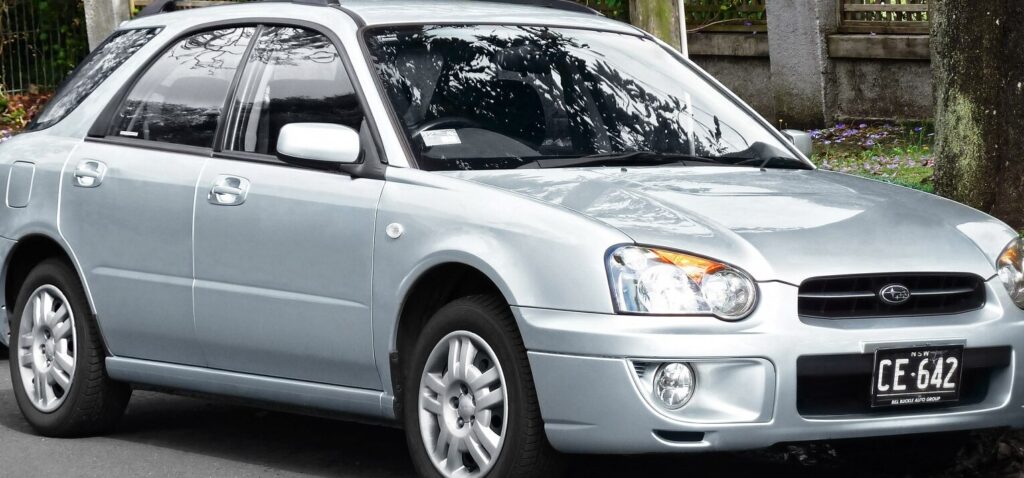
The Subaru Impreza II Station Wagon, specifically the facelifted version introduced in 2002, represented Subaru’s entry into the competitive compact estate car segment. Produced from 2002 to 2005, this variant, equipped with a 2.0-liter naturally aspirated engine producing 125 horsepower and paired with an automatic transmission, offered a blend of practicality, all-wheel-drive capability, and relative affordability. It sat within the broader Impreza range, positioned as a more comfort-oriented alternative to the sportier, turbocharged models and those with manual transmissions. This model was primarily marketed in Europe and other regions where the demand for compact wagons remained strong.
Technical Specifications
| Brand | Subaru |
| Model | Impreza |
| Generation | Impreza II Station Wagon (facelift 2002) |
| Type (Engine) | 2.0 (125 Hp) AWD Automatic |
| Start of production | 2002 |
| End of production | 2005 |
| Powertrain Architecture | Internal Combustion engine |
| Body type | Station wagon (estate) |
| Seats | 5 |
| Doors | 5 |
| Fuel consumption (economy) – urban (NEDC) | 12.3 l/100 km (19.1 US mpg, 23 UK mpg, 8.1 km/l) |
| Fuel consumption (economy) – extra urban (NEDC) | 6.5 l/100 km (36.2 US mpg, 43.5 UK mpg, 15.4 km/l) |
| Fuel consumption (economy) – combined (NEDC) | 8.6 l/100 km (27.4 US mpg, 32.8 UK mpg, 11.6 km/l) |
| CO2 emissions (NEDC) | 206 g/km |
| Fuel Type | Petrol (Gasoline) |
| Acceleration 0 – 100 km/h | 12.7 sec |
| Acceleration 0 – 62 mph | 12.7 sec |
| Acceleration 0 – 60 mph | 12.1 sec |
| Maximum speed | 179 km/h (111.23 mph) |
| Emission standard | Euro 3 |
| Weight-to-power ratio | 11.1 kg/Hp, 90.3 Hp/tonne |
| Weight-to-torque ratio | 7.5 kg/Nm, 132.9 Nm/tonne |
| Power | 125 Hp @ 5600 rpm |
| Power per litre | 62.7 Hp/l |
| Torque | 184 Nm @ 3600 rpm (135.71 lb.-ft. @ 3600 rpm) |
| Engine layout | Front, Longitudinal |
| Engine Model/Code | EJ201 |
| Engine displacement | 1994 cm3 (121.68 cu. in.) |
| Number of cylinders | 4 |
| Engine configuration | Boxer |
| Cylinder Bore | 92 mm (3.62 in.) |
| Piston Stroke | 75 mm (2.95 in.) |
| Compression ratio | 10:1 |
| Number of valves per cylinder | 4 |
| Fuel injection system | Multi-port manifold injection |
| Engine aspiration | Naturally aspirated engine |
| Valvetrain | SOHC |
| Engine oil capacity | 4.5 l (4.76 US qt | 3.96 UK qt) |
| Coolant | 7 l (7.4 US qt | 6.16 UK qt) |
| Kerb Weight | 1385 kg (3053.4 lbs.) |
| Max. weight | 1800 kg (3968.32 lbs.) |
| Max load | 415 kg (914.92 lbs.) |
| Trunk (boot) space – minimum | 356 l (12.57 cu. ft.) |
| Trunk (boot) space – maximum | 1266 l (44.71 cu. ft.) |
| Fuel tank capacity | 50 l (13.21 US gal | 11 UK gal) |
| Max. roof load | 80 kg (176.37 lbs.) |
| Permitted trailer load with brakes (12%) | 1200 kg (2645.55 lbs.) |
| Permitted trailer load without brakes | 500 kg (1102.31 lbs.) |
| Length | 4415 mm (173.82 in.) |
| Width | 1695 mm (66.73 in.) |
| Height | 1465 mm (57.68 in.) |
| Wheelbase | 2525 mm (99.41 in.) |
| Front track | 1465 mm (57.68 in.) |
| Rear (Back) track | 1455 mm (57.28 in.) |
| Ride height (ground clearance) | 150 mm (5.91 in.) |
| Drivetrain Architecture | The Internal combustion engine (ICE) drives permanently the four wheels of the vehicle. |
| Drive wheel | All wheel drive (4×4) |
| Number of gears and type of gearbox | 4 gears, automatic transmission |
| Front suspension | Spring Strut, Transverse stabilizer |
| Rear suspension | Spring Strut, Transverse stabilizer |
| Front brakes | Ventilated discs |
| Rear brakes | Disc |
| Assisting systems | ABS (Anti-lock braking system) |
| Steering type | Steering rack and pinion |
| Power steering | Hydraulic Steering |
| Tires size | 195/60 R15 |
| Wheel rims size | 6J x 15 |
Powertrain & Engine Architecture
The heart of this Impreza variant is the EJ201 2.0-liter naturally aspirated boxer engine. Subaru’s horizontally opposed “boxer” configuration, where pistons move horizontally rather than vertically, provides inherent balance and a lower center of gravity, contributing to the car’s handling characteristics. The EJ201 utilizes a single overhead camshaft (SOHC) design and multi-port fuel injection. This engine produced 125 horsepower at 5600 rpm and 184 Nm (135.71 lb-ft) of torque at 3600 rpm. The engine’s longitudinal mounting and the standard all-wheel-drive system necessitated a more complex drivetrain layout compared to front-wheel-drive cars. The automatic transmission was a conventional four-speed unit, chosen for its ease of use and suitability for drivers prioritizing comfort over sporty performance.
Driving Characteristics
The 125 hp automatic Impreza Station Wagon offered a comfortable and predictable driving experience. Acceleration was adequate for everyday driving, with a 0-60 mph time of around 12.1 seconds, but it wasn’t particularly quick. The automatic transmission, while smooth, lacked the responsiveness of a manual gearbox, and the gear ratios were tuned for fuel efficiency rather than outright performance. The all-wheel-drive system provided excellent traction in various weather conditions, making it a secure and confident vehicle to drive year-round. Compared to the more powerful turbocharged Impreza models, this variant felt noticeably slower, but it offered a more relaxed and refined driving experience. The manual transmission versions of the 2.0L engine offered a more engaging drive, while the turbocharged models provided significantly more power.
Equipment & Trim Levels
The 2.0-liter automatic Impreza Station Wagon typically came with a reasonable level of standard equipment. This included power windows, power door locks, air conditioning, and an AM/FM radio. Interior upholstery was typically cloth, and the dashboard featured a functional, if somewhat basic, design. Optional extras could include alloy wheels, a sunroof, and upgraded audio systems. The trim level often dictated the availability of these options, with higher trims offering more features as standard. This variant was generally positioned as a mid-range offering, bridging the gap between the more basic models and the higher-specification turbocharged versions.
Chassis & Braking
The Impreza II Station Wagon featured a MacPherson strut suspension setup at both the front and rear, with a transverse stabilizer bar to reduce body roll. The braking system consisted of ventilated discs at the front and solid discs at the rear. ABS (Anti-lock Braking System) was standard, enhancing safety and control during emergency braking. The suspension was tuned for a balance between comfort and handling, providing a reasonably compliant ride without sacrificing too much stability. The weight distribution, aided by the boxer engine, contributed to the car’s predictable handling characteristics.
Market Reception & Comparison
The 2.0-liter automatic Impreza Station Wagon was generally well-received as a practical and reliable family car. Critics praised its all-wheel-drive system and spacious interior, but noted that its performance was not particularly exciting. Fuel economy was average for its class, with combined fuel consumption around 8.6 l/100 km (27.4 US mpg). Compared to other trims in the Impreza lineup, this variant offered a more affordable entry point to the Impreza range, but at the expense of performance. It competed with other compact estate cars such as the Ford Focus Estate and Volkswagen Golf Estate.
Legacy
The EJ201 engine, in its various iterations, proved to be a durable and reliable powerplant. While not without its potential maintenance needs (such as head gasket issues common to some Subaru engines), it generally offered good longevity when properly maintained. Today, the 2002-2005 Impreza Station Wagon, particularly the 2.0-liter automatic version, can be found on the used car market at relatively affordable prices. It remains a practical and capable vehicle, particularly appealing to those seeking a reliable all-wheel-drive wagon for everyday use. Its simplicity and relatively low running costs make it an attractive option for budget-conscious buyers.