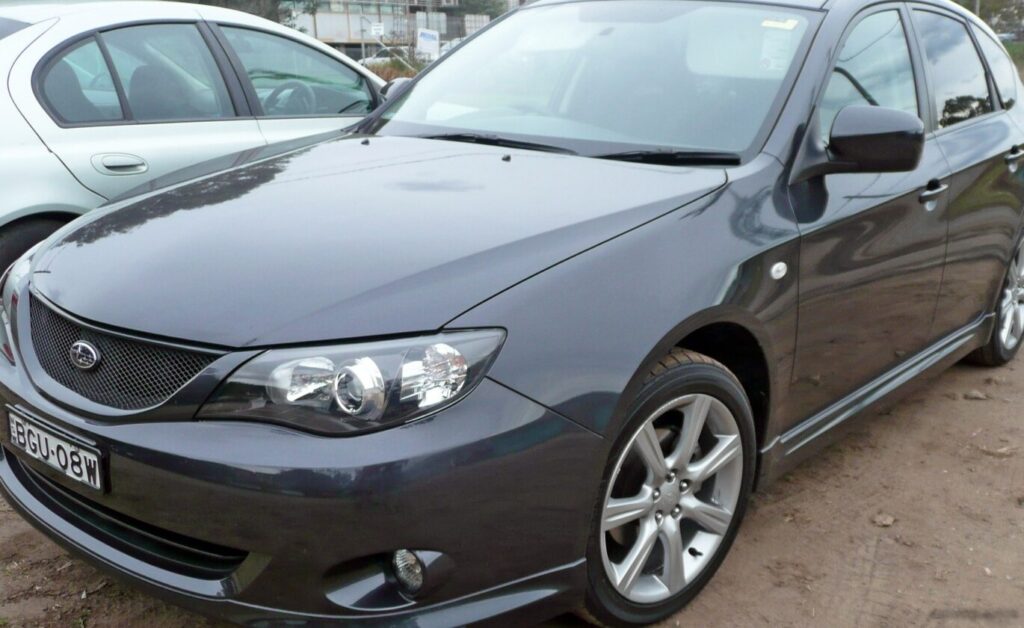
The Subaru Impreza III Hatchback 2.0R, produced between 2007 and 2011, represents the third generation of Subaru’s popular compact car. This particular variant, equipped with the 2.0-liter naturally aspirated Boxer engine producing 150 horsepower and paired with a five-speed manual transmission, occupied a middle ground within the Impreza lineup. It offered a balance between performance and fuel efficiency, appealing to buyers seeking a practical and engaging driving experience with the added security of Subaru’s symmetrical all-wheel drive system. The Impreza III, built on the Subaru Global Platform, aimed to improve rigidity and refinement over its predecessor, while maintaining the brand’s reputation for durability and all-weather capability. This model was primarily sold in markets like North America, Europe, and Australia.
Technical Specifications
| Brand | Subaru |
| Model | Impreza |
| Generation | Impreza III Hatchback |
| Type (Engine) | 2.0R (150 Hp) AWD |
| Start of production | 2007 |
| End of production | 2011 |
| Powertrain Architecture | Internal Combustion engine |
| Body type | Hatchback |
| Seats | 5 |
| Doors | 5 |
| Fuel consumption (urban) | 11.1 l/100 km (21.2 US mpg) |
| Fuel consumption (extra urban) | 6.5 l/100 km (36.2 US mpg) |
| Fuel consumption (combined) | 8.2 l/100 km (28.7 US mpg) |
| Fuel Type | Petrol (Gasoline) |
| Acceleration 0 – 100 km/h | 9.6 sec |
| Acceleration 0 – 62 mph | 9.6 sec |
| Acceleration 0 – 60 mph | 9.1 sec |
| Maximum speed | 193 km/h (119.92 mph) |
| Emission standard | Euro 4 |
| Weight-to-power ratio | 9 kg/Hp |
| Weight-to-torque ratio | 6.9 kg/Nm |
| Power | 150 Hp @ 6400 rpm |
| Torque | 196 Nm @ 3200 rpm (144.56 lb.-ft. @ 3200 rpm) |
| Engine layout | Front, Longitudinal |
| Engine Model/Code | EJ20 |
| Engine displacement | 1994 cm3 (121.68 cu. in.) |
| Number of cylinders | 4 |
| Engine configuration | Boxer |
| Cylinder Bore | 92 mm (3.62 in.) |
| Piston Stroke | 75 mm (2.95 in.) |
| Compression ratio | 10.2:1 |
| Number of valves per cylinder | 4 |
| Fuel injection system | Multi-port manifold injection |
| Engine aspiration | Naturally aspirated engine |
| Valvetrain | OHC |
| Engine oil capacity | 4.2 l (4.44 US qt | 3.7 UK qt) |
| Coolant capacity | 6.8 l (7.19 US qt | 5.98 UK qt) |
| Kerb Weight | 1345 kg (2965.22 lbs.) |
| Trunk (boot) space – maximum | 538 l (19 cu. ft.) |
| Fuel tank capacity | 60 l (15.85 US gal | 13.2 UK gal) |
| Length | 4415 mm (173.82 in.) |
| Width | 1740 mm (68.5 in.) |
| Height | 1475 mm (58.07 in.) |
| Wheelbase | 2620 mm (103.15 in.) |
| Front track | 1495 mm (58.86 in.) |
| Rear track | 1500 mm (59.06 in.) |
| Minimum turning circle | 10.6 m (34.78 ft.) |
| Drive wheel | All wheel drive (4×4) |
| Number of gears | 5 gears, manual transmission |
| Front suspension | Independent, type McPherson with coil spring and anti-roll bar |
| Rear suspension | Several levers and rods |
| Front brakes | Ventilated discs |
| Rear brakes | Disc |
| Assisting systems | ABS (Anti-lock braking system) |
| Steering type | Steering rack and pinion |
| Tires size | 205/50 R17 |
| Wheel rims size | 17 |
Introduction
The 2007-2011 Subaru Impreza III Hatchback 2.0R AWD represents a significant evolution in Subaru’s compact offering. Positioned as a versatile and practical vehicle, it catered to drivers needing all-weather capability and a reasonable level of performance. The “2.0R” designation signifies the 2.0-liter naturally aspirated Boxer engine, while “AWD” highlights Subaru’s renowned symmetrical all-wheel drive system. This combination aimed to provide a secure and confident driving experience in a variety of conditions. The Impreza III, built on the new Subaru Global Platform, offered improvements in body rigidity and noise, vibration, and harshness (NVH) compared to previous generations. It was a key model for Subaru in markets where all-wheel drive was highly valued, such as the United States, Canada, and parts of Europe.
Powertrain & Engine Architecture
At the heart of the Impreza 2.0R lies the EJ20 engine, a 1994cc horizontally opposed four-cylinder Boxer engine. This engine configuration, a Subaru hallmark, provides a low center of gravity, contributing to improved handling and stability. The EJ20 utilizes a multi-port fuel injection system, delivering fuel directly into the intake ports. The engine features a single overhead camshaft (OHC) design operating four valves per cylinder. The 150 horsepower output is achieved at 6400 rpm, while peak torque of 196 Nm (144.56 lb-ft) arrives at 3200 rpm. The five-speed manual transmission was the standard offering for this trim, providing direct control over the engine’s power. The transmission’s gear ratios were tuned to balance acceleration and fuel economy, with a final drive ratio optimized for all-wheel drive operation. The engine code, EJ20, is a common designation for Subaru’s 2.0-liter Boxer engines, and while generally reliable, regular maintenance, particularly oil changes, is crucial for longevity.
Driving Characteristics
The Impreza 2.0R with the five-speed manual transmission delivers a reasonably engaging driving experience. Acceleration from 0-60 mph takes approximately 9.1 seconds, and the top speed is around 119.92 mph. While not a performance-oriented vehicle, the Boxer engine provides a unique sound and a responsive feel. The all-wheel drive system provides excellent traction, particularly in slippery conditions, inspiring confidence in the driver. Compared to the more powerful 2.5-liter variants, the 2.0R feels less urgent in acceleration, but it offers better fuel economy. The manual transmission allows for precise gear selection, and the clutch feel is generally light and easy to modulate. The gear ratios are spaced to provide adequate acceleration in most driving situations, although some drivers may find themselves shifting frequently on hilly terrain. The steering is precise and well-weighted, contributing to a connected feel with the road.
Equipment & Trim Levels
The Impreza 2.0R typically came standard with features such as air conditioning, power windows and locks, a CD player with auxiliary input, and ABS brakes. Interior upholstery was typically cloth, with a functional and durable design. Optional extras included a sunroof, upgraded audio system, and alloy wheels. The dashboard layout was straightforward and user-friendly, with clearly labeled controls. Higher trim levels, such as the Limited, added features like leather upholstery, automatic climate control, and a premium sound system. The 2.0R trim was considered a mid-range offering, providing a good balance of features and affordability.
Chassis & Braking
The Impreza III utilizes a McPherson strut front suspension with coil springs and an anti-roll bar, providing a comfortable ride and responsive handling. The rear suspension employs a multi-link design, further enhancing ride quality and stability. Braking duties are handled by ventilated discs at the front and solid discs at the rear. The ABS system helps to prevent wheel lockup during hard braking, improving control and safety. The chassis was designed to be rigid, contributing to improved handling and crashworthiness. The all-wheel drive system distributes power to all four wheels, providing optimal traction in a variety of conditions. The standard tire size is 205/50 R17, offering a good balance of grip and ride comfort.
Market Reception & Comparison
The Impreza 2.0R was generally well-received by automotive critics, who praised its all-wheel drive system, comfortable ride, and practical hatchback design. However, some critics noted that the 2.0-liter engine could feel underpowered, particularly when fully loaded or driving uphill. Compared to the 2.5-liter Impreza, the 2.0R offered better fuel economy, achieving around 28.7 US mpg in combined driving. The 2.0R was also more affordable than the higher-output models. In terms of reliability, the EJ20 engine is generally considered to be durable, but it is known to be susceptible to oil consumption issues if not properly maintained. The Impreza’s all-wheel drive system is highly regarded for its reliability and effectiveness.
Legacy
The Subaru Impreza III Hatchback 2.0R remains a popular choice in the used car market, particularly for buyers seeking a reliable and capable all-wheel drive vehicle. The EJ20 engine, while not the most powerful, is known for its durability and relatively low maintenance costs. Regular maintenance, including oil changes and timing belt replacements, is essential for ensuring the long-term reliability of this powertrain. The Impreza’s reputation for safety and all-weather capability continues to make it a desirable option for drivers in regions with harsh climates. Today, well-maintained examples of the Impreza 2.0R can still provide years of reliable service, offering a practical and engaging driving experience.