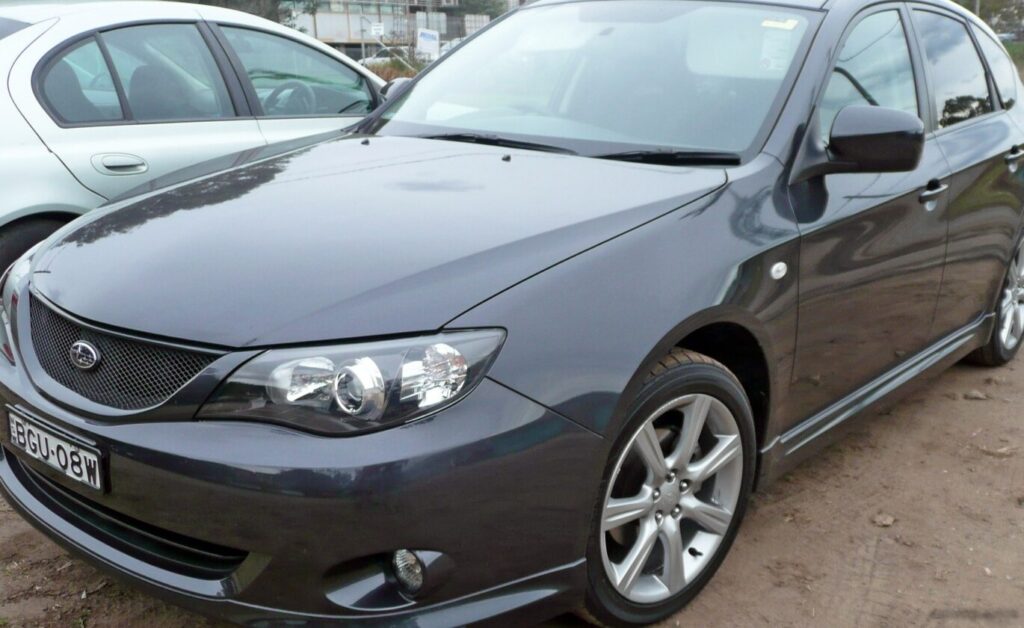
The Subaru Impreza III Hatchback 2.0R, produced between 2007 and 2011, represented a significant evolution in Subaru’s compact car lineup. Positioned as a mid-range offering within the Impreza III generation (based on the 1HX0 platform), the 2.0R variant combined a 2.0-liter naturally aspirated boxer engine with a four-speed automatic transmission and Subaru’s renowned symmetrical all-wheel drive system. This configuration aimed to provide a balance of performance, practicality, and all-weather capability for the North American and European markets, where the Impreza competed with vehicles like the Honda Civic, Mazda3, and Volkswagen Golf. It was a popular choice for drivers seeking a reliable and capable daily driver with a touch of sporty character.
Technical Specifications
| Brand | Subaru |
| Model | Impreza |
| Generation | Impreza III Hatchback |
| Type (Engine) | 2.0R (150 Hp) AWD Automatic |
| Start of production | 2007 |
| End of production | 2011 |
| Powertrain Architecture | Internal Combustion engine |
| Body type | Hatchback |
| Seats | 5 |
| Doors | 5 |
| Fuel consumption (urban) | 11.1 l/100 km (21.2 US mpg) |
| Fuel consumption (extra urban) | 6.9 l/100 km (34.1 US mpg) |
| Fuel consumption (combined) | 8.4 l/100 km (28 US mpg) |
| Fuel Type | Petrol (Gasoline) |
| Acceleration 0 – 100 km/h | 11.6 sec |
| Acceleration 0 – 62 mph | 11.6 sec |
| Acceleration 0 – 60 mph | 11 sec |
| Maximum speed | 182 km/h (113.09 mph) |
| Emission standard | Euro 4 |
| Weight-to-power ratio | 9 kg/Hp |
| Weight-to-torque ratio | 6.9 kg/Nm |
| Power | 150 Hp @ 6400 rpm |
| Torque | 196 Nm @ 3200 rpm (144.56 lb.-ft. @ 3200 rpm) |
| Engine layout | Front, Longitudinal |
| Engine Model/Code | EJ20 |
| Engine displacement | 1994 cm3 (121.68 cu. in.) |
| Number of cylinders | 4 |
| Engine configuration | Boxer |
| Cylinder Bore | 92 mm (3.62 in.) |
| Piston Stroke | 75 mm (2.95 in.) |
| Compression ratio | 10.2:1 |
| Number of valves per cylinder | 4 |
| Fuel injection system | Multi-port manifold injection |
| Engine aspiration | Naturally aspirated engine |
| Valvetrain | OHC |
| Engine oil capacity | 4.2 l (4.44 US qt | 3.7 UK qt) |
| Coolant capacity | 6.8 l (7.19 US qt | 5.98 UK qt) |
| Kerb Weight | 1345 kg (2965.22 lbs.) |
| Trunk (boot) space – maximum | 538 l (19 cu. ft.) |
| Fuel tank capacity | 60 l (15.85 US gal | 13.2 UK gal) |
| Length | 4415 mm (173.82 in.) |
| Width | 1740 mm (68.5 in.) |
| Height | 1475 mm (58.07 in.) |
| Wheelbase | 2620 mm (103.15 in.) |
| Front track | 1495 mm (58.86 in.) |
| Rear track | 1500 mm (59.06 in.) |
| Minimum turning circle | 10.6 m (34.78 ft.) |
| Drive wheel | All wheel drive (4×4) |
| Number of gears | 4 |
| Gearbox type | automatic transmission |
| Front suspension | Independent, type McPherson with coil spring and anti-roll bar |
| Rear suspension | Several levers and rods |
| Front brakes | Ventilated discs |
| Rear brakes | Disc |
| Assisting systems | ABS (Anti-lock braking system) |
| Steering type | Steering rack and pinion |
| Tires size | 205/50 R17 |
| Wheel rims size | 17 |
The Subaru Impreza III Hatchback 2.0R Automatic, launched in 2007, was a key model in Subaru’s strategy to broaden the appeal of the Impreza. Building upon the success of previous generations, the III series introduced a more refined and contemporary design, along with improvements to ride quality and interior comfort. The 2.0R trim, when paired with the four-speed automatic, offered a comfortable and accessible entry point into the Impreza range, appealing to buyers who prioritized ease of use and all-weather confidence over outright performance. It served as a practical and reliable option for families and commuters alike.
Powertrain & Engine Architecture
At the heart of the 2.0R was the EJ20 2.0-liter horizontally-opposed (boxer) four-cylinder engine. This engine, a hallmark of Subaru engineering, was known for its smooth operation and inherent balance. The EJ20 featured a single overhead camshaft (OHC) design and multi-point fuel injection. The automatic transmission was a conventional four-speed unit, chosen for its simplicity and cost-effectiveness. While not offering the most advanced gear ratios, it provided smooth shifts and adequate performance for everyday driving. The engine code, EJ20, is a common designation for Subaru’s 2.0-liter boxer engines, and variations within the code existed depending on the specific market and emissions regulations. The engine’s longitudinal mounting, coupled with Subaru’s symmetrical all-wheel-drive system, contributed to the car’s balanced handling characteristics.
Driving Characteristics
The Impreza 2.0R Automatic delivered a comfortable and predictable driving experience. With 150 horsepower and 196 Nm (144.56 lb-ft) of torque, acceleration was adequate but not particularly brisk. The four-speed automatic transmission, while smooth, lacked the responsiveness of a manual gearbox or a more modern automatic with additional gears. The gear ratios were tuned for fuel efficiency and everyday drivability rather than sporty performance. Compared to the five-speed manual version of the 2.0R, the automatic offered less driver engagement and slightly slower acceleration. However, it excelled in providing a relaxed and effortless driving experience, particularly in urban environments. The all-wheel-drive system provided excellent traction in all weather conditions, enhancing stability and confidence.
Equipment & Trim Levels
The 2.0R Automatic trim typically included standard features such as air conditioning, power windows and locks, a CD player with auxiliary input, and alloy wheels. Safety features included ABS brakes, front and side airbags, and a tire pressure monitoring system. Optional extras included a sunroof, upgraded audio system, and leather upholstery. The interior featured a functional and straightforward design, with durable materials and comfortable seating. The dashboard layout was logically organized, with easy-to-read gauges and intuitive controls. The hatchback body style offered good cargo space and versatility, making it suitable for families and those with active lifestyles.
Chassis & Braking
The Impreza III Hatchback utilized a McPherson strut front suspension and a multi-link rear suspension, providing a comfortable ride and predictable handling. The suspension was tuned to balance ride comfort with handling stability. Braking duties were handled by ventilated discs at the front and solid discs at the rear. The ABS system helped to maintain control during emergency braking situations. The chassis was relatively lightweight, contributing to the car’s nimble handling characteristics. Stabilizer bars were fitted to both the front and rear axles to reduce body roll during cornering.
Market Reception & Comparison
The Impreza 2.0R Automatic received generally positive reviews from automotive critics. It was praised for its all-weather capability, comfortable ride, and practical hatchback body style. However, some critics noted that the four-speed automatic transmission felt dated compared to the more advanced transmissions offered by competitors. Fuel economy was considered average for its class. Compared to the higher-performance WRX and STI models, the 2.0R Automatic offered a more refined and accessible driving experience, appealing to a different segment of the market. Compared to the manual transmission version, the automatic traded some performance for convenience.
Legacy
The Subaru Impreza III Hatchback 2.0R Automatic has proven to be a reliable and durable vehicle. The EJ20 engine, while not without its potential maintenance needs (such as head gasket issues common to some Subaru engines of this era), is generally considered a robust and long-lasting powerplant. The four-speed automatic transmission is also known for its reliability. Today, these Imprezas can be found on the used car market at affordable prices, making them attractive options for budget-conscious buyers seeking a practical and capable all-wheel-drive vehicle. Their reputation for reliability and all-weather performance continues to make them a popular choice among those seeking a dependable and versatile compact car.