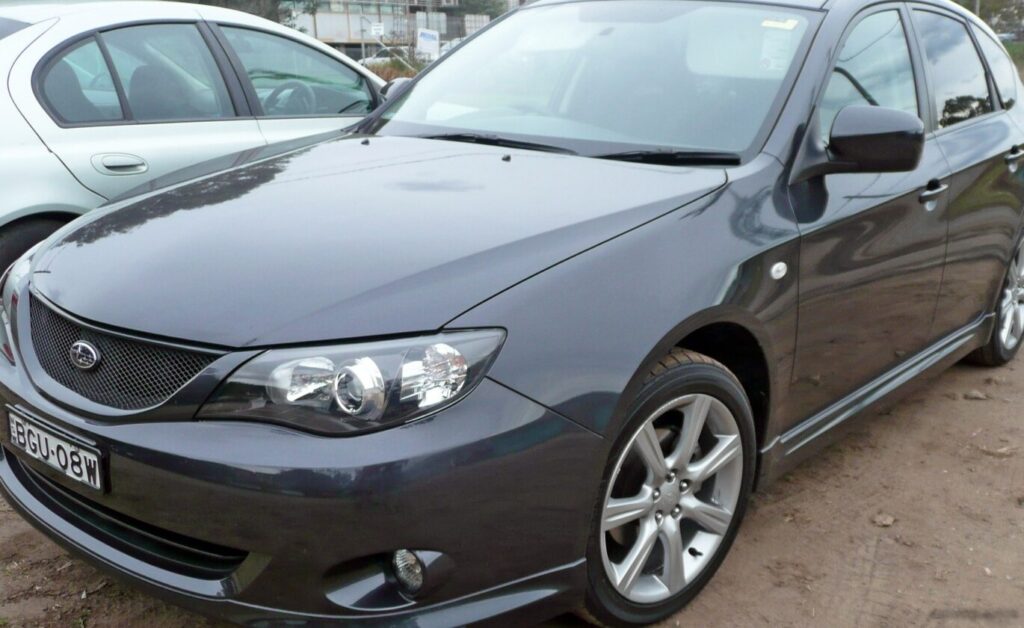
The Subaru Impreza III Hatchback WRX 2.5, produced between 2007 and 2011, represented a significant evolution of the Impreza line, particularly in its performance-oriented WRX trim. This generation, internally designated as the GE/GH platform, saw Subaru refine the Impreza’s blend of practicality and rally-inspired driving dynamics. The WRX 2.5, equipped with a 2.5-liter turbocharged boxer engine and a four-speed automatic transmission, occupied a middle ground within the WRX lineup, offering a balance between accessible performance and everyday usability. It was positioned as a step up from the naturally aspirated Impreza models, but below the more focused and often manually-equipped WRX STI.
Technical Specifications
| Brand | Subaru |
| Model | Impreza |
| Generation | Impreza III Hatchback |
| Type | WRX 2.5 (224 Hp) AWD Automatic |
| Start of production | 2007 |
| End of production | 2011 |
| Powertrain Architecture | Internal Combustion engine |
| Body type | Hatchback |
| Seats | 5 |
| Doors | 5 |
| Fuel consumption (urban) | 12.4 l/100 km (19 US mpg, 22.8 UK mpg, 8.1 km/l) |
| Fuel consumption (combined) | 9.8 l/100 km (24 US mpg, 28.8 UK mpg, 10.2 km/l) |
| Fuel Type | Petrol (Gasoline) |
| Acceleration 0 – 100 km/h | 5.8 sec |
| Acceleration 0 – 62 mph | 5.8 sec |
| Acceleration 0 – 60 mph | 5.5 sec |
| Emission standard | Euro 4 |
| Weight-to-power ratio | 6.4 kg/Hp, 157.2 Hp/tonne |
| Weight-to-torque ratio | 4.7 kg/Nm, 214.7 Nm/tonne |
| Power | 224 Hp @ 5200 rpm |
| Power per litre | 91.2 Hp/l |
| Torque | 306 Nm @ 2800 rpm (225.69 lb.-ft. @ 2800 rpm) |
| Engine layout | Front, Longitudinal |
| Engine Model/Code | EJ255 |
| Engine displacement | 2457 cm3 (149.94 cu. in.) |
| Number of cylinders | 4 |
| Engine configuration | Boxer |
| Cylinder Bore | 99.5 mm (3.92 in.) |
| Piston Stroke | 79 mm (3.11 in.) |
| Number of valves per cylinder | 4 |
| Fuel injection system | Multi-port manifold injection |
| Engine aspiration | Turbocharger, Intercooler |
| Valvetrain | DOHC |
| Engine oil capacity | 4.2 l (4.44 US qt | 3.7 UK qt) |
| Coolant capacity | 7.4 l (7.82 US qt | 6.51 UK qt) |
| Kerb Weight | 1425 kg (3141.59 lbs.) |
| Trunk (boot) space – maximum | 538 l (19 cu. ft.) |
| Fuel tank capacity | 60 l (15.85 US gal | 13.2 UK gal) |
| Length | 4415 mm (173.82 in.) |
| Width | 1740 mm (68.5 in.) |
| Height | 1475 mm (58.07 in.) |
| Wheelbase | 2620 mm (103.15 in.) |
| Front track | 1495 mm (58.86 in.) |
| Rear track | 1500 mm (59.06 in.) |
| Minimum turning circle | 10.6 m (34.78 ft.) |
| Drive wheel | All wheel drive (4×4) |
| Number of gears | 4 |
| Gearbox type | automatic transmission |
| Front suspension | Independent type McPherson |
| Rear suspension | Several levers and rods |
| Front brakes | Ventilated discs |
| Rear brakes | Disc |
| Assisting systems | ABS (Anti-lock braking system) |
| Steering type | Steering rack and pinion |
| Tires size | 205/50 R17 |
| Wheel rims size | 17 |
Powertrain & Engine Architecture
The heart of the Impreza WRX 2.5 was the EJ255 2.5-liter horizontally-opposed (boxer) four-cylinder engine. This engine, a staple of Subaru’s performance models, featured a single turbocharger with an intercooler to mitigate heat soak and improve efficiency. The EJ255 utilized multi-port fuel injection and a dual overhead camshaft (DOHC) valvetrain. The automatic transmission paired with this engine was a four-speed unit, designed to handle the engine’s torque output. While offering convenience, this transmission was often criticized for its relatively slow shift times compared to the available five-speed manual. The engine code, EJ255, is crucial for identifying specific parts and maintenance requirements.
Driving Characteristics
The WRX 2.5 Automatic offered a distinct driving experience compared to its manual counterpart and other Impreza trims. The automatic transmission, while providing ease of use, did impact acceleration times and overall responsiveness. The four-speed gearbox’s gear ratios were tuned for a balance of fuel economy and performance, but it lacked the direct engagement and control offered by a manual. The all-wheel-drive system, a hallmark of Subaru, provided excellent traction in various conditions, making the WRX 2.5 a capable performer year-round. However, the added weight of the automatic transmission and AWD system meant the car wasn’t as nimble as some of its rear-wheel-drive competitors.
Equipment & Trim Levels
The WRX 2.5 Automatic typically came standard with features such as air conditioning, power windows and locks, a CD player with auxiliary input, and alloy wheels. Interior upholstery was generally cloth, with optional leather available. Common optional extras included a sunroof, upgraded audio system, and heated front seats. The dashboard layout was functional and driver-focused, with clear instrumentation and easy-to-reach controls. The trim level often dictated the availability of these optional features.
Chassis & Braking
The Impreza WRX 2.5 utilized an independent McPherson strut suspension in the front and a multi-link suspension in the rear. This setup provided a good balance of ride comfort and handling performance. Braking duties were handled by ventilated discs in the front and solid discs in the rear. Anti-lock brakes (ABS) were standard equipment. The suspension was tuned to accommodate the increased weight and power of the WRX model, with stiffer springs and dampers compared to the base Impreza trims.
Market Reception & Comparison
The Impreza WRX 2.5 Automatic received mixed reviews. Critics praised its all-weather capability and the potent engine, but often criticized the automatic transmission for its sluggishness. Compared to the manual WRX 2.5, the automatic version consistently lagged in acceleration tests. Fuel economy was also a concern, with the combined fuel consumption of 9.8 l/100 km (24 US mpg) being relatively high for its class. The 1.8L naturally aspirated Impreza models offered significantly better fuel economy, but lacked the performance of the WRX. The WRX STI, with its more powerful engine and six-speed manual transmission, was the clear performance leader in the Impreza lineup.
Legacy
The EJ255 engine, while generally reliable, is known to require regular maintenance, particularly regarding oil changes. The head gasket is a common point of failure, especially if the engine is subjected to aggressive driving or neglected maintenance. The four-speed automatic transmission, while durable, is not known for its refinement or efficiency. Today, the Impreza WRX 2.5 Automatic represents an affordable entry point into the Subaru performance world. Well-maintained examples are sought after by enthusiasts who appreciate the car’s all-wheel-drive capability and the potential for modification. However, prospective buyers should be aware of the potential maintenance costs associated with the EJ255 engine and the limitations of the automatic transmission.