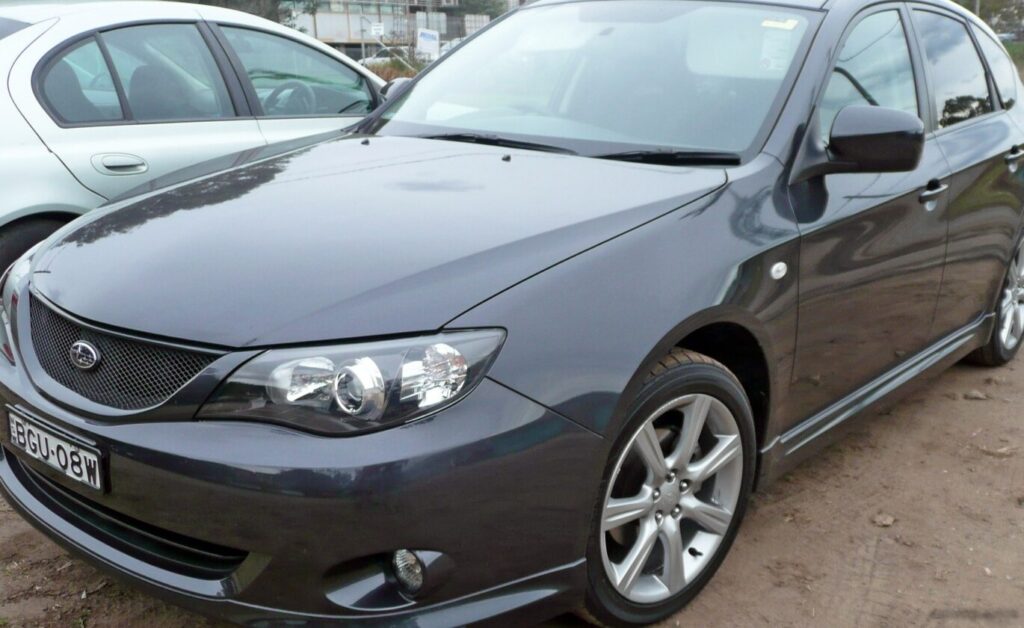
The Subaru Impreza III Hatchback WRX STI 2.5, produced between 2007 and 2011, represents a high-performance iteration of Subaru’s popular compact car. Positioned as the flagship model within the Impreza III range (chassis code GE/GH/GR/GV), the WRX STI 2.5 was designed to deliver uncompromising performance and rally-bred handling. It built upon the foundation of the standard Impreza hatchback, offering a significantly more powerful engine, upgraded suspension, and a driver-focused interior. This generation marked a shift in styling for the Impreza, moving away from the more utilitarian look of previous models towards a more aggressive and modern aesthetic. The WRX STI 2.5 specifically targeted enthusiasts seeking a capable all-weather performance car with a strong motorsport pedigree.
Technical Specifications
| Brand | Subaru |
| Model | Impreza |
| Generation | Impreza III Hatchback |
| Type | WRX STI 2.5 (300 Hp) AWD |
| Start of production | 2007 |
| End of production | 2011 |
| Powertrain Architecture | Internal Combustion engine |
| Body type | Hatchback |
| Seats | 5 |
| Doors | 5 |
| Fuel consumption (urban) | 13 l/100 km (18.1 US mpg, 21.7 UK mpg, 7.7 km/l) |
| Fuel consumption (extra urban) | 8.2 l/100 km (28.7 US mpg, 34.4 UK mpg, 12.2 km/l) |
| Fuel consumption (combined) | 10.3 l/100 km (22.8 US mpg, 27.4 UK mpg, 9.7 km/l) |
| Fuel Type | Petrol (Gasoline) |
| Emission standard | Euro 4 |
| Weight-to-power ratio | 4.7 kg/Hp, 215.1 Hp/tonne |
| Weight-to-torque ratio | 3.4 kg/Nm, 291.8 Nm/tonne |
| Power | 300 Hp @ 6000 rpm |
| Power per litre | 122.1 Hp/l |
| Torque | 407 Nm @ 4400 rpm (300.19 lb.-ft. @ 4400 rpm) |
| Engine layout | Front, Longitudinal |
| Engine Model/Code | EJ257 |
| Engine displacement | 2457 cm3 (149.94 cu. in.) |
| Number of cylinders | 4 |
| Engine configuration | Boxer |
| Cylinder Bore | 99.5 mm (3.92 in.) |
| Piston Stroke | 79 mm (3.11 in.) |
| Number of valves per cylinder | 4 |
| Fuel injection system | Multi-port manifold injection |
| Engine aspiration | Turbocharger, Intercooler |
| Valvetrain | DOHC |
| Engine oil capacity | 4.3 l (4.54 US qt | 3.78 UK qt) |
| Coolant capacity | 7.7 l (8.14 US qt | 6.78 UK qt) |
| Kerb Weight | 1395 kg (3075.45 lbs.) |
| Trunk (boot) space – maximum | 538 l (19 cu. ft.) |
| Fuel tank capacity | 60 l (15.85 US gal | 13.2 UK gal) |
| Length | 4415 mm (173.82 in.) |
| Width | 1740 mm (68.5 in.) |
| Height | 1475 mm (58.07 in.) |
| Wheelbase | 2620 mm (103.15 in.) |
| Front track | 1495 mm (58.86 in.) |
| Rear track | 1500 mm (59.06 in.) |
| Minimum turning circle | 10.6 m (34.78 ft.) |
| Drive wheel | All wheel drive (4×4) |
| Number of gears | 6 |
| Gearbox type | Manual transmission |
| Rear suspension | Several levers and rods |
| Front brakes | Ventilated discs |
| Rear brakes | Disc |
| Assisting systems | ABS (Anti-lock braking system) |
| Steering type | Steering rack and pinion |
| Tires size | 245/40 R18 |
| Wheel rims size | 18 |
Powertrain & Engine Architecture
The heart of the Impreza WRX STI 2.5 is the 2.5-liter EJ257 boxer engine. This horizontally-opposed four-cylinder engine benefits from a closed-deck block design for increased strength, crucial for handling the stresses of forced induction. The EJ257 utilizes multi-point fuel injection and a single turbocharger with an intercooler to deliver 300 horsepower at 6000 rpm and 407 Nm (300.19 lb-ft) of torque at 4400 rpm. The engine’s flat configuration contributes to a low center of gravity, enhancing handling characteristics. The six-speed manual transmission, a hallmark of the STI, provides precise gear changes and a direct connection to the engine. The transmission features a robust design to cope with the engine’s output.
Driving Characteristics
The WRX STI 2.5 delivers a raw and engaging driving experience. The combination of the turbocharged engine and all-wheel-drive system provides exceptional traction and acceleration. While the power output is substantial, the turbocharger does exhibit some lag at lower engine speeds. However, once the turbo spools up, the engine delivers a strong and linear powerband. The six-speed manual transmission allows for precise control over gear selection, maximizing performance. Compared to the standard Impreza or even the non-STI WRX models, the STI’s suspension is significantly firmer, resulting in reduced body roll and improved cornering ability. This firmness, however, can translate to a less comfortable ride on rough road surfaces. The all-wheel-drive system is biased towards the rear wheels, providing a more dynamic and sporty feel.
Equipment & Trim Levels
The WRX STI 2.5 was generally well-equipped, though options were available to further enhance the experience. Standard features typically included sport seats with bolstered support, a leather-wrapped steering wheel, air conditioning, and a basic audio system. The interior featured aluminum pedal covers and unique STI badging. Optional extras included a premium audio system, sunroof, and upgraded interior trim materials. The STI trim level was the highest available for the Impreza, and as such, it did not offer many additional packages beyond individual options.
Chassis & Braking
The Impreza WRX STI 2.5 boasts a significantly upgraded chassis compared to lower trim levels. It features a reinforced body structure, stiffer springs, and more aggressive damper settings. The rear suspension utilizes a multi-link design for improved handling and stability. Braking performance is also enhanced, with ventilated disc brakes on all four wheels and an Anti-lock Braking System (ABS) as standard. The STI models often featured larger brake rotors and more aggressive brake pad compounds for improved stopping power.
Market Reception & Comparison
The Impreza WRX STI 2.5 was generally well-received by automotive critics, praised for its performance, handling, and all-weather capability. However, some reviewers noted the firm ride quality and the presence of turbo lag. Compared to the standard Impreza and the WRX, the STI represented a significant step up in performance and price. The STI also competed with other performance hatchbacks, such as the Mitsubishi Lancer Evolution and the Subaru WRX. The STI typically offered a more focused and track-oriented experience compared to the WRX, while the Lancer Evolution provided a similar level of performance with a slightly different driving feel. Fuel economy, at 10.3 l/100 km (22.8 US mpg), was typical for a high-performance vehicle of this type.
Legacy
The Subaru Impreza WRX STI 2.5 has become a sought-after vehicle in the used car market, particularly among enthusiasts. The EJ257 engine, while robust, requires regular maintenance, including oil changes and timing belt replacements. The turbocharger and intercooler are also potential areas for maintenance. However, with proper care, the EJ257 engine can provide reliable performance for many years. The STI’s all-wheel-drive system and durable drivetrain contribute to its longevity. Today, the Impreza WRX STI 2.5 remains a popular choice for those seeking a capable and engaging performance car with a rich motorsport heritage. Its blend of performance, practicality, and all-weather capability continues to appeal to a dedicated following.