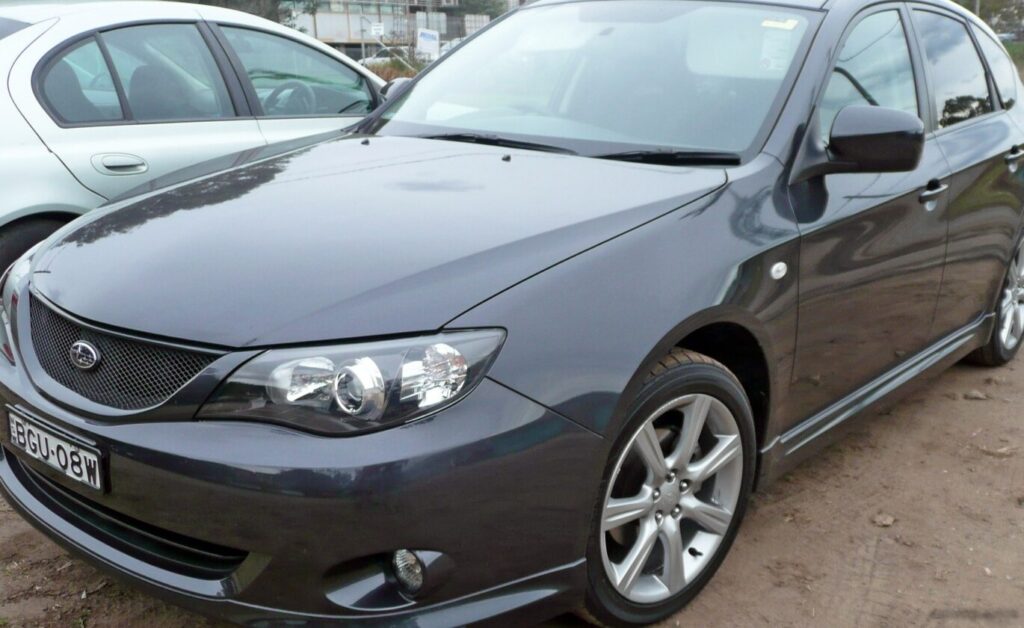
The Subaru Impreza III Hatchback WRX STI 2.5, produced between 2007 and 2011, represents a high-performance iteration of Subaru’s popular compact car. Positioned as the flagship model within the Impreza III range (chassis code GE/GH/GR/GV), the WRX STI 2.5 was designed to deliver uncompromising performance and rally-bred handling. It built upon the foundation of the standard Impreza hatchback, offering a significantly more powerful engine, upgraded suspension, and a driver-focused interior. This generation marked a shift in styling for the Impreza, moving away from the more utilitarian look of previous models towards a more aggressive and modern aesthetic. The WRX STI 2.5 was primarily sold in markets like North America, Europe, and Australia, catering to enthusiasts seeking a capable and engaging all-wheel-drive performance car.
Technical Specifications
| Brand | Subaru |
| Model | Impreza |
| Generation | Impreza III Hatchback |
| Type | WRX STI 2.5 (305 Hp) AWD |
| Start of production | 2007 |
| End of production | 2011 |
| Powertrain Architecture | Internal Combustion engine |
| Body type | Hatchback |
| Seats | 5 |
| Doors | 5 |
| Fuel consumption (urban) | 13.8 l/100 km (17 US mpg, 20.5 UK mpg, 7.2 km/l) |
| Fuel consumption (extra urban) | 8.2 l/100 km (28.7 US mpg, 34.4 UK mpg, 12.2 km/l) |
| Fuel consumption (combined) | 10.3 l/100 km (22.8 US mpg, 27.4 UK mpg, 9.7 km/l) |
| Fuel Type | Petrol (Gasoline) |
| Emission standard | Euro 4 |
| Weight-to-power ratio | 4.6 kg/Hp, 218.6 Hp/tonne |
| Weight-to-torque ratio | 3.5 kg/Nm, 281.7 Nm/tonne |
| Power | 305 Hp @ 6000 rpm |
| Power per litre | 124.1 Hp/l |
| Torque | 393 Nm @ 4400 rpm (289.86 lb.-ft. @ 4400 rpm) |
| Engine layout | Front, Longitudinal |
| Engine Model/Code | EJ257 |
| Engine displacement | 2457 cm3 (149.94 cu. in.) |
| Number of cylinders | 4 |
| Engine configuration | Boxer |
| Cylinder Bore | 99.5 mm (3.92 in.) |
| Piston Stroke | 79 mm (3.11 in.) |
| Number of valves per cylinder | 4 |
| Fuel injection system | Multi-port manifold injection |
| Engine aspiration | Turbocharger, Intercooler |
| Valvetrain | DOHC |
| Engine oil capacity | 4.3 l (4.54 US qt | 3.78 UK qt) |
| Coolant capacity | 7.7 l (8.14 US qt | 6.78 UK qt) |
| Kerb Weight | 1395 kg (3075.45 lbs.) |
| Trunk (boot) space – maximum | 538 l (19 cu. ft.) |
| Fuel tank capacity | 60 l (15.85 US gal | 13.2 UK gal) |
| Length | 4415 mm (173.82 in.) |
| Width | 1740 mm (68.5 in.) |
| Height | 1475 mm (58.07 in.) |
| Wheelbase | 2620 mm (103.15 in.) |
| Front track | 1495 mm (58.86 in.) |
| Rear track | 1500 mm (59.06 in.) |
| Minimum turning circle | 10.6 m (34.78 ft.) |
| Drive wheel | All wheel drive (4×4) |
| Number of gears | 6 |
| Gearbox type | Manual transmission |
| Front suspension | Independent type McPherson |
| Rear suspension | Several levers and rods |
| Front brakes | Ventilated discs |
| Rear brakes | Disc |
| Assisting systems | ABS (Anti-lock braking system) |
| Steering type | Steering rack and pinion |
| Tires size | 245/40 R18 |
| Wheel rims size | 18 |
Powertrain & Engine Architecture
The heart of the WRX STI 2.5 is the 2.5-liter EJ257 boxer engine. This horizontally-opposed four-cylinder engine is a hallmark of Subaru’s performance models, known for its smooth power delivery and compact design. The EJ257 featured a closed-deck engine block for increased strength, forged pistons, and a high-flow cylinder head. A twin-scroll turbocharger, along with an intercooler, provided significant boost, contributing to the engine’s 305 horsepower output. Fuel delivery was managed by a multi-point fuel injection system. The engine’s longitudinal mounting and all-wheel-drive system necessitated a robust drivetrain. The standard transmission was a close-ratio six-speed manual, designed for quick shifts and optimal power transfer. The EJ257 engine code is specifically tuned for higher performance compared to the standard EJ25 found in non-STI Imprezas.
Driving Characteristics
The WRX STI 2.5 delivered a distinctly engaging driving experience. The combination of the powerful engine, all-wheel-drive system, and well-tuned suspension resulted in exceptional grip and handling. The six-speed manual transmission allowed for precise control, while the turbocharger provided a noticeable surge of power in the mid-range. Compared to the naturally aspirated 2.5-liter engine found in lower Impreza trims, the STI offered a dramatically different level of performance. While the STI wasn’t known for being particularly fuel-efficient (around 22.8 US mpg combined), the performance trade-off was considered worthwhile by enthusiasts. The all-wheel-drive system, utilizing a driver-controlled center differential, allowed drivers to adjust the front/rear torque bias for optimal traction in various conditions.
Equipment & Trim Levels
The WRX STI 2.5 was generally well-equipped, though options varied by market. Standard features typically included sport seats with bolstering, a leather-wrapped steering wheel, air conditioning, and a premium audio system. The interior featured unique STI badging and aluminum pedal covers. Optional extras could include a sunroof, navigation system, and upgraded speakers. The STI trim level was the highest available on the Impreza, and as such, it didn’t offer many standalone options beyond the standard equipment list. The focus was on providing a complete performance package rather than allowing extensive customization.
Chassis & Braking
The STI’s chassis was significantly upgraded compared to the standard Impreza. It featured a reinforced body structure, stiffer springs, and more aggressive damper settings. The suspension utilized a McPherson strut setup at the front and a multi-link configuration at the rear. Braking performance was also enhanced, with ventilated disc brakes at all four corners and an Anti-lock Braking System (ABS) as standard. The STI typically featured larger brake rotors and more aggressive brake pads than lower Impreza trims. The car’s relatively low weight (around 3075 lbs) contributed to its agile handling.
Market Reception & Comparison
The Subaru Impreza WRX STI 2.5 was generally well-received by automotive critics. It was praised for its exceptional handling, powerful engine, and all-weather capability. However, some reviewers noted its firm ride quality and relatively high fuel consumption. Compared to other performance cars in its class, such as the Mitsubishi Lancer Evolution, the STI was often seen as being more raw and focused on driving enjoyment. Against lower Impreza trims (like the 2.5i), the STI represented a substantial performance upgrade, but at a significantly higher price point. The STI appealed to a niche market of enthusiasts who prioritized performance over comfort and practicality.
Legacy
The Subaru Impreza WRX STI 2.5 remains a popular choice among enthusiasts today. The EJ257 engine, while known for requiring regular maintenance (particularly oil changes), is generally considered to be a robust and reliable unit when properly cared for. The car’s all-wheel-drive system and durable drivetrain make it a capable performer in a variety of conditions. Used examples are often sought after by those looking for a relatively affordable and engaging performance car. The STI’s rally heritage and iconic status have contributed to its enduring appeal, and it continues to be a respected name in the world of performance automobiles. However, potential buyers should be aware of the higher maintenance costs associated with a high-performance turbocharged engine and the importance of a thorough pre-purchase inspection.