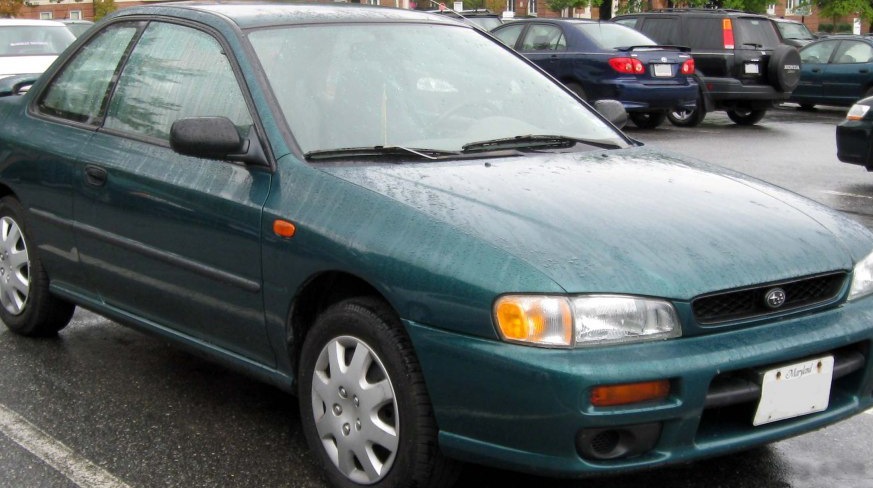
The Subaru Impreza III Sedan WRX 2.5, produced between 2008 and 2011, represented a significant evolution of the Impreza line, particularly in the North American market where the WRX variant gained considerable popularity. This generation, based on the GE/GH platform, aimed to blend practicality with performance, offering a compelling option for drivers seeking all-weather capability and spirited driving dynamics. The 2.5-liter turbocharged engine paired with an automatic transmission positioned this trim as a more accessible entry point into the WRX world, appealing to buyers who prioritized ease of use over the ultimate in track performance. It sat in the middle of the Impreza lineup, above the naturally aspirated models and below the more focused, manual-transmission WRX STI.
Technical Specifications
| Brand | Subaru |
| Model | Impreza |
| Generation | Impreza III Sedan |
| Type | WRX 2.5 (224 Hp) AWD Automatic |
| Start of production | 2008 |
| End of production | 2011 |
| Powertrain Architecture | Internal Combustion engine |
| Body type | Sedan |
| Seats | 5 |
| Doors | 4 |
| Fuel consumption (urban) | 14.3 l/100 km (16.4 US mpg, 19.8 UK mpg, 7 km/l) |
| Fuel consumption (extra urban) | 8.2 l/100 km (28.7 US mpg, 34.4 UK mpg, 12.2 km/l) |
| Fuel consumption (combined) | 10.4 l/100 km (22.6 US mpg, 27.2 UK mpg, 9.6 km/l) |
| Fuel Type | Petrol (Gasoline) |
| Acceleration 0 – 100 km/h | 5.8 sec |
| Acceleration 0 – 62 mph | 5.8 sec |
| Acceleration 0 – 60 mph | 5.5 sec |
| Maximum speed | 209 km/h (129.87 mph) |
| Emission standard | Euro 4 |
| Weight-to-power ratio | 6.2 kg/Hp, 160.6 Hp/tonne |
| Weight-to-torque ratio | 4.6 kg/Nm, 219.4 Nm/tonne |
| Power | 224 Hp @ 5200 rpm |
| Power per litre | 91.2 Hp/l |
| Torque | 306 Nm @ 2800 rpm (225.69 lb.-ft. @ 2800 rpm) |
| Engine layout | Front, Longitudinal |
| Engine Model/Code | EJ255 |
| Engine displacement | 2457 cm3 (149.94 cu. in.) |
| Number of cylinders | 4 |
| Engine configuration | Boxer |
| Cylinder Bore | 99.5 mm (3.92 in.) |
| Piston Stroke | 79 mm (3.11 in.) |
| Number of valves per cylinder | 4 |
| Fuel injection system | Multi-port manifold injection |
| Engine aspiration | Turbocharger, Intercooler |
| Valvetrain | DOHC |
| Engine oil capacity | 4.2 l (4.44 US qt | 3.7 UK qt) |
| Coolant capacity | 7.4 l (7.82 US qt | 6.51 UK qt) |
| Kerb Weight | 1395 kg (3075.45 lbs.) |
| Trunk (boot) space – maximum | 538 l (19 cu. ft.) |
| Fuel tank capacity | 60 l (15.85 US gal | 13.2 UK gal) |
| Length | 4580 mm (180.31 in.) |
| Width | 1740 mm (68.5 in.) |
| Height | 1475 mm (58.07 in.) |
| Wheelbase | 2620 mm (103.15 in.) |
| Front track | 1495 mm (58.86 in.) |
| Rear track | 1500 mm (59.06 in.) |
| Minimum turning circle | 10.6 m (34.78 ft.) |
| Drive wheel | All wheel drive (4×4) |
| Number of gears | 4 |
| Gearbox type | Automatic transmission |
| Front suspension | Independent type McPherson |
| Rear suspension | Several levers and rods |
| Front brakes | Ventilated discs |
| Rear brakes | Disc |
| Assisting systems | ABS (Anti-lock braking system) |
| Steering type | Steering rack and pinion |
| Tires size | 205/50 R17 |
| Wheel rims size | 17 |
Powertrain & Engine Architecture
The heart of the Impreza WRX 2.5 was the EJ255 2.5-liter horizontally-opposed (Boxer) four-cylinder engine. This engine, a hallmark of Subaru’s engineering, featured a single turbocharger with an intercooler to boost power output. The EJ255 utilized multi-port fuel injection and a dual overhead camshaft (DOHC) valvetrain. The automatic transmission was a four-speed unit, designed to provide smooth shifts and ease of driving. While not as sporty as the available five-speed manual, it offered a more relaxed driving experience, particularly in urban environments. The engine code, EJ255, is crucial for identifying specific parts and maintenance requirements. The turbocharger system was designed to minimize turbo lag, providing a relatively linear power delivery, although not as aggressive as the STI’s engine.
Driving Characteristics
The 224 horsepower and 306 lb-ft of torque delivered by the EJ255 engine, when coupled with Subaru’s symmetrical all-wheel-drive system, provided confident handling in a variety of conditions. However, the automatic transmission did impact performance compared to the manual version. Gear ratios were tuned for comfort and fuel efficiency rather than outright acceleration. While the 0-60 mph time of around 5.5 seconds was respectable, it was noticeably slower than the manual WRX. The automatic transmission also altered the driving experience, reducing driver engagement and the ability to precisely control engine speed. The all-wheel-drive system remained a key strength, providing excellent traction and stability, especially on slippery surfaces.
Equipment & Trim Levels
The WRX 2.5 Automatic typically came standard with features such as air conditioning, power windows and locks, keyless entry, and a basic audio system. Upholstery was generally cloth, although leather options were available. Optional extras included a sunroof, upgraded audio systems, and alloy wheels. The interior design was functional and straightforward, prioritizing practicality over luxury. The dashboard layout was typical of Subaru at the time, with a focus on clear instrumentation and ease of use. Compared to higher-trim models, the WRX 2.5 Automatic often lacked some of the more premium features like heated seats or advanced infotainment systems.
Chassis & Braking
The Impreza WRX 2.5 utilized an independent McPherson strut suspension in the front and a multi-link suspension in the rear. This setup provided a good balance between ride comfort and handling performance. Brakes consisted of ventilated discs at the front and solid discs at the rear. Anti-lock brakes (ABS) were standard. The chassis was reinforced compared to the base Impreza models to handle the increased power and torque of the WRX engine. Stabilizer bars were fitted to both the front and rear axles to reduce body roll during cornering. The suspension tuning was generally softer than the STI, prioritizing comfort over ultimate track performance.
Market Reception & Comparison
The Impreza WRX 2.5 Automatic received mixed reviews. Critics praised its all-weather capability and comfortable ride, but some found the automatic transmission to be a detriment to the driving experience. Fuel economy was also a concern, with combined figures around 22.6 US mpg. Compared to the manual WRX, the automatic version offered less driver engagement and slightly slower acceleration. However, it appealed to a broader audience who preferred the convenience of an automatic transmission. Against competitors like the Mitsubishi Lancer Evolution, the Impreza WRX offered a unique combination of performance, practicality, and all-wheel-drive capability.
Legacy
The EJ255 engine, while generally reliable, is known to require regular maintenance, particularly regarding oil changes. The turbocharger and associated components can be prone to wear and tear over time. The four-speed automatic transmission, while durable, is not as sophisticated as more modern automatic transmissions. Today, the Impreza WRX 2.5 Automatic represents an affordable entry point into the Subaru WRX world. Well-maintained examples are sought after by enthusiasts who appreciate the car’s unique character and all-weather capability. Its status as a capable and practical performance sedan has ensured its continued presence in the used car market.