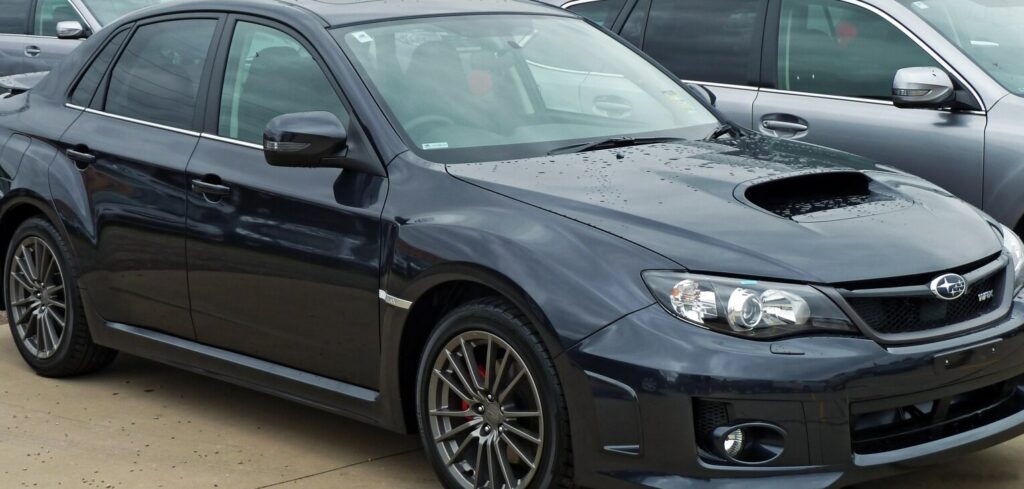
The Subaru Impreza III Sedan WRX 2.5, produced between 2008 and 2011, represented a significant evolution of the Impreza line, particularly in the North American market where the WRX variant gained a strong following. Positioned as the performance-oriented trim of the third-generation Impreza (internally designated GE/GH/GR/GV), the WRX 2.5 offered a compelling blend of all-wheel-drive capability, turbocharged power, and practical sedan packaging. It sat above the base Impreza models and below the even more potent STI variant, targeting enthusiasts seeking a spirited driving experience without the higher price tag and more aggressive tuning of the STI.
Technical Specifications
| Brand | Subaru |
| Model | Impreza |
| Generation | Impreza III Sedan |
| Type (Engine) | WRX 2.5 (265 Hp) AWD |
| Start of production | 2008 |
| End of production | 2011 |
| Powertrain Architecture | Internal Combustion engine |
| Body type | Sedan |
| Seats | 5 |
| Doors | 4 |
| Fuel consumption (urban) | 14.4 l/100 km (16.3 US mpg, 19.6 UK mpg, 6.9 km/l) |
| Fuel consumption (extra urban) | 8.1 l/100 km (29 US mpg, 34.9 UK mpg, 12.3 km/l) |
| Fuel consumption (combined) | 10.4 l/100 km (22.6 US mpg, 27.2 UK mpg, 9.6 km/l) |
| Fuel Type | Petrol (Gasoline) |
| Acceleration 0 – 100 km/h | 6 sec |
| Acceleration 0 – 62 mph | 6 sec |
| Acceleration 0 – 60 mph | 5.7 sec |
| Maximum speed | 209 km/h (129.87 mph) |
| Emission standard | Euro 4 |
| Weight-to-power ratio | 5.3 kg/Hp, 190 Hp/tonne |
| Weight-to-torque ratio | 4.1 kg/Nm, 245.9 Nm/tonne |
| Power | 265 Hp @ 6000 rpm |
| Power per litre | 107.9 Hp/l |
| Torque | 343 Nm @ 4000 rpm (252.98 lb.-ft. @ 4000 rpm) |
| Engine layout | Front, Longitudinal |
| Engine Model/Code | EJ255 |
| Engine displacement | 2457 cm3 (149.94 cu. in.) |
| Number of cylinders | 4 |
| Engine configuration | Boxer |
| Cylinder Bore | 99.5 mm (3.92 in.) |
| Piston Stroke | 79 mm (3.11 in.) |
| Number of valves per cylinder | 4 |
| Fuel injection system | Multi-port manifold injection |
| Engine aspiration | Turbocharger, Intercooler |
| Valvetrain | DOHC |
| Engine oil capacity | 4.2 l (4.44 US qt | 3.7 UK qt) |
| Coolant | 7.5 l (7.93 US qt | 6.6 UK qt) |
| Kerb Weight | 1395 kg (3075.45 lbs.) |
| Trunk (boot) space – maximum | 538 l (19 cu. ft.) |
| Fuel tank capacity | 60 l (15.85 US gal | 13.2 UK gal) |
| Length | 4580 mm (180.31 in.) |
| Width | 1740 mm (68.5 in.) |
| Height | 1475 mm (58.07 in.) |
| Wheelbase | 2620 mm (103.15 in.) |
| Front track | 1495 mm (58.86 in.) |
| Rear (Back) track | 1500 mm (59.06 in.) |
| Minimum turning circle | 10.6 m (34.78 ft.) |
| Drive wheel | All wheel drive (4×4) |
| Number of gears and type of gearbox | 5 gears, manual transmission |
| Front suspension | Independent type McPherson |
| Rear suspension | Several levers and rods |
| Front brakes | Ventilated discs |
| Rear brakes | Disc |
| Assisting systems | ABS (Anti-lock braking system) |
| Steering type | Steering rack and pinion |
| Tires size | 225/45 R17 |
| Wheel rims size | 17 |
INTRODUCTION
The 2008-2011 Subaru Impreza WRX 2.5 Sedan was a key model in Subaru’s lineup, building upon the Impreza’s reputation for reliability and all-weather capability with a significant performance upgrade. It was part of the GE/GH/GR/GV platform generation, which saw a shift towards a more refined and comfortable Impreza compared to previous generations. The “WRX” designation signified a performance variant, and the “2.5” denoted the engine displacement. This model was primarily sold in North America, Australia, and select European markets, where there was a strong demand for affordable, all-wheel-drive performance cars.
Powertrain & Engine Architecture
At the heart of the WRX 2.5 was the EJ255 2.5-liter turbocharged boxer-four engine. This engine was a departure from the 2.0-liter EJ20 engine found in earlier WRX models in many markets. The larger displacement provided increased torque and a broader powerband. The EJ255 featured multi-port fuel injection and a single-scroll turbocharger with an intercooler to manage intake air temperatures. The engine’s boxer configuration, with horizontally opposed pistons, contributed to a low center of gravity, enhancing handling. The standard transmission was a five-speed manual, optimized for the engine’s power delivery. The engine code, EJ255, is crucial for identifying specific parts and maintenance requirements.
Driving Characteristics
The WRX 2.5 offered a noticeably more engaging driving experience than the standard Impreza. The 265 horsepower and 253 lb-ft of torque provided brisk acceleration, with 0-60 mph times consistently in the high 5-second range. The all-wheel-drive system, a Subaru hallmark, delivered excellent traction in all conditions. The five-speed manual transmission offered precise shifts, although some reviewers noted that the gear ratios were spaced to prioritize acceleration over fuel economy. Compared to the STI, the WRX 2.5 felt less raw and aggressive, offering a more compliant ride and a more accessible power delivery. The turbo lag was present but manageable, providing a surge of power as the boost built.
Equipment & Trim Levels
The WRX 2.5 typically came standard with features such as sport seats, a leather-wrapped steering wheel, air conditioning, and a basic audio system. Optional extras included a sunroof, upgraded audio systems, and alloy wheels. Interior upholstery was typically cloth, with leather options available. The dashboard layout was functional and straightforward, prioritizing usability over luxury. The WRX 2.5 trim level was generally considered a step up from the base Impreza, offering a more comprehensive set of features and a sportier aesthetic.
Chassis & Braking
The WRX 2.5 featured a reinforced chassis and a sport-tuned suspension compared to the standard Impreza. The front suspension utilized McPherson struts, while the rear employed a multi-link setup. Brakes consisted of ventilated discs at the front and solid discs at the rear. Anti-lock brakes (ABS) were standard. The suspension was tuned to provide a balance between handling performance and ride comfort. The WRX 2.5 also benefited from a slightly wider track than the base Impreza, further enhancing stability.
Market Reception & Comparison
The 2008-2011 Subaru Impreza WRX 2.5 was generally well-received by automotive critics. It was praised for its performance, all-wheel-drive capability, and practicality. However, some reviewers criticized its fuel economy and interior refinement. Compared to the STI, the WRX 2.5 offered a more affordable entry point into the world of Subaru performance. Compared to other competitors in the same price range, such as the Mitsubishi Lancer Evolution or the Volkswagen GTI, the WRX 2.5 stood out for its unique engine configuration and standard all-wheel drive. Fuel economy averaged around 22.6 mpg combined, which was typical for a turbocharged performance car of that era.
Legacy
The EJ255 engine, while generally reliable, is known to require regular maintenance, particularly oil changes, to prevent issues such as head gasket failure. The WRX 2.5 has maintained a strong following among Subaru enthusiasts, and well-maintained examples continue to command reasonable prices on the used car market. The model represents a sweet spot in the Impreza lineage, offering a compelling blend of performance, practicality, and affordability. Its enduring popularity is a testament to Subaru’s engineering prowess and the appeal of its all-wheel-drive system.