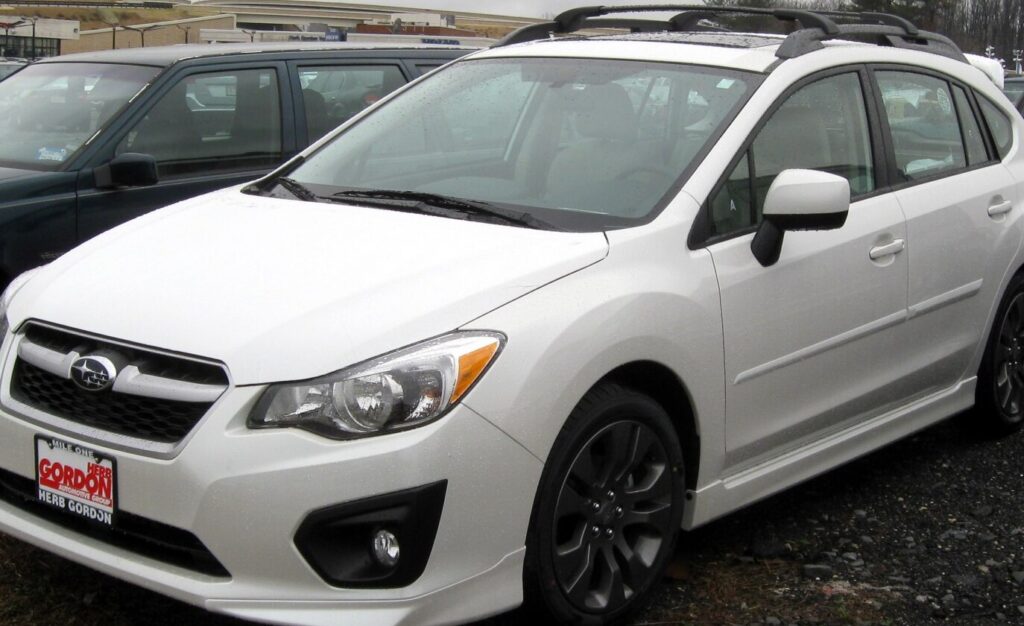
The Subaru Impreza IV Hatchback 1.6i (114 hp) was a front-wheel-drive variant produced between 2011 and 2015, forming a key part of the fourth-generation (GE/GH/GR/GV) Impreza lineup. Positioned as the entry-level model in many markets, it offered a more affordable and fuel-efficient alternative to the higher-performance and all-wheel-drive versions of the Impreza. This model was primarily aimed at buyers seeking a practical, reliable, and economical hatchback for daily commuting and family use. It represented Subaru’s attempt to broaden the Impreza’s appeal beyond its traditional rally-inspired image.
Technical Specifications
| Brand | Subaru |
| Model | Impreza |
| Generation | Impreza IV Hatchback |
| Type (Engine) | 1.6i (114 Hp) |
| Start of production | 2011 |
| End of production | 2015 |
| Powertrain Architecture | Internal Combustion engine |
| Body type | Hatchback |
| Seats | 5 |
| Doors | 5 |
| Fuel consumption (urban) | 7.8 l/100 km (30.2 US mpg) |
| Fuel consumption (extra urban) | 5.2 l/100 km (45.2 US mpg) |
| Fuel consumption (combined) | 6.1 l/100 km (38.6 US mpg) |
| Fuel Type | Petrol (Gasoline) |
| Acceleration 0 – 100 km/h | 11.4 sec |
| Acceleration 0 – 62 mph | 11.4 sec |
| Acceleration 0 – 60 mph | 10.8 sec |
| Maximum speed | 185 km/h (114.95 mph) |
| Weight-to-power ratio | 11 kg/Hp |
| Weight-to-torque ratio | 8.3 kg/Nm |
| Power | 114 Hp @ 5600 rpm |
| Torque | 150 Nm @ 4000 rpm (110.63 lb.-ft. @ 4000 rpm) |
| Engine layout | Front, Longitudinal |
| Engine Model/Code | FB16 |
| Engine displacement | 1600 cm3 (97.64 cu. in.) |
| Number of cylinders | 4 |
| Engine configuration | Boxer |
| Cylinder Bore | 78.8 mm (3.1 in.) |
| Piston Stroke | 82 mm (3.23 in.) |
| Compression ratio | 10.5:1 |
| Number of valves per cylinder | 4 |
| Fuel injection system | Multi-port manifold injection |
| Engine aspiration | Naturally aspirated engine |
| Valvetrain | DOHC |
| Engine oil capacity | 4.8 l (5.07 US qt | 4.22 UK qt) |
| Coolant capacity | 8.1 l (8.56 US qt | 7.13 UK qt) |
| Kerb Weight | 1250 kg (2755.78 lbs.) |
| Trunk (boot) space – minimum | 1270 l (44.85 cu. ft.) |
| Fuel tank capacity | 55 l (14.53 US gal | 12.1 UK gal) |
| Length | 4415 mm (173.82 in.) |
| Width | 1740 mm (68.5 in.) |
| Height | 1465 mm (57.68 in.) |
| Wheelbase | 2645 mm (104.13 in.) |
| Front track | 1510 mm (59.45 in.) |
| Rear track | 1515 mm (59.65 in.) |
| Minimum turning circle | 10.6 m (34.78 ft.) |
| Drivetrain Architecture | Front wheel drive |
| Number of gears | 5 |
| Gearbox type | Manual transmission |
| Front suspension | Independent type McPherson |
| Rear suspension | Double wishbone |
| Front brakes | Ventilated discs |
| Rear brakes | Disc |
| Assisting systems | ABS (Anti-lock braking system) |
| Steering type | Steering rack and pinion |
| Tires size | 195/65 R15 |
| Wheel rims size | 6J x 15 |
INTRODUCTION
The Subaru Impreza IV Hatchback 1.6i, released between 2011 and 2015, represented a shift in Subaru’s strategy for the Impreza. While the Impreza had historically been synonymous with all-wheel drive and performance, this variant was designed to appeal to a broader audience seeking a practical and economical hatchback. Built on the Subaru Global Platform (SGP) – though early iterations of the fourth generation still utilized elements of the previous platform – the 1.6i aimed to provide a comfortable and reliable driving experience. It was sold primarily in Europe and other markets where smaller-displacement engines were favored due to tax regulations and fuel costs.
Powertrain & Engine Architecture
At the heart of the 1.6i was the FB16 1.6-liter horizontally-opposed (Boxer) four-cylinder engine. This engine was a key component of Subaru’s new engine family, designed for improved fuel efficiency and reduced emissions. The FB16 featured a square bore and stroke (78.8mm x 82mm) and a relatively high compression ratio of 10.5:1. It utilized multi-point fuel injection and a double overhead camshaft (DOHC) valvetrain with four valves per cylinder. Unlike earlier Subaru engines, the FB16 employed a chain-driven camshaft, intended to improve long-term reliability. The engine produced 114 horsepower at 5600 rpm and 150 Nm (110.63 lb-ft) of torque at 4000 rpm. This power was delivered to the front wheels through a five-speed manual transmission. The transmission was chosen to keep costs down and contribute to the vehicle’s fuel efficiency. An automatic transmission was not offered with this specific engine configuration.
Driving Characteristics
The 1.6i’s driving experience was characterized by its smooth and predictable nature. While not particularly sporty, the engine provided adequate power for everyday driving. Acceleration from 0-60 mph took around 10.8 seconds, and the top speed was approximately 115 mph. The five-speed manual transmission offered a decent spread of gears, but the engine felt somewhat strained at higher speeds. Compared to the 2.0-liter naturally aspirated or turbocharged Impreza models, the 1.6i lacked the punch and responsiveness that Subaru enthusiasts had come to expect. However, the lighter weight of the 1.6i, due to the smaller engine, contributed to improved handling and fuel economy. The front-wheel-drive configuration also resulted in a noticeable difference in handling characteristics compared to the all-wheel-drive Impreza variants, with a tendency towards understeer when pushed hard.
Equipment & Trim Levels
The 1.6i typically came with a fairly basic level of equipment, reflecting its position as the entry-level model. Standard features generally included air conditioning, power windows, power door locks, and a basic audio system with CD player and auxiliary input. Safety features such as ABS (Anti-lock Braking System) and multiple airbags were also standard. Higher trim levels, often denoted by additions like “S” or “SE”, added features such as alloy wheels, a more sophisticated audio system, and sometimes climate control. Interior upholstery was typically cloth, and the dashboard featured a functional but somewhat plain design. Optional extras included a sunroof, navigation system, and upgraded sound systems.
Chassis & Braking
The Impreza 1.6i utilized an independent McPherson strut suspension at the front and a double wishbone suspension at the rear. This setup provided a comfortable ride quality, although it wasn’t particularly sporty. The front brakes were ventilated discs, while the rear brakes were solid discs. The steering was a rack and pinion system, providing reasonably precise control. The 1.6i’s curb weight of around 1250 kg (2755.78 lbs) was relatively light for a hatchback, which contributed to its decent handling. Tire size was typically 195/65 R15, mounted on 6J x 15 inch steel or alloy wheels.
Market Reception & Comparison
The Impreza 1.6i received mixed reviews from automotive critics. While praised for its fuel efficiency and affordability, it was often criticized for its lack of performance and somewhat basic interior. Compared to other hatchbacks in its class, such as the Volkswagen Golf or Ford Focus, the Impreza 1.6i offered a unique Boxer engine configuration but lacked the refinement and driving dynamics of its European rivals. Fuel economy was a strong point, with combined figures around 38.6 US mpg. Reliability was generally good, although some owners reported minor issues with the engine’s cooling system. Compared to the higher-output Impreza 2.0i models, the 1.6i offered significantly lower running costs but at the expense of performance and driving enjoyment.
Legacy
The Subaru Impreza IV Hatchback 1.6i remains a relatively affordable and practical used car option. The FB16 engine has proven to be reasonably reliable, although regular maintenance is essential. The front-wheel-drive configuration simplifies maintenance compared to the all-wheel-drive models. While not a particularly sought-after model by Subaru enthusiasts, the 1.6i offers a good balance of fuel efficiency, practicality, and reliability for everyday use. Its availability in the used car market is moderate, and prices typically reflect its entry-level status. The 1.6i represents a significant, if somewhat controversial, chapter in the Impreza’s history, demonstrating Subaru’s willingness to adapt to changing market demands.